06.03.15
Posted in Inmarsat, Iridium, KVH, Maritime, Operators, Services, VSAT at 8:53 am by timfarrar
Despite the delays in the launch of GX, it seems Inmarsat may be looking to stitch up an even larger share of the maritime market in the near term. Rumors are flying that Inmarsat may soon make a formal bid to acquire KVH, the largest maritime VSAT player in terms of vessels (though not in revenues), adding about 3500 more terminals to Inmarsat’s existing 2200 VSAT equipped ships.
KVH generated nearly $80M from its miniVSAT business in 2014 with an average service ARPU of $1500 per month, compared to Inmarsat’s $90M and ARPU of $4000 including equipment leases (this equates to $2500 per month after stripping out hardware, according to Inmarsat’s most recent results call, which is a more appropriate point of comparison with the KVH ARPU).
The difference in ARPUs between Inmarsat’s current VSAT business and KVH is striking, in fact KVH’s smaller V3 terminal (which has about 900 active terminals) is generating around $500 in monthly ARPU, below even Inmarsat’s FleetBB ARPU of $700 (note that the standard FleetBB package sold by KVH now only provides 20 Mbytes per month of data for $749, whereas KVH offers airtime at rates as low as $0.99 per Mbyte).
If Inmarsat does move ahead with a KVH bid, it would likely be seen as a counter to Airbus’s disposal of its Vizada business unit, because Inmarsat would then have by far the largest number of VSAT-equipped ships. Indeed it would not be surprising to see attempts by competitors to block the deal on antitrust grounds, not to mention the concerns that current KVH customers will have about potential future price increases.
However, it would also be something of an acknowledgement that GX is optimally positioned as a lower end off-the-shelf maritime VSAT service (like KVH’s miniVSAT), as a step up from FleetBB, rather than as a high end solution for cruise ships and oil rigs. KVH’s growth has slowed in the last year, with terminal shipments staying at close to 1000 per year in 2012, 2013 and 2014, but net adds and ARPUs declining. Pressure from Inmarsat will only intensify, once the low cost 60cm GX antenna is available with global coverage, so this looks like it would be a good time for KVH to sell out.
Inmarsat investors will presumably also welcome a deal, with a much clearer path established to a GX maritime business of $200M+ in annual service revenues over the next few years (though its important to note this represents a retail service business, not the wholesale spend on satellite capacity). However, the obvious question that customers will ask is whether low end price packages will still be offered for miniVSAT users, or whether Inmarsat will move them up to much higher price points, as it has done with FleetBB over the last few years.
And what will be the alternative for these users: will it be other VSAT solutions, or will it be the new broadband services (comparable in capability to FleetBB) offered by Iridium’s NEXT constellation? It will take some time for either of these options to emerge, with low cost small Ku-band VSAT antennas needed for the former, and completion of the NEXT constellation needed for the latter. That provides a further motivation for Inmarsat to move sooner rather than later, while its freedom of action in the low end of the maritime market remains relatively unconstrained by competitive alternatives.
Permalink
03.26.15
Posted in Broadband, Operators, Regulatory, Services, Spectrum at 1:51 pm by timfarrar

At last week’s Satellite 2015 conference, considerable attention was focused on new LEO constellations, most prominently OneWeb, whose founder Greg Wyler made a keynote speech to introduce the system and a couple of mockup terminals. Although many doubts exist about the feasibility of the OneWeb system (particularly with regard to the very ambitious cost estimates and the plausibility of building a profitable global Internet access business), its clear that OneWeb is moving aggressively to try and secure funding and sign a contract for satellite construction with one of five bidders in the next month.
Much less was said at the conference about SpaceX’s proposed 4000 satellite constellation, which Elon Musk announced in January with a half-baked speech in Seattle, which included many off-the-wall and some completely incorrect statements (such as that Teledesic “were trying to talk to phones”). Back in January, Google’s investment of $900M in SpaceX was seen as initiating a partnership to launch this new satellite system. However, at Satellite 2015, SpaceX made clear that the satellite venture was in the “very early stages” and Google’s investment was “not for the global internet project we’re exploring right now.”
A logical conclusion to draw, given Musk’s usually impeccable technical depth and the later change in description of Google’s investment, is that the announcement of the SpaceX constellation was rushed out in order to overshadow Wyler’s announcement of the much more modest investment he had secured from Qualcomm and Virgin.
However, what SpaceX has already done (on March 2) is make a filing at the FCC, which “support[ed] the extension of proposed changes to the Commission’s ITU coordination procedures to NGSO systems to encourage such filings through the U.S. administration”. SpaceX noted that there were “incentives for foreign administrations to pursue NGSO broadband satellite filing strategies that effectively block access to available spectrum and orbital resources” in contrast to the FCC’s “modified processing round” approach.
SpaceX proposed that licensees also be required to launch and operate a percentage of the authorized number of satellites (such as 5%) within 3.5 years and then 75% of the authorized satellites within 6 years, rather than the current milestones of 1 satellites then the entire constellation. In addition, it was proposed that the initial milestones for contracting for, and beginning construction of, the satellite constellation should each be shortened by 6 months.
All of these proposals are clearly intended to make OneWeb’s life more difficult. However, the more important subtext of SpaceX’s submission is that it would clearly like to be subject to the FCC rules, which mandate a sharing of both Ku-band and Ka-band NGSO spectrum between all entrants, regardless of ITU filing priority, based on avoidance of inline interference events.
Under these rules, the spectrum is split in half when two satellites from different systems are inline with one another and would therefore interfere with terminals at a particular location on the ground, and the first system to launch simply gets to indicate which (fixed) half of the spectrum it will use during these inline events. Given the large number of satellites that SpaceX and OneWeb both propose to launch, this splitting of the spectrum would happen almost all the time, and therefore for all intents and purposes, OneWeb would lose access to half of the Ku-band NGSO spectrum once both systems were operational.
Some have argued that OneWeb could simply rely on its ITU priority and not seek a license from the FCC. However, its hard to imagine that ignoring the US market is practical, given that the vast majority of the world’s satellite broadband subscribers today are in North America, and OneWeb has expressed its ambitions to provide inflight connectivity services, when most equipped aircraft are also based in North America. Moreover, if as many suspect, one of Qualcomm’s reasons for investing in OneWeb is to gain access to spectrum that could eventually be authorized for terrestrial 5G use (just like the ATC applications by LightSquared, Globalstar and others for 4G in the L-band and S-band), it is hard to imagine trying to pursue such an approach through any administration other than the FCC.
While it might be more difficult for the FCC to enforce its mandated allocation on systems licensed through other administrations when they are operating outside the US (notably Globalstar licensed its second generation constellation through France for precisely this reasons, after the FCC reallocated some L-band spectrum to Iridium), mutually assured destruction could potentially result if a US-licensed system decided to transmit in half of the spectrum in accordance with US rules, wherever its satellites were operating around the globe. (Note that, in contrast, Iridium and Globalstar have reportedly not noticed any interference from the two systems operating at relatively low levels of loading in the portion of the L-band spectrum that the two operators share.)
With OneWeb looking to close an investment round of between $300M and $500M in April, and start manufacturing satellites, it would therefore not be in the least surprising if SpaceX decides to ask the FCC to initiate an NGSO processing round in the very near future (perhaps in both the Ku-band and Ka-band) as a way of impairing OneWeb’s ability to move forward, and perhaps even preventing the investment round from closing. Musk certainly seems to have decided that he wants to destroy Wyler’s project (perhaps because he doesn’t like any potential imitator as a publicity-seeking space entrepreneur), and it is notable that the Steam filings, through Norway, which are generally believed to be controlled by SpaceX, were received at the ITU on June 27, 2014, when Wyler and Musk were still in discussions about potential collaboration.
The effects of an FCC processing round would be to delay any regulatory certainty about NGSO spectrum allocations for at least a year and possibly much more, while the FCC decided whether to confirm its existing rules for spectrum sharing, and it became clear whether this approach would be adopted elsewhere. There could also be some notable knock-on effects from any Ka-band processing round on O3b, whose FCC authorization specifically states that O3b’s use of the NGSO Ka-band spectrum is “subject to the sharing method specified in Establishment of Policies and Service Rules for the Non-Geostationary Satellite Orbit, Fixed Satellite Service in the Ka-band, Report and Order, IB Docket 02-19, 18 FCC Rcd 14708 (2003) and 47 C.F.R.§ 25.261.”
Thus the FCC has mandated that O3b must share its existing NGSO Ka-band spectrum with future systems, and the launch of a new large NGSO Ka-band system (which might include SpaceX’s constellation, if it operates in both Ku- and Ka-band) could have a meaningful effect on O3b’s operations in the future, whether O3b complies with the FCC ruling or withdraws from operating in the US in (what might end up being) a futile attempt to evade these constraints.
Permalink
11.13.14
Posted in Financials, Globalstar, Handheld, Operators, Regulatory, Services, Spectrum at 10:57 am by timfarrar
I’ve just released my new 69 page Globalstar profile, analyzing both Globalstar’s MSS business and their spectrum valuation and potential partnerships. Over the last month its been interesting to observe the rather hyperbolic comments from both supporters and opponents of the company, and unfortunately those on both sides appear poorly informed about the potential value of the TLPS spectrum and the growth of the MSS opportunity.
In the MSS business, its crystal clear that growth has fallen far short of expectations in the business plan presented to COFACE in summer 2013, and it is expected that Globalstar will need to make equity cures to address an EBITDA shortfall in 2015, and perhaps even at the end of this year. However, those amounts will be modest, nothing like the $200M raised by Iridium earlier this year, and so there is no need for concern that MSS challenges will disrupt Globalstar’s attempts to monetize its spectrum in the next year or two.
Nevertheless, it seems unlikely that the new Hughes-based devices will dramatically change this picture: MSS terminals offering WiFi links to smartphones but no standalone functionality have generally been fairly unsuccessful in comparison to self-contained communications devices (compare SPOT Connect vs SPOT or the original inReach vs inReach SE/Explorer), and low price terminals/consumer distribution channels have not altered the dynamics of the handheld market very much (for example, the SPOT Global Phone has not changed Globalstar’s business prospects materially). Its also little use selling a new device for $100 if the customer still has to choose from the existing handheld airtime plans (which have a four times higher ARPU than SPOT). So overall, we don’t expect Globalstar’s MSS business to generate enough value to match the $1B invested, or even the current COFACE debt.
While the MSS picture may not be encouraging, I’m more positive about Globalstar’s TLPS opportunity. It’s clear that Globalstar’s spectrum does have potential value to partners, since Globalstar came close to a deal with Google in early 2013, and we suspect a deal with a different partner was almost reached earlier this year. I also expect the FCC to approve TLPS without material concerns, although it seems likely to come in Q1 not Q4, and may involve giving up some L-band spectrum to Iridium, as happened in the past when Globalstar was seeking ATC authority.
The key question is therefore whether a partner can now be secured who will pay a substantial sum for access to the spectrum, from a limited universe of possibilities in the service provider category. Equipment and infrastructure providers are more likely to want to make money from selling equipment to Globalstar (and its service provider partner), than to pay Globalstar for access to the spectrum. The second question is then what the appropriate valuation would be if a deal can be struck: based on comparable valuations for high band spectrum and the alternative sources of spectrum out there (including AWS-3) it is hard to believe that anyone could seriously envisage a $6B or $10B valuation for TLPS. However, the debate should be about what Globalstar’s spectrum is worth, not whether it is worthless.
All of these issues are discussed in more detail in the report: we give specific forecasts for the MSS business by product through 2018 and explain what we believe to be the most appropriate valuation benchmarks for TLPS and who is now the most likely partner. Contact us if you’re interested in more information.
Permalink
07.01.14
Posted in Aeronautical, Financials, Services at 2:13 pm by timfarrar

I’ve often wondered if Global Eagle’s founders experienced the same dilemma as Benjamin Franklin when deciding which bird to choose as their emblem, and I’ve noted my opinion on several occasions that they appear to have chosen poorly.
Now it seems that Global Eagle is up for sale and is trying to entice other inflight connectivity providers such as Panasonic, Gogo and Thales to buy the company. Its therefore not surprising that Global Eagle has recently cut a somewhat lonely figure when maintaining that the inflight connectivity sector is not in a bubble, while Panasonic is hinting strongly that “The supplier with insufficient subscribing aircraft would likely need to exit.”
Global Eagle will obviously be pointing to the $400M that Thales paid for LiveTV as evidence that it should command a premium price, but Global Eagle itself was the main cause of that high price. Global Eagle came in with a last minute knockout bid and on Tuesday March 11, when John Guidon presented at Satellite 2014, Global Eagle clearly thought it would win, because Guidon hinted at the possibility that Global Eagle would soon have a new Ka-band modem. However, Thales countered with an even higher bid and was announced as the winner on Thursday March 13, at what appears to have been almost double that price that Thales had on the table a week earlier.
The bid for LiveTV was indicative of Global Eagle’s desperate struggle to achieve critical mass in its Row44 connectivity business, and after that failure, Global Eagle now seems to have decided to try and escape by selling the company while the going is good. Global Eagle also faces added time pressure from the potential expiry (at the end of the year) of DISH’s sponsorship deal for the Southwest “TV Flies Free” service, which is critical to Row44′s current business model.
My presentation at the GCAS conference in early June (where Global Eagle were conspicuous by their absence), highlighted some of the difficulties that standalone connectivity providers will face in the next year or two, and now Par Capital, which has been Global Eagle’s main backer, has taken a clear step towards selling the company, by converting its non-voting stock to common equity last month.
The challenge is that none of the potential buyers have an incentive to pay a high price for a vulnerable connectivity business (heavily dependent on Southwest Airlines who are widely rumored to be unhappy with service performance) and a slow growing content packaging business (which is reaching the limits of the gains that can be made through consolidation of smaller companies in the sector).
Thales has just paid a large premium for LiveTV and now needs to integrate that acquisition, while Gogo has had challenges in its past relationship with Southwest (which enabled Row44 to win that deal in the first place) and might not be sure of retaining the Southwest contract. Thus, although a Gogo-Global Eagle merger would make sense, Panasonic is potentially the IFC player that is most likely to consider taking over Global Eagle, although again it probably wouldn’t be willing to pay a large sum in cash (as seen in Panasonic’s apparent attempts to publicly talk down Global Eagle’s prospects).
Perhaps the only plausible deal that might make sense for both sides is if Panasonic decided to proceed with a spin-off of its Avionics division, and injected it into Global Eagle to gain a public listing for what should be a very valuable business. However, if that isn’t deemed feasible, then several people in the industry have told me that they expect Global Eagle will ultimately have to be sold at “fire-sale” prices.
Permalink
05.29.14
Posted in Broadband, General, Services, Spectrum at 4:04 pm by timfarrar

Over the last two weeks rumors have swept the satellite industry about Google’s plans to build a huge new broadband satellite constellation (dubbed “son of Teledesic” in a February article). I’ve done a fair amount of digging and since it looks like we will see this story in the mainstream press pretty soon, I thought it would be useful to summarize the analysis I produced for research clients last weekend.
As The Information reported on Tuesday, last month Google hired Brian Holz (former CTO of O3b) and Dave Bettinger (former CTO of iDirect) to work on the design of a massive new broadband satellite system, as part of Google’s Access division.
What has so far gone unreported are the technical details of the planned system, which is expected to involved 360 LEO Ku-band satellites using a filing by WorldVu in Jersey. The constellation will have 18 planes of 20 satellites, with half at an altitude of 950km and the remainder at 800km. I would expect the constellation to be launched in two phases, with the higher altitude satellites providing complete global coverage, and the lower satellites being added later, in between the initial 9 planes, to provide additional capacity. It also seems likely that the system could include inter-satellite crosslinks (within each of the two halves of the constellation) given the near polar orbit that is planned. WorldVu is apparently owned/controlled by Greg Wyler, the founder of O3b, who is rumored to have a handshake agreement with Larry Page to move ahead with the project.
The satellite system is budgeted to cost $3B, which is a very aggressive price target (recall Teledesic was supposed to cost $10B back in 1999), based on a plan to use very small (100kg) satellites. If this ultimately proves infeasible then the cost would certainly rise: for example the O3b and Iridium NEXT systems (700kg and 800kg respectively) cost at least $40M per satellite to build and launch.
UPDATE (6/1): The WSJ now has more details of the plan, confirming my supposition that it would start with 180 satellites and add the rest later. I was quoted in that article as stating that “180 small satellites could be launched for as little as about $600 million” but that should not be interpreted as a total cost for building and launching the satellites. If the target of 100kg could be achieved, the all-in cost for the first 180 satellites would certainly approach $2B, and if the satellites end up being more like 200-300kg, which a satellite designer suggested to me might be easier to achieve, then that all-in cost could reach $3B. The full 360 satellite system would likely cost $3B for the 100kg satellites and $4B-$5B for the 200-300kg satellites.
Notably the satellites would use the Ku-band, not the Ka-band which has been popular for broadband in recent years. This takes advantage of the FCC and international rulings secured by Skybridge in the late 1990s, which made over 3GHz of spectrum available for NGSO Ku-band systems, so long as they avoid interfering with satellites along the geostationary arc. In practice this means turning off the satellite when it is within about 10 degrees of the equator and handing over to an another satellite that is outside this exclusion zone. WorldVu apparently has priority ITU filing status with respect to this huge amount of spectrum on a global basis.
The total system capacity is unclear, but it could certainly be 1-2 Tbps or more for the full constellation, although not all of this will be usable (for example in polar and oceanic regions). Importantly, any LEO system would be critically dependent on the successful development of Kymeta’s new flat panel meta-materials antennas (which are being developed initially for Ka-band, but could also be extended to operate in Ku-band), because otherwise the need for tracking dish antennas makes it impossible to build terminals cost-effectively. After all, this terminal problem ultimately proved terminal for Teledesic in the late 1990s, and O3b is already telling potential enterprise customers that they should look to Kymeta to provide a viable low end terminal in a couple of years time.
Construction and launch of the first half of the constellation could probably be achieved within 5 years, if the satellites were small enough for dozens of them to be launched at once, and sufficient launch slots could be secured. However, it seems Google has not yet engaged actively with satellite manufacturers to seek their input on design feasibility (let alone bids) and so it might be premature to expect any formal announcement (and for the clock to start running on construction) at this stage.
Nevertheless this prospect is causing considerable excitement amongst satellite manufacturers, who had been bracing for a potential decline in business after record orders in recent years, and corresponding trepidation amongst satellite operators, who were already wary of a potential price war (and accelerated depreciation in the value of some older satellite assets) brought on by new high throughput Ku and Ka-band GEO satellites. Those investing in new broadband satellite systems of their own (like Intelsat, Inmarsat, ViaSat and Hughes) will certainly have to take this wildcard into account, but like the movie, only time will tell if Google’s space odyssey is going to be regarded as more than just dazzling special effects.
Permalink
03.24.14
Posted in Aeronautical, Inmarsat, Operators, Services at 9:06 pm by timfarrar
Over the last week a great deal of useful data has been accumulating in the comments section of my previous blog post on locating satellite pings from MH370 and I’ve greatly enjoyed all the input from many dedicated contributors across various fields of engineering and aviation. If you’re visiting for the first time then you might want to read my original primer on pings first.
In this post I’m going to try to distill this information and explain what we’ve been told today, since there is still plenty of confusion out there, and address one thing that we haven’t yet been told, but which should be able to be determined from the analysis that has been conducted. Note that the diagrams shown below aren’t mine – I’ve provided links to original sources in the supporting text.
Almost immediately after the plane disappeared, Inmarsat discovered that the satellite terminal on the plane had continued sending “pings” to the satellite every hour. This was in response to the Inmarsat network checking in with each terminal that it had not seen traffic from, in order to check that it was still connected to the network, just like the cellular network checks every so often that your phone is connected. In technical terms (from the Classic Aero specification), commenter GuardedDon described it well:
The ‘ping’ is a component of the Aero-L [or Aero-H] protocol where the GES [Inmarsat's Gateway Earth Station] attempts to check the ‘log-on’ state of previously logged on but apparently idle AES [the plane's Airborne Earth Station]. The GES determines the AES to be idle if a timer ‘tG6′ expires, tG6 is obviously the hourly period.
The GES transmits to the AES over the P channel & receives over the R channel. The initial response burst on the R channel is the timing datum transmitted by the AES ±300 ?s of receiving the incoming frame on the P channel. All very deterministic to give us the range to AES from satellite using the Round Trip Timing.
The delay can be measured fairly accurately, since as noted above, the timing is specified to within ±300 ?s. This calculation, from PPRUNE [Professional Pilots Rumor Network], shows that the difference in round trip delay between ping arcs 1 degree apart is around 600 ?s at the relevant angle for MH370. Thus the location of each arc is known to within 1 or 2 degrees, depending on whether the satellite actually measures the round trip or one way delay to the aircraft.

The arc information was released to the public on March 15 and there was some confusion at that point about why part of the arc close to Malaysia was excluded. Possibilities included:
1) that the area had been checked by radar
2) that the plane’s minimum speed would have meant it could not have been that close to Malaysia
3) that another Inmarsat satellite over the Pacific would have received the signals in this excluded part of the arc.
This issue has still not been clarified, but of these it appears that a combination of the first and second explanations is the most plausible.
Inmarsat measured the arc positions each hour from 2.11am to 8.11am and the possible routes taken by MH370 can be estimated by assuming that the plane was flying at a constant cruise speed, and then noting that the distance between the points at which the plane crossed each successive arc is equal to the distance the plane traveled in one hour. That led to the NTSB’s two potential tracks for the southern route, published by AMSA on March 18, which included two different assumptions for the speed at which the plane was flying.

Several news organization have published purported ping arcs for the intermediate ping times, including CNN and the Washington Post. However, its important to realize that these arcs are not based on real data, and are purely illustrative, like the chart produced by Scott Henderson.
What was not stated initially by Inmarsat or the investigators was that each of the hourly arcs is further away from the satellite than the previous one. In other words the plane was moving away from the satellite continuously from sometime soon after the 2.11am ping. This statement was made by Inmarsat on Friday (and I have also confirmed it). Once this sequence becomes clear, then it becomes impossible for the plane to have flown out over the Indian Ocean and later have returned to the vicinity of Malaysia. It also has significance for additional reasons that will be discussed below. As Jeff Wise noted, this means that the plane flew only between the green arc (the pink dot where it was at 2.11am) out towards the red arc where the last ping was recorded.

To be more precise, since Inmarsat has indicated that the plane was outside the green arc by 3.11am, the plane did not continue on its northwesterly course for long at all after contact was lost by Malaysian military radar at 2.22am (enabling it to return outside the green arc before the 3.11am ping). That would be consistent with avoiding Malaysian radar, but heading south the plane would have very likely crossed Indonesian radar coverage (something that the Indonesians have denied).

This sequence of ping arcs led inexorably to either a northern or a southern track, but there was still some uncertainty about which one was correct. The analysis that Inmarsat undertook over the last week took into account that the I3F1 satellite is in a slightly inclined orbit, which moves north and south of the equator each day. In other words it is only station-kept in the east-west direction, not north-south. While this situation is often the case for old FSS satellites, where the fuel is nearly exhausted, even new MSS geostationary satellites do not use strict north-south stationkeeping because the beam width of a small L-band antenna is pretty wide and so accurate pointing is not required.
DuncanSteel noted that the satellite was actually north of the equator at the time in question and Inmarsat was able to use the fact that the satellite was moving relative to the aircraft to calculate the resulting Doppler effect that shifted the frequency of the ping as measured at the satellite. If the satellite was moving towards the south, then the frequency of pings from airplanes flying in the southern hemisphere would be shifted up in frequency, while the frequency of pings from airplanes in the northern hemisphere would be shifted slightly down in frequency.
Last week Inmarsat performed an analysis of pings received from other aircraft flying in the Indian Ocean region to confirm that this effect is consistent across all of these planes and therefore concluded that MH370 must have been to the south of the satellite at the time of the last ping, not to its north. This led up to today’s announcement that the plane must have crashed in the Southern Ocean.
Now for an interesting piece of information that does not appear to have been considered in detail. A pilot on PPRUNE pointed out that there are two different modes of operation of the 777 flight management computer. A programmed route will take a straight line (great circle) route to the next programmed waypoint, but if there is no longer any waypoint in the computer, then the plane will fly on a magnetic bearing. While this is not material around Malaysia, it becomes highly significant in the Southern Ocean.

As a result, a magnetic heading would need to start out going significantly further west (and would also fly much further) to end up at the same point as a great circle route.

It is easy to see that in combination with Jeff Wise’s chart of the ping lines, a magnetic bearing heading is highly unlikely to have resulted in the 3.11am ping arc lying outside the 2.11am ping arc. Once this is realized, the hypothesis that the plane suffered an accident that left it flying on autopilot becomes rather less likely than the plane being deliberately directed towards a part of the southern ocean where presumably whoever was in charge believed the aircraft would never be found.
Indeed the NTSB tracks appear to implicitly assume an absolute not a magnetic heading, so would require the plane to be flying in a pre-programmed direction. Of course we need to see the ping arcs themselves (or at least get absolute confirmation about the trend in the ping arcs) before reaching a definitive conclusion, but this issue appears quite significant for any assessment of what might have happened onboard MH370.
UPDATE (Mar25): The Malaysia government has just released this full picture of the potential southern route tracks. The red track appears to be a magnetic bearing heading which would have required a slower speed (400 knots) and would result in a location far to the northeast of previous estimates. The yellow track is apparently the originally assumed programmed heading at cruising speed of 450 knots and is consistent with the current search area. There is clearly an enormous difference in where the plane ended up.

UPDATE (Mar25): The Doppler shift data release by the Malaysian government gives full details of the ping times (note that they are in UTC so add 8 hours for local Malaysian time which is used above). Several pings were received at just before 2.30am, then at 3.40am, 4.40am, 5.40am, 6.40am and 8.11am, not at 2.11am, 3.11am, etc as surmised above.

It seems clear from the Doppler information that the plane made a sharp turn very shortly after it was lost from Malaysian radar coverage at 2.22am. There is also much more time for the plane to move outside the 2.30am arc by 3.40am so this does not impose as much of a constraint on the possible routes of the plane.
The question has been raised about the apparent “partial” ping shortly after the 8.11am ping was recorded. Was that a partial ping because the plane lost power during the course of that handshake? Its hard to tell, but I note that there were several pings quite close together around 2.30am after the “possible turn”. Those appear to have occurred for a different reason than the regular pings (and also from the more frequent earlier handshakes after take off which I assume relate to regular ACARS messages being transferred).
So an understanding of why those occurred is likely to shed some light on why a ping might have been attempted so soon after 8.11am. In particular, could it have been initiated from the plane’s terminal rather than the satellite network? And if so why – for example, could it be due to the plane’s terminal trying to re-establish contact with the satellite after a sharp change in direction?
Permalink
03.17.14
Posted in Aeronautical, Inmarsat, Operators, Services at 11:30 am by timfarrar
As a follow-up to my post on understanding satellite pings, I thought it would be helpful to give a bit more detail on how the location of a ping can be identified. In my previous post I indicated that you could potentially measure range (based on timing) or angle (based on power). After some further thought, it is likely that the range measurement would be much more accurate, not least because a change in angle (e.g. a plane banking) would throw off the power measurement significantly. The determination of a “measurable distance” is also what David Coiley of Inmarsat described in an interview with the New York Times last week.
How does this measurement happen, and how accurate is it? The first thing to understand is that the pings are sent to the satellite in a specific “time slot”, which has a given frequency and start time, but the burst of energy in the signal might not always be exactly in the center of the slot. This is illustrated very well in a recent Inmarsat patent, which shows the variation between three different bursts B1 to B3 which are scheduled in the same frequency (f1) and successive time slots (T1-T3).

How much the burst is offset in time relative to the center of its designated timeslot gives a measurement of range, since the further the terminal is away, the longer the energy will take to reach the satellite. How much the burst is offset in frequency relative to the center of its designated timeslot gives a measurement of speed, since if the terminal is traveling towards the satellite, the frequency will get higher and if it is traveling away from the satellite, the frequency will get lower (this frequency offset is the Doppler effect).
So in the illustration above, B2 is shifted both in time (range) and frequency (speed), whereas B3 is shifted in frequency (speed) but not in time (range).
UPDATE: One complicating factor is that if the Doppler correction takes place only in the terminal itself, then it is possible that the network may not see much if any frequency shift for the ping that is returned from the terminal. I am trying to confirm how this aspect is handled.
I should also note that it would not necessarily be expected to be standard operating procedures for a satellite operator like Inmarsat to save the precise time/frequency offset associated with each burst received by its satellites. But since the precise time data appears to have been used in the range calculation, it seems logical to conclude that this information (and potentially the associated frequency offsets as well if these are available, although this was not mentioned in a CNN interview today) must have been recorded.
Key point 1: It is likely to be feasible to calculate the range and possibly also the speed relative to the satellite from the ping information via the time/frequency offset method described above.
What we’ve seen in terms of the arcs of possible locations so far just represent the range component of this measurement. It seems that there is no triangulation involved (which is consistent with the CNN interview), because in this particular coverage region the specific frequencies involved are only used on the Inmarsat 3F1 satellite and not on any other satellites.
Its much harder to interpret the speed component (if it is available), because it is the speed relative to the satellite. So if the terminal was moving along one of these arcs, it would not be getting closer to or further away from the satellite and there would be no frequency shift. So in that situation the signal would look the same as from a plane that was stationary on the ground at the time of the transmission. If this information is actually available would expect Inmarsat to have been able to interpret the frequency shift as well as the time shift, but even then there would be no easy way to illustrate “relative speed” on a chart like the one given above.
Key point 2: Speed relative to the satellite is not the same as absolute speed, so (even if this information were available) it would not be possible to determine with certainty if the plane was on the ground and stopped.
Similarly, comparable data has not been released for previous “pings” before the last one. Whether or not the frequency/speed data is available, I would expect that it should be possible to determine that some points on the arcs above are more likely than others, but even with both pieces of information it is unlikely to eliminate any points completely unless other information is known (or assumed). For example, if one assumed that the plane flew at a constant speed and bearing then it would be possible to narrow down the locations quite significantly (because the speed and range would change in a predictable way, although north/south ambiguity would remain). However, that may or may not have been the case.
UPDATE: Similarly, one could test the theory about “following another aircraft” because the track of the other aircraft is known and its position would have to coincide with the arcs calculated for intermediate pings while this “following” was in progress.
Key point 3: The combined information from multiple pings would potentially be fairly dispositive as to whether the plane flew at a constant speed and bearing (i.e. on autopilot), although there might still be some uncertainty in the ultimate location (and north/south ambiguity) unless speed information was also available. The intermediate pings would also determine whether the “following another aircraft” theory is feasible.
So now for the big question, how accurate is the location of this arc. Without the ability to triangulate between multiple satellites, then geolocation accuracy (i.e. the ability to identify where on Earth a signal is being transmitted from) is considerably reduced, but a single satellite geolocation detector from Glowlink is said to have an accuracy of 40-60 miles. However, that detector may use more measurements (of a static source) than is possible with this limited number of pings from a terminal that is moving around. So I would expect my initial estimate of say 100 miles is still fairly reasonable. Its also important to remember that the plane could have had enough fuel onboard to have flown as much as a couple of hundred miles after the last ping.
Key point 4: The range accuracy is unlikely to be much better than 100 miles, and perhaps more because the plane could have continued flying after the last ping.
UPDATE: This is the latest search area, as shown by Reuters Aerospace News, including up to 59 minutes of potential travel after the final ping (i.e. the full period before the next hourly ping, regardless of remaining fuel).

UPDATE (Mar18): The Australian Maritime Safety Authority has held a press briefing today at which they described exactly the procedure outlined above for the southern route, i.e. assuming a constant speed and heading and correlating the results from all of the pings. They have produced the following map based on NTSB analysis showing that there only two paths consistent with the set of arcs and a constant speed/heading assumption. They declined to speculate on the northern route but indicated in the press briefing that similar analysis had been conducted. Presumably therefore it is now known whether or not the “following another aircraft” theory is feasible.
UPDATE (Mar 19/20): This evening, CNN put the image below on screen, showing purported ping arcs and the overlap with one of the projected southern tracks. It is not known if these are accurate locations, or if the image was purely illustrative. However, if the arcs are accurate, then (if the debris is a false lead) the “shadowing” hypothesis can be ruled out because the plane would not have gone far enough out into the Bay of Bengal. Moreover, if the plane is found in the southern search area having traveled along one of the projected paths, then it was flying in a straight line at constant speed (as AMSA and NTSB previously assumed in making these projections) and so was not likely to have been under active pilot control when it crashed. In addition, if the plane is found in the identified search area so quickly, it will intensify the scrutiny of the delays in making use of the ping information which Inmarsat provided very early in the investigation.

UPDATE (Mar 20): As noted by a commenter, the Washington Post published 3 of the earlier ping arcs in a graphic shown below. These are quite similar to the ping arcs depicted by CNN, suggesting that if the 4.11am ping arc is as close to the 5.11am arc as suggested by the CNN graphic, the “shadowing” hypothesis for the northern route is likely to be infeasible.

Permalink
03.15.14
Posted in Aeronautical, Inmarsat, Operators, Services at 11:55 am by timfarrar
There’s so much confusion about the satellite communications aspects of the MH370 incident that I thought it would be useful to give a little bit of background and an analogy to aid understanding of what we know and what we don’t. As with all analogies, this is perhaps oversimplified, but may help those without a detailed knowledge of satellite communications. I’m not a satellite designer, so I may also have overlooked some of the intricacies – please feel free to chime in with any corrections or amplifications.
Firstly, it needs to be made clear that the radar transponder “squawks” and the satellite communications “pings” are from completely separate systems (just because its talking about a transponder, that is nothing to do with satellite transponders). The radar transponder sends an amplified signal in response to reception an incoming radar transmission, which has much more power than a simple reflection from the metal skin of the plane, and has additional information about the plane’s ID. If turned off, less sensitive civilian radar will struggle to pick up the plane’s reflection, though military (air defense) radar should still be able to see the plane. But military radar systems are looking for hostile forces and have missed civilian aircraft in the past (e.g. the Mathias Rust incident).
Key point 1: The transponders are nothing to do with the satellite communications system.
So let’s turn to the satellite communications system. There has been talk about ACARS transmissions for monitoring the status of the plane. That is a communications protocol, separate from the underlying satellite (or VHF radio) link. Think of ACARS as like Twitter. I can send a message from my cellphone, which may or may not include my location. When I’m at home, on WiFi, the message goes to Twitter via my home broadband connection. Similarly, when the plane is over land, the ACARS message goes over VHF radio to SITA, who then send it on to the destination (e.g. Rolls Royce if the purpose is engine monitoring, Malaysian Airlines if its an internal airline message, or the Air Traffic Control center if its a navigation related message). [ACARS messages can also be sent over long distances via HF radio, but its not been suggested that was the case on MH370.]
With Twitter, when I leave home, my cellphone connects to the cellular network, and my Twitter messages go over that. But it makes no difference to the message and Twitter doesn’t care. Somewhat similarly, when the plane goes over the ocean, the ACARS system sends its messages over the plane’s satellite connection instead, but it doesn’t affect the content of the message.
Just like I use AT&T for my cellphone service, the plane’s satellite communication system is from Inmarsat, but so long as I have bought the right data service from AT&T, Twitter will work, and so long as I have an Inmarsat data service, ACARS will work fine.
Key point 2: ACARS is an “app” (communications protocol) which can operate over different (satellite and VHF) communications links.
I can sign out of Twitter on my cellphone and then won’t be able to transmit or receive Twitter messages. But that has nothing to do with whether my cellphone is connected to AT&T’s network. Similarly, the pilots can terminate ACARS sessions and stop reporting their position or other data (see for example this document), but that doesn’t affect whether the satellite terminal itself is connected to the Inmarsat network.
Key point 3: ACARS reporting can be disconnected without affecting the underlying satellite communications link.
On my cellphone, even if I’m not sending any data, AT&T needs to know if I’m registered on the network. When I turn on my phone, or move from cell to cell, the network exchanges data with the phone to make sure the network knows which cell the phone is located in. More importantly, even if I stay in one place with the phone in my pocket, the cellphone network checks in occasionally to make sure that the phone is still active (and say the battery hasn’t run out without the phone signing off from the network, or I haven’t gone into an underground car park and the connection has been lost), so that it knows what to do with an incoming call. You don’t normally notice that, because the timescales are pretty long (you don’t usually go into a car park for an hour or two). As another example, if I go to France with my AT&T phone, when I turn the phone on, it is registered in the Visitor Location Register (VLR), but eventually, after I stop using the phone there, my details are purged from the VLR.
Similarly with the Inmarsat connection, the network needs to know if it should continue to assign network resources to a particular terminal in case a communications link needs to be established. Not every aeronautical terminal in the world will be active simultaneously, and indeed there are quite a few that are rarely if ever used, so Inmarsat doesn’t provision resources for all terminals to be used simultaneously. However, once a given terminal are turned on, it needs to be contactable while it is inflight. So the Inmarsat network checks in with the terminal periodically (it appears to be roughly once an hour), to ensure that it should continue to be included in the list of active terminals and gets a message back to confirm that it should remain registered. These are the “satellite pings” that have shown that MH370 was still powered on and active after the ACARS messages and radar transponder were turned off, because the terminal was responding to the requests from the Inmarsat network to confirm it was still connected.
Key point 4: The “satellite pings” are due to the Inmarsat network checking that the terminal on board the aircraft is still connected to the Inmarsat satellite system and the terminal responding in the affirmative.
So now the question is how accurately does the Inmarsat network know where the plane is located? To go back to my cellphone analogy, when the network is checking my phone is still connected, it looks in the last cell it was registered. If I move to a different cell, then my phone should check in with the network to request a new assignment. But AT&T doesn’t need to know my precise position within the cell, it just needs to know where to route an incoming call. Similarly with Inmarsat, there isn’t a need to know exactly where in a cell the plane is located, just that its there and not somewhere (or nowhere) else.
Key point 5: The “satellite pings” indicate the plane is in a cell, but do not intrinsically give specific position information.
How big is a “cell” on the Inmarsat network and why the confusion? First of all, we need to recognize that there are different Inmarsat network architectures for different generations of aeronautical terminals. Think of it like 2G, 3G and 4G phones. If I have a first generation iPhone then I can only use 2G (GSM+EDGE), an iPhone 3G can use 3G, and an iPhone 5 can use LTE. AT&T supports all of these phones, but in slightly different ways. Inmarsat introduced a new SwiftBroadband aeronautical service in 2010, using its latest generation Inmarsat 4 satellites (like AT&T’s LTE network). That has much smaller spot beams (“cells”) than the older Inmarsat 3 satellites. And the Inmarsat 3 satellites (like AT&T’s 3G network) in turn have regional spot beams as well as a “global” beam (covering an entire hemisphere) to support the oldest aeronautical terminals.
As an aside, part of the SwiftBroadband communications protocol (essentially identical to BGAN) conveys (GPS-based) position information to the satellite when establishing a connection, so that the satellite can assign the terminal to the right spot beam. But it isn’t clear that GPS data is required as part of the “pings” which maintain registration on the network. That was one additional source of confusion about whether the specific position was being reported.
In any case, it appears that MH370 had a Swift64 terminal onboard (or possibly an older Aero-H or H+ terminal), not one of the latest SwiftBroadband terminals (that’s hardly surprising since SwiftBroadband is not yet fully approved for aeronautical safety services and is mostly used for passenger connectivity services at the moment, which don’t seem to have been available onboard). This is the equivalent of the iPhone 3G (or the original iPhone), not the newest version.
In the Indian Ocean, Inmarsat’s Classic Aero services, which are provided over both Swift64 and Aero-H/H+ terminals, operate on the Inmarsat 3F1 satellite located at 64E (equivalent to AT&T’s 3G network not its latest LTE network), and can use both the regional and global beams, but it appears that Inmarsat’s network only uses the global beam for the “pings” to maintain network registration. Otherwise it would have been possible to rule out a location in the Southern Ocean.

Key point 6: The “satellite pings” were exchanged with the Inmarsat 3F1 satellite at 64E longitude through the global beam.
So how can anyone find the position within this enormous global beam? There are two potential ways to measure the location:
1) Look at the time delay for transmission of the signal to the satellite. This would give you a range from the sub-satellite point if measured accurately enough, which would be a circle on the Earth’s surface.
2) Measure the power level of the signal as received at the satellite. The antennas on the satellite and the plane amplify the signal more at some elevation angles than others. If you know the transmission power accurately enough, and know how much power was received, you can estimate the angle it came from. This again would produce a similar range from the sub-satellite point, expressed as a circle on the Earth’s surface.
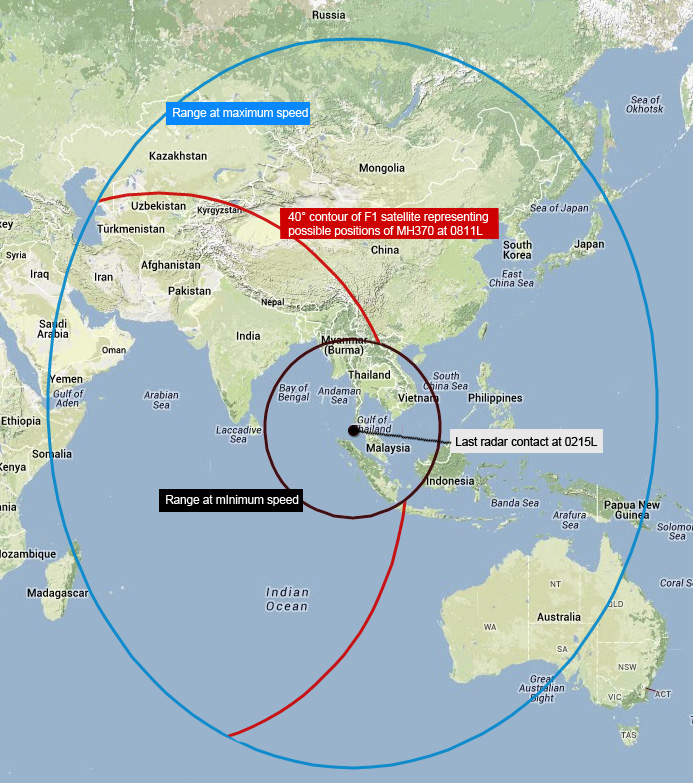
[UPDATE: I believe that the first of these approaches is more likely to produce an accurate estimate. See my new blog post for more information on locating satellite pings.] We can see in the chart below (taken from a Reuters Aerospace News photo of the search area posted at the media center) that the search locations are based on exactly these curves at a given distance from the sub-satellite point. However, it is unlikely that the measurements are more accurate than within say 100 miles.
We can also see that the arcs are cut off at each end. The cutoff due east of the sub-satellite point may be due to the fact that the transmissions would also potentially be received by Inmarsat’s Pacific Ocean Region satellite at that point, and if they weren’t, then that region would be ruled out (although others have suggested that military radar plots have already been checked in these regions). Its possible that the boundaries to the north and south have been established similarly by the boundaries of Inmarsat’s Atlantic Ocean Region satellite coverage, but they may instead be based on available fuel (or simply the elapsed time multiplied by the maximum speed of the plane), rather than the satellite measurements per se.
UPDATE (Mar 18): I originally attributed the picture below to a Malaysian government release, based on information from a journalist in Kuala Lumpur. As a commenter below notes, the diagram was put together based on an interpretation of what was stated in a briefing (indicating that the ends of the arcs were determined based on the minimum and maximum speed of the aircraft, rather than being based on the overlap of the Inmarsat satellite coverage areas) and is not an official document. Apologies for any confusion.

Key point 8: The position of the aircraft is being estimated based on the signal timing/power measured at the satellite. Its not based on the data content of any message and is not highly accurate.
ADDITIONAL POINT (Mar 17): Many have asked why it took so long to figure out where these satellite pings were coming from. Taking an extension of the analogy above, assume you have a friend staying in a hotel. The hotel catches fire and burns to the ground and your friend’s regular Twitter updates cease. For the first few days, the fire department is trying to find his body in the hotel. When he can’t be found the police check to see when his iPhone was last turned on. It turns out the phone was still connected to AT&T’s network hours after the fire. So then the police ask AT&T to figure out where the phone was operating by looking at their database of network records.
That’s exactly the sequence of events here. The plane’s ACARS (and radar) communications suddenly ceased and in the first few days, everyone assumed there had been a crash and was looking for the crash site. After no debris was found, investigators started to look at other possibilities. Inmarsat discovered the plane’s terminal was still connected to their network even after the ACARS messages ceased. Then it took a bit more time to calculate the location of the pings from Inmarsat’s network data records.
Finding missing people this way using cellphones is well known, but no-one’s ever had to do it before in the aeronautical satellite world, so its hardly surprising that this would be not be standard practice in an air accident investigation. I’m sure it wasn’t standard practice for cellphone companies in the 1980s either.
UPDATE (Mar20): The WSJ is reporting that Inmarsat had this information very quickly but the Malaysian government delayed making use of ping arc data to revise the search area for several days.
I hope that’s helpful. Let me know of any questions or need for further explanation.
Permalink
02.10.14
Posted in Globalstar, Handheld, Inmarsat, Iridium, Operators, Services, Thuraya at 4:20 pm by timfarrar
Last week, at its partner conference, Iridium announced the launch of its new GO! product, which will provide the ability to relay calls and data to and from a smartphone via WiFi, at a reported retail cost of $700-$800. Iridium is looking to boost its revenues from handheld data (i.e. email, texting, etc.) which to date have been fairly modest in the satellite phone market, and will offer lower cost bundles of data minutes, including unlimited packages for intensive users. Indeed, one of the likely use cases is on yachts and fishing boats, which don’t need a full blown high speed data solution. This is slightly different to Thuraya’s SatSleeve, which is more likely to stimulate incremental voice usage, because the SatSleeve is physically attached to an iPhone or Samsung S3/S4 phone and so is easier to use for voice communications.
Globalstar also threw its hat in the ring, pre-empting Iridium’s announcement with the Sat-Fi, which is “expected to receive final FCC certification…during the second quarter of 2014, with shipments starting shortly thereafter.” Globalstar has had a “puck-like” device on its roadmap for several years, but has always wrestled with whether it is worthwhile to invest in product development for a product based on its existing Qualcomm air interface, with a potentially limited lifespan, or if it is better to wait for the new Hughes chipsets in 2015, which will offer improved data capabilities and will be supported throughout the lifetime of the second generation constellation.
Its therefore interesting to note that (according to my sources) the Sat-Fi will be based on the Qualcomm GSP-1720 voice and data module rather than the Hughes chipset. This suggests that Globalstar either perceives a large near term opportunity, which would justify making the investment now, or was particularly focused on spoiling Iridium’s announcement. Iridium clearly thinks it was the latter, and doesn’t believe that the Sat-Fi is actually “real”.
Globalstar has kept details of the Sat-Fi pretty quiet (although it filed a patent application on some aspects of the concept two years ago), and none of the MSS distributors I’ve spoken to seems to know much about the size, price or market positioning of the Sat-Fi device. However, despite Globalstar’s greater focus on the consumer market, it does not appear likely that Sat-Fi would sell in significantly higher volumes than Globalstar’s existing satellite phones, assuming a comparable price point. Indeed estimates that there might be 150K hotspots in use by 2022 would represent only 10%-20% of the expected satellite phone market in that timeframe.
I’m sure this will be make for a fascinating discussion during the MSS CEO panel at Satellite 2014 and perhaps even a return to some of the contentious debates of prior years. Ironically, the barbs being thrown around over the GO! and Sat-Fi don’t fully reflect the competitive landscape in the MSS industry, with Iridium and Globalstar focusing to a significant degree on different distribution strategies, target customers, and (to some extent) geographies.
In that context, both could be successful in different parts of the market, which would make this much like prior arguments over Inmarsat’s ISatPhone Pro and its supposed advantages over Iridium (reflected in the Gabby Wonderland video produced by Inmarsat’s marketing agency in 2010). In that case Inmarsat’s initial belief was that the ISatPhone Pro would hurt Iridium’s satellite phone business significantly, but in reality Iridium continued to dominate the higher end of the MSS handheld market (and sold more satellite phones than Inmarsat at much higher equipment margins), while Inmarsat expanded the low end of market instead.
Permalink
11.10.13
Posted in Aeronautical, Services at 12:29 pm by timfarrar
An interesting debate has ensued about whether the cost of inflight connectivity services will increase if airlines can provide service from gate to gate rather than being restricted to operating above 10,000ft. Obviously on a short flight the extra time might be quite substantial as a proportion of the total flight length, although even if the increased availability is as much as 30%-75% more time (which I think is a little on the high side), the increase in data consumption per user will be far lower, because:
a) longer flights see much greater usage (especially when its paid-for) – the figure quoted by Delta was that take rates for Gogo service were 4 times higher on flights of more than 1500 miles, and
b) laptops consume a lot more data than tablets and phones, and laptops will not be able to be used during take off and landing (because they are too heavy to be safe in the event of an incident).
As a ballpark number, I’d suggest the actual increase in bandwidth consumption per paying passenger might be at most 10%-15% for Row44, given its exposure to Southwest, and much less for Panasonic and Gogo’s Ku-band service, given their different mix of customers. Note that total bandwidth consumption might increase more, because increased availability will stimulate higher take-up, but that’s a good problem to have, because more customers means more revenues as well.
I was quoted in the article offering a cost estimate of “10-20 cents per Mbyte” for traditional Ku-band services (while LiveTV’s Ka-band service will be “single digit cents” – that statement was not referring to GX). I’ve received considerable pushback from one Ku provider that my cost estimate for Ku is far too high and that the number for LiveTV/ViaSat’s Ka-band service is far too low.
I’d note that the retail rate for ViaSat’s consumer broadband service is $5-$7 per Gbyte (i.e. 0.5 to 0.7 cents per Mbyte), so it hardly seems implausible that the number for mobility services (which have a less efficient antenna and bandwidth utilization) would be a few cents. Last time I saw it, LiveTV’s customer pitch said 3 cents.
In terms of Ku-band, I derived my estimate from the cost of Ku-band transponders and the average likely utilization. Row44′s average cost of buying capacity from Hughes is about $2M p.a. for a 36MHz transponder, although that figure might be a bit lower for Panasonic and Gogo when they buy direct from a satellite operator (though there are teleport and backhaul costs to add onto raw transponder lease costs). Then you need to consider the number of bits you get from each Hz of satellite capacity. I assumed around 0.75 bits/Hz for a relatively small aero antenna, though that could go up if you have a very asymmetric usage profile (the aero antenna is far less efficient on the uplink than the downlink) and will certainly improve for High Throughput Satellites which offer a more powerful signal in their small spot beams. Then you look at the peak to average ratio – i.e. how much capacity you need for peak traffic. I assumed usage for around 10 hours per day and 5 days a week, due to the concentration of flights at peak times, the focus on business travelers and the lack of usage on overnight flights, giving a peak to average ratio of 3.36:1 (24/10*7/5). Providers might squash that peak a bit, but only at the cost of increased customer dissatisfaction when their service slows to a crawl (not an infrequent occurrence, implying providers probably do that at the moment).
That means that the underlying cost of capacity, if you had perfectly efficient capacity purchases, is around 6.3 cents. However, to provide global coverage, you need to lease a lot of transponders you don’t use very efficiently, especially at the moment when there are only a few aircraft flying on numerous different long haul routes. At best the efficiency (i.e. usage of purchased capacity) is likely to be no more than 50% today, though perhaps that will get a bit better in the future. So if you’re a provider, you could offer a reasonable service at cost to an airline at around 12.6 cents a Mbyte. And if you actually want to make a profit, then you ought to charge something closer to 20 cents per Mbyte.
Of course that’s not what providers do charge right now: Row44′s service revenues are only about half what it pays for capacity, and I doubt Panasonic’s revenue to capacity cost ratio is much better. So put another way, Row44 is probably getting paid about half of its per Mbyte cost (estimated as 12.6 cents per Mbyte above) or 6 cents per Mbyte, rather than the 20 cents it needs to have a decent business. Does that mean my 10-20 cent estimate is wrong? I think it really means that the current business plan is unsustainable.
Permalink
« Previous Page — « Previous entries « Previous Page · Next Page » Next entries » — Next Page »