06.04.26
Posted in Amazon, Broadband, Financials, SpaceX at 1:10 pm by timfarrar
One of the biggest uncertainties in the SpaceX IPO relates to the potential future growth of Starlink’s consumer business, which we discussed in detail in our 65 page report released on Tuesday this week. The most attention-grabbing claim from ARK Invest is that Starlink represents “a business without precedent” because even the early Starship launches of V3 satellites will produce twice as much revenue each year as it costs to manufacture and launch the satellites and acquire customers to fill them.
Those assertions (endorsed by Elon Musk) have led other analysts to predict that “SpaceX will disrupt [the] $1.6 trillion US communications industry” and justify a downgrade of AT&T, while Goldman Sachs is predicting that Starlink will generate $144B in revenue in 2030.
Starlink undoubtedly has a strong platform for growth, although you have to wonder why SpaceX suddenly decided to raise prices in the wake of a disappointing set of Q1 results, where ARPU dropped sharply, and incremental revenue per new subscriber was unsustainably low. That’s not the action of a company that’s looking to compete aggressively against terrestrial telcos and cable companies where multi-year “price lock” guarantees are all the rage.

Some have tried to explain away the price rises, as being “put in place because Starlink was having trouble coping with recent subscriber demand that was driven by price cuts”. But that doesn’t make much sense when Starlink net adds were lower in 2026Q1 (1.4M) than in 2025Q4 (~1.6M) and overall network performance improved continuously throughout 2025. Even potential terminal manufacturing constraints that were pointed out back in February will have been eased by the combination of fewer subscriber adds and increased production (which went from 170K per week at the end of 2025 to 200K per week as reported in the S-1).
[EDIT] And now Starlink has just announced it reached the 12M customer milestone, 111 days after the 10M milestone in February, which is a slightly slower growth rate than the 52 days from 9M to 10M and the 48 days from 8M to 9M customers.
Returning to the mad claims made by ARK, there are multiple errors in the assumptions, including that Starship will be able to launch 60 satellites right away when the roadshow presentation points out that will only be achieved “over time” and most importantly a dramatic underestimate of terminal costs, which at present are multiples of ARK’s assumed $100.
In their recent investor briefing, ST Microelectronics, who make the key chipsets for Starlink, said that “When you look at Ku band user terminal, I think that actually we’re going to soon reach a plateau” in the cost of their chips (which alone cost “a few tens of dollars” before the rest of the manufacturing takes place). At the end of the day, the cost of Starlink terminals is the key barrier to competing with terrestrial, not the cost of bandwidth.
Most egregious of all are ARK’s estimates of revenue per Tbps. If you look at Starlink’s $11.4B of revenues in 2025 and adjust for product revenues and Starshield/Starlink Mobile revenues that aren’t related to Starlink’s broadband business, then you get broadband service revenue in 2025 of about $15M per Tbps. With each extra Starlink V2 mini satellite adding capacity for ~2000 subs around the world, that’s about $62 of revenue per subscriber per month.
But Starlink’s current bandwidth provisioning will have to at least double if it is to compete fully for terrestrial subscribers. If we take the 10x increase in capacity per satellite on V3, but assume that provisioning doubles, that means each V3 satellite will add enough bandwidth to serve 10,000 new subscribers. At the same $62 per sub per month then that’s only $7.5M per Tbps launched. And if you want to compete with terrestrial then the incremental revenue per sub might only be $40 or so (under $5M per Tbps).
In contrast, ARK assumes that the initial Starship launches will generate $17M per Tbps (with a doubling of total system capacity) and $13M per Tbps if 10 times the current capacity is added, i.e. Starlink adds 6000Tbps, which would equate to winning another 100M subscribers with each generating an average of $65/month. That’s just not remotely credible (and incidentally explains why Musk’s daily or hourly launch tempo for Starship simply can’t be achieved based solely on Starlink demand).
Of course once you fix ARK’s underestimated costs and vastly inflated revenue assumptions then Starlink still looks like a very good business, with potential gross margins of around 60%. And Starlink should be able to capture a meaningful number of customers from terrestrial telcos in developed countries (about 100K per month in the US at the moment) if it does decide to price more aggressively at some point in the future. But don’t take these ridiculous assessments, which are being thrown out there to justify an IPO valuation of $1.75T, as saying anything about the reality of Starlink’s business potential and its impact on terrestrial telcos and cable companies. And ask yourself whether you believe Starlink’s next move will be to increase or decrease the price that customers are paying, especially when the prospect of competition from Amazon just moved even further into the future…
Permalink
06.02.26
Posted in Amazon, Broadband, Financials, Operators, SpaceX at 3:06 pm by timfarrar
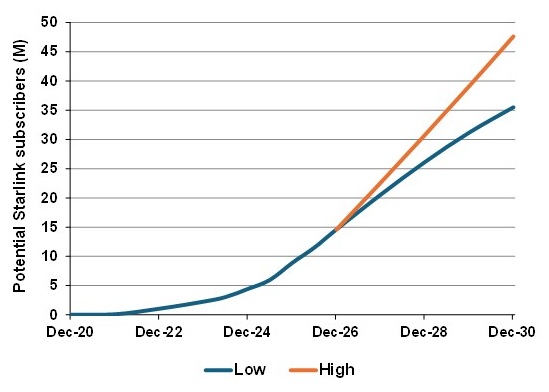
I’ve been writing a lot about Starlink’s financials since the SpaceX S-1 came out almost two weeks ago and now I’ve just released my new 65 page report forecasting the opportunity for Starlink’s consumer business. The report pulls together the first detailed breakdown of how Starlink’s customers are distributed around the world, based on weekly monitoring of active terminals, and projects how the reported subscriber base and revenues will grow in the coming quarters and years by country and region.
The report analyzes Starlink capacity density and terminal production and how these factors have constrained growth in recent years. It also discusses the limitations to future growth and how successfully Starlink will be able to compete with terrestrial alternatives in different countries. And the report compares the technology of Starlink and Amazon Leo to assess whether there is any realistic prospect of Amazon making significant inroads into Starlink’s subscriber base in the coming years.
Do you know the top 10 Starlink country markets (United States, Brazil, Canada, Argentina, Australia, Mexico, UK, Chile, France, Germany) and how many subscribers are in each country? Do you want to understand how Starlink’s growth in each country has changed since the price cuts in January, and why the price increases last month were so significant for Starlink’s future growth trajectory? You can even see why the various online estimates either significantly overestimate the subscriber base or get the regional distribution dramatically wrong.
This report will be followed up with a detailed set of projections for Starlink’s other business lines later this week, updating our previous company profile, and you can get both reports together at a discount. Or subscribe to the full research service and access our other reports from last year covering the D2D and professional satellite markets that Starlink competes in, plus all of our regular notes on key breaking news in the satellite sector for the next 12 months.
Permalink
03.24.26
Posted in Amazon, AST SpaceMobile, D2D, Globalstar, Lynk, Operators, Services, SpaceX, Spectrum, ViaSat at 5:43 pm by timfarrar
After more than 20 years, it looks like Jay Monroe has finally achieved his goal of selling Globalstar at a profit. In the coming days, I understand that the sale process initiated back in October will reach its conclusion, and Globalstar will be sold at something close to Jay’s asking price of $10B. And as I promised Jay in Paris last September, I’ll owe him an apology for ever doubting that he would be able to make money on his Globalstar investment.
Rumors have been swirling all week here at the satellite conference in Washington DC and many people have guessed that the winning bidder would be Amazon. That seemed to be the most likely outcome back in January. However, I think that Jay took Amazon’s offer to SpaceX and they probably decided to beat it, in order to further cement Starlink’s dominance of the satellite industry. Amazon already faces severe competitive pressure from Starlink in the broadband market, and a Starlink purchase of Globalstar would block another opportunity for Amazon to broaden its appeal and match Starlink’s D2D offer.
Buying yet more spectrum might not be seen as the wisest course of action for SpaceX, if some international regulators decide that because Starlink controls Globalstar’s MSS spectrum there is no need to grant Starlink additional rights in the 2GHz MSS spectrum acquired from EchoStar. But Brendan Carr’s threats that he will block European satellite operators from the US market if the EU withdraws Starlink’s spectrum rights should carry the day in the near term.
In particular, a two year extension is likely to be granted for the current EU 2GHz spectrum licenses (which is conveniently beyond the November 2028 presidential election). And 2029 is a long way away, given the number of balls Elon Musk has to juggle in the next few years to get Starship flying, meet NASA’s moon ambitions and sort out the challenges at xAI and Tesla.
What is much less clear, is what will happen to Globalstar’s C-3 constellation and the relationship with Apple after a sale. Would Apple continue to pay Starlink hundreds of millions of dollars per year to support connectivity on existing iPhones? Would the C-3 constellation still be completed, especially if it takes MDA another two years or more, by which time Starlink might have its own next generation Starlink Mobile constellation on orbit? That decision could go either way, depending on how confident SpaceX is that Starship will be ready to launch the next gen constellation on time.
Meanwhile, in other news, it seems that Viasat has concluded that it will have to put some of its own money on the line to get started with the 2800 satellite Equatys constellation, with RocketLab likely to be chosen as the satellite bus contractor. Plausibly, RocketLab’s recent $1B fundraising could be used to provide an equity injection into the Equatys joint venture.
And AST is telling people that it will now rely on New Glenn for 9 of its first 12 launches, implicitly confirming the rumors that the company can’t figure out how to stack satellites within the much smaller Falcon 9 fairing. Of course, there’s no way that New Glenn will provide AST with anything like 9 launches this year, so AST’s deployment plans will be pushed out even further.
The level of skepticism about AST at the conference is quite remarkable, but despite Starlink’s dominance, there’s little reason for mobile operators to withdraw their support in the immediate future. Instead, with Starlink’s next generation Starlink Mobile constellation at least two years away and alternatives including AST, Equatys and Lynk all on a similar timetable, MNOs can wait and see, and perhaps pray, that one or more alternatives to Starlink ultimately emerges, and that, in the meantime, more clarity emerges about whether their customers actually care about D2D at all.
Permalink