06.26.26
Posted in D2D, Financials, SpaceX, Spectrum, T-Mobile at 8:28 am by timfarrar
Since the SpaceX IPO earlier this month, speculation about SpaceX entering the mobile market has reached fever pitch, most recently in an FT article that cites comments made by Gwynne Shotwell to investors during the IPO roadshow. And of course we’ll hear imminently about the results of FCC Auction 113, where SpaceX is one of the bidders, and some analysts have been suggesting that SpaceX will buy much or all of the $3.5B in spectrum that was sold, not just the two unpaired licenses that SpaceX definitely need for their Band 70 offering (and which only sold for $10.5M).
But what is not being talked about is the context of a knife fight behind the scenes between SpaceX and T-Mobile over what T-Mobile will pay for the T-Satellite service after exclusivity expires next month. Because SpaceX was desperate to secure a launch partner and pre-empt Apple’s announcement with Globalstar back in August 2022, the current contract is reportedly only valued at “about $100M” in total since 2022, which means T-Mobile is likely only paying a few million dollars per month for the service. That’s only of order $1-$2 per monthly active user, when less than 10% of T-Mobile customers with T-Satellite included in their plan make use of the service in a given month. Or put another way, about $0.10 per month for each customer with access to the service.
But late last year, when SpaceX looked like it was going to come up short of Elon Musk’s 2025 projection of $15.5B in revenues, it seems the company booked an incremental $632M in (deferred) Starlink Mobile revenues so SpaceX would come close to Musk’s target (SpaceX’s actual reported revenue last year, excluding xAI, was $15.473B). That’s far above the current runrate reported for Starlink Mobile of $85M in 2026Q1.
So now, in order to show growth in 2026, SpaceX needs vastly increased revenues from T-Mobile (5-10 times the current level), when (based on the 2026Q1 runrate) T-Mobile is seemingly paying much less than SpaceX’s other MNO partners. As an example, I understand Rogers in Canada has suggested it might end up paying SpaceX up to CAD100M per year in a market which is about one tenth the size of the US. And we’ve seen numbers being floated like $500M per year for Starlink Mobile to provide service in Iran.
What is clear is that T-Mobile does not believe the service is worth that much, which is why they are being so vocal about how “most of the usage we’re seeing is in national parks” and “we’re seeing a lot less usage than we were originally thinking”, later quantified as “satellite usage is 0.0002% of our total network usage” and “pretty much, no one buys satellite stand-alone”. T-Mobile is even explicitly stating that “we expect that our exclusivity will end”.
T-Mobile is offering some carrots as well as sticks, promoting its new Super Broadband solution with Starlink as a backup for businesses. And of course in Europe, Deutsche Telekom’s support is going to be even more critical after the recent EU 2GHz proposal indicated that Starlink would not be allowed to utilize EchoStar’s spectrum license, even though that license will be extended to spring 2029.
But the proposed D2D joint venture with AT&T and Verizon aims to stop SpaceX from playing off the mobile operators against one another, and the operators have been united in their refusal to consider an MVNO relationship with SpaceX.
This is certainly the right time for the MNOs to hold the line on pricing of the Starlink Mobile service, as it will set an advantageous precedent for future D2D services if the wholesale cost for MNOs is in the low tens of cents per customer per month (an order of magnitude lower than the $2-$3/month assumed by many D2D proponents). And it seems hard to imagine SpaceX turning off the T-Satellite service before its own offering is ready in 2028 (though I wouldn’t completely dismiss the possibility of SpaceX completing the EchoStar transaction early and using some of the Band 70 spectrum on the current Starlink DTC satellites).
Are SpaceX’s current threats enough to change the mobile operators’ minds, even if SpaceX does buy more terrestrial spectrum? It’s always been expected that there will be some direct-to-consumer Starlink Mobile offering, most likely in the form of a smaller version of the Starlink Mini (a Starlink Nano?) operating in MSS frequencies with a much improved battery life, that you can connect to your phone via Bluetooth or WiFi. That’s very different to offering a fully fledged mobile service, when satellite links won’t deliver the data rates and inbuilding penetration expected from a terrestrial network.
But threats to buy a mobile operator or build a terrestrial mobile network seem like a paper tiger, which would do nothing to leverage SpaceX’s “core strengths” as set out in the S-1:
Global leadership in orbital launch services
Unrivaled satellite and connectivity platform across design, manufacturing, deployment, and operations
Truth-seeking AI model enhanced by real-time data
Extreme vertical integration enabling high velocity and superior cost efficiency at scale
Unique ability to scale new trillion-dollar markets across Space, Connectivity, and AI
Business models that are incredibly difficult to replicate
Our mission-driven culture and world-class talent.
So I look forward to seeing the revenues that SpaceX is able to report from Starlink Mobile in Q2 and Q3, and whether this is really a growth engine for the company in 2026, or if revenues actually fall from 2025 levels. If that’s the case then Starlink Mobile will presumably become another business (like Orbital Data Centers) where the hype is focused on what might be achieved with a next generation constellation in 2028 and beyond, while analysts continue seeking attention by playing up the possibility of SpaceX building, buying or leasing capacity for a fully fledged mobile service.
Permalink
06.04.26
Posted in Amazon, Broadband, Financials, SpaceX at 1:10 pm by timfarrar
One of the biggest uncertainties in the SpaceX IPO relates to the potential future growth of Starlink’s consumer business, which we discussed in detail in our 65 page report released on Tuesday this week. The most attention-grabbing claim from ARK Invest is that Starlink represents “a business without precedent” because even the early Starship launches of V3 satellites will produce twice as much revenue each year as it costs to manufacture and launch the satellites and acquire customers to fill them.
Those assertions (endorsed by Elon Musk) have led other analysts to predict that “SpaceX will disrupt [the] $1.6 trillion US communications industry” and justify a downgrade of AT&T, while Goldman Sachs is predicting that Starlink will generate $144B in revenue in 2030.
Starlink undoubtedly has a strong platform for growth, although you have to wonder why SpaceX suddenly decided to raise prices in the wake of a disappointing set of Q1 results, where ARPU dropped sharply, and incremental revenue per new subscriber was unsustainably low. That’s not the action of a company that’s looking to compete aggressively against terrestrial telcos and cable companies where multi-year “price lock” guarantees are all the rage.

Some have tried to explain away the price rises, as being “put in place because Starlink was having trouble coping with recent subscriber demand that was driven by price cuts”. But that doesn’t make much sense when Starlink net adds were lower in 2026Q1 (1.4M) than in 2025Q4 (~1.6M) and overall network performance improved continuously throughout 2025. Even potential terminal manufacturing constraints that were pointed out back in February will have been eased by the combination of fewer subscriber adds and increased production (which went from 170K per week at the end of 2025 to 200K per week as reported in the S-1).
[EDIT] And now Starlink has just announced it reached the 12M customer milestone, 111 days after the 10M milestone in February, which is a slightly slower growth rate than the 52 days from 9M to 10M and the 48 days from 8M to 9M customers.
Returning to the mad claims made by ARK, there are multiple errors in the assumptions, including that Starship will be able to launch 60 satellites right away when the roadshow presentation points out that will only be achieved “over time” and most importantly a dramatic underestimate of terminal costs, which at present are multiples of ARK’s assumed $100.
In their recent investor briefing, ST Microelectronics, who make the key chipsets for Starlink, said that “When you look at Ku band user terminal, I think that actually we’re going to soon reach a plateau” in the cost of their chips (which alone cost “a few tens of dollars” before the rest of the manufacturing takes place). At the end of the day, the cost of Starlink terminals is the key barrier to competing with terrestrial, not the cost of bandwidth.
Most egregious of all are ARK’s estimates of revenue per Tbps. If you look at Starlink’s $11.4B of revenues in 2025 and adjust for product revenues and Starshield/Starlink Mobile revenues that aren’t related to Starlink’s broadband business, then you get broadband service revenue in 2025 of about $15M per Tbps. With each extra Starlink V2 mini satellite adding capacity for ~2000 subs around the world, that’s about $62 of revenue per subscriber per month.
But Starlink’s current bandwidth provisioning will have to at least double if it is to compete fully for terrestrial subscribers. If we take the 10x increase in capacity per satellite on V3, but assume that provisioning doubles, that means each V3 satellite will add enough bandwidth to serve 10,000 new subscribers. At the same $62 per sub per month then that’s only $7.5M per Tbps launched. And if you want to compete with terrestrial then the incremental revenue per sub might only be $40 or so (under $5M per Tbps).
In contrast, ARK assumes that the initial Starship launches will generate $17M per Tbps (with a doubling of total system capacity) and $13M per Tbps if 10 times the current capacity is added, i.e. Starlink adds 6000Tbps, which would equate to winning another 100M subscribers with each generating an average of $65/month. That’s just not remotely credible (and incidentally explains why Musk’s daily or hourly launch tempo for Starship simply can’t be achieved based solely on Starlink demand).
Of course once you fix ARK’s underestimated costs and vastly inflated revenue assumptions then Starlink still looks like a very good business, with potential gross margins of around 60%. And Starlink should be able to capture a meaningful number of customers from terrestrial telcos in developed countries (about 100K per month in the US at the moment) if it does decide to price more aggressively at some point in the future. But don’t take these ridiculous assessments, which are being thrown out there to justify an IPO valuation of $1.75T, as saying anything about the reality of Starlink’s business potential and its impact on terrestrial telcos and cable companies. And ask yourself whether you believe Starlink’s next move will be to increase or decrease the price that customers are paying, especially when the prospect of competition from Amazon just moved even further into the future…
Permalink
06.02.26
Posted in Amazon, Broadband, Financials, Operators, SpaceX at 3:06 pm by timfarrar
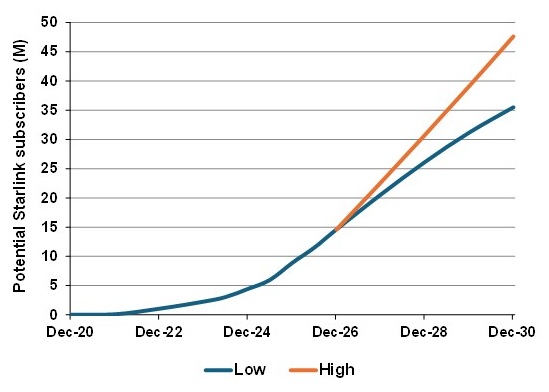
I’ve been writing a lot about Starlink’s financials since the SpaceX S-1 came out almost two weeks ago and now I’ve just released my new 65 page report forecasting the opportunity for Starlink’s consumer business. The report pulls together the first detailed breakdown of how Starlink’s customers are distributed around the world, based on weekly monitoring of active terminals, and projects how the reported subscriber base and revenues will grow in the coming quarters and years by country and region.
The report analyzes Starlink capacity density and terminal production and how these factors have constrained growth in recent years. It also discusses the limitations to future growth and how successfully Starlink will be able to compete with terrestrial alternatives in different countries. And the report compares the technology of Starlink and Amazon Leo to assess whether there is any realistic prospect of Amazon making significant inroads into Starlink’s subscriber base in the coming years.
Do you know the top 10 Starlink country markets (United States, Brazil, Canada, Argentina, Australia, Mexico, UK, Chile, France, Germany) and how many subscribers are in each country? Do you want to understand how Starlink’s growth in each country has changed since the price cuts in January, and why the price increases last month were so significant for Starlink’s future growth trajectory? You can even see why the various online estimates either significantly overestimate the subscriber base or get the regional distribution dramatically wrong.
This report will be followed up with a detailed set of projections for Starlink’s other business lines later this week, updating our previous company profile, and you can get both reports together at a discount. Or subscribe to the full research service and access our other reports from last year covering the D2D and professional satellite markets that Starlink competes in, plus all of our regular notes on key breaking news in the satellite sector for the next 12 months.
Permalink
02.08.26
Posted in Broadband, Financials, Operators, Regulatory, SpaceX at 2:29 pm by timfarrar
On Friday, redacted versions of two SpaceX financial forecasts, one from 2021 and the other from 2023, were disclosed in the Delaware litigation between SpaceX shareholders.
While only very limited numbers in the financial projections remain unredacted (beyond the expectation in the 2021 forecast that “government” revenue for Starlink would grow to $5B by 2027), there is enough that can be extracted to determine that Starlink has exceeded the 2021 revenue forecast, but Starship has fallen dramatically behind expectations even in 2023. The 2021 forecast helpfully used redactions matched to the number of characters, showing that Starlink was first expected to exceed $10B in revenues in 2026, while in actual fact Starlink passed $10B in 2025.
The projected valuations on the last page of this document also make it possible to back into the total company revenues forecast in 2021 and 2027: the $102.8B valuation was 25x revenues, implying a revenue forecast of $4113M for 2021. By 2027 this valuation was expected to have increased 4.9x, to around $500B, which was said to be 20x revenues, implying a revenue forecast of ~$25B for 2027. That again is slightly less than SpaceX’s likely total revenues in 2027, even if you remain skeptical about SpaceX’s ability to meet the current published 2026 forecast of $22B-$24B.
However, the 2023 forecast shows how SpaceX was expecting Starship to start launching Starlink satellites to orbit in 2024, with Falcon 9 phased out for Starlink launches in 2026. Now even on Musk’s optimistic timeline from December 2025, Starlink V3 launches on Starship aren’t expected “at scale” until “around Q4″ of this year. So Starship launches of usable payloads have now consistently remained 12 months out for nearly three years.
It’s also fascinating to me how the ongoing debate about orbital data centers tends to ignore launch constraints. SpaceX is just beginning to scale up to develop these “AI satellites”, but until now the emphasis for Starship has been on getting it ready to launch Starlink V3 in volume. That’s meant building extensive launch pad infrastructure in Florida and seeking permission for a high launch tempo there.
Florida is ideal for Starlink launches to 40 and 50 degree inclinations, which will be much more difficult in Boca Chica. However, Florida is a terrible location for sun synchronous launches, which is where these orbital data centers are supposed to go, to utilize maximum sunlight. Back in 2020, SpaceX conducted the first sun synchronous launch from Florida in more than 50 years, and has continued to launch some Transporter rideshare missions to sun synchronous orbits since then, but this requires a very fuel inefficient “dog leg” maneuver and so is only suitable for light payloads, not bulk launches of AI satellites.
Similarly, undertaking sun synchronous launches from Boca Chica would be extremely challenging (and potentially cause an international dispute), as these rockets would need to fly completely across Mexico, not over the open ocean. That’s why Vandenberg is typically used for sun synchronous missions, but SpaceX hasn’t even begun building a Starship pad there, and a high launch tempo is likely to be very politically controversial in California. So how exactly does SpaceX intend to get these AI satellites to the desired orbit?
Permalink
01.03.26
Posted in Broadband, D2D, Financials, Operators, Services, SpaceX at 11:52 am by timfarrar
The reactions to my comments last month on The Information’s TITV program about SpaceX needing a new story for its planned $1.5T IPO were fascinating, mainly because no one actually disagreed with the fact that SpaceX has consistently missed its targeted revenue growth over the last three years. Back in July 2023 SpaceX originally estimated revenues for the year would double to around $8B, before this whisper number was raised in November 2023 to $9B, with a forecast of $15B in 2024. That caused analysts such as Payload Space to come up with a figure of $8.7B for 2023, which is still often repeated as the actual figure, despite the NY Times finally confirming in August 2025 that SpaceX’s 2023 revenue was only $7.4B (with Starlink generating “roughly $8 billion” in revenue during 2024, implying a companywide total of ~$11B).
In 2025, SpaceX once again appears to have missed the revenue prediction of $15.5B that Musk stated publicly back in June, with Bloomberg reporting in its IPO coverage that “the company is expected to produce around $15 billion in revenue in 2025, increasing to between $22 billion and $24 billion in 2026.” That’s despite surging broadband subscriber numbers, which reached 9.2M by the end of the year as SpaceX dramatically cut the price of its terminals and reduced US residential service pricing to stimulate demand. Of course Starlink’s revenue growth is incredibly impressive, as is the speed with which it has come to dominate the satellite industry, but justifying an $800B current valuation (let alone a $1.5T IPO valuation), usually requires outperforming revenue guidance, not missing it.
Even so, it seems likely that SpaceX’s revenue target for 2026 will once again prove too optimistic, because ARPUs on those millions of customers are much lower than most analysts think (especially now there’s a $5 per month service option for suspended terminals). And the next generation D2D/DTC system won’t start launching in volume until “around Q4″ 2026 (at best since that depends on rapid progress with Starship), while SpaceX can’t access EchoStar’s AWS-4 spectrum until November 2027, so it can’t start offering a Band 70 DTC solution in the US with existing handsets until then.
It’s also undeniable that SpaceX needs more than just Starlink to justify a $1.5T valuation, given that even its expected lead investment bank, Morgan Stanley, only thinks Starlink revenues will get to $126B in 2040. So its understandable that the proposal for space-based data centers took center stage in last month’s reports of IPO preparations.
Curiously, however, data centers didn’t even rate a mention in Starlink’s end of year progress report, which focused instead on talking up the Starlink V3 satellites and the DTC constellation in particular as the key payload for Starship. And interestingly, in this progress report Starlink also modified the company’s September 2025 comments that “in most environments, [DTC] will enable full 5G cellular connectivity with a comparable experience to current terrestrial LTE service,” to instead promise that “in most environments [DTC] will enable full 5G cellular connectivity with a comparable experience to current terrestrial service.”
In many ways, Musk’s plan for space-based data centers offers a Rorschach test for potential SpaceX investors, just like Optimus does for Tesla investors. Both allow for near term demonstrations that look impressive but aren’t meaningfully revenue-generating, while allowing Musk to make long term projections of “infinite” revenues that can be (nearly) infinitely postponed.
In the case of Optimus, he’s claimed “humanoid robots will be the biggest product ever. Because everyone is gonna want one, or more than one,” while for space-based data centers, he’s claimed that “satellites with localized AI compute, where just the results are beamed back from low-latency, sun-synchronous orbit, will be the lowest cost way to generate AI bitstreams in <3 years. And by far the fastest way to scale within 4 years, because easy sources of electrical power are already hard to find on Earth."
Or put another way “Optimus and space data centers are two sides of the same coin…Optimus promises to provide all needed physical labor (and even better than a human!), while space data centers promise to provide all needed mental labor (and even better than a human!).”
But if you read yesterday’s WSJ piece on Optimus and think that Musk is simply lying again because “in public appearances, the robot is often remotely operated by human engineers” then you’ll believe the same is likely true of his plans for SpaceX’s space-based data centers. Conversely if you read that article and think that Tesla is making continued progress in opening up an untapped market opportunity where Adam Jonas “predicts that by 2050, humanoids will bring in $7.5 trillion in annual revenue across the industry globally,” you’ll probably have the same reaction about space-based data centers. And of course the latter are the investors that SpaceX actually wants for any IPO.
This is not to say that the market for either is non-existent: just like many companies are working on robots (with or without legs!), there is plenty of interest in space-based data centers. Both will also be particularly useful to the DoD, and especially in the space market the US government is seen as the best source of new revenue by many players right now.
And SpaceX has substantial advantages both in access to cheap launch, and in the ability to build a distributed network of data centers based on the Starlink V3 bus (which is a much better solution than a handful of extremely large space-based data centers several km in diameter, not least because achieving low latency requires the data center to be in view). However, that’s very different to saying revenue will be “infinite” or that this market can justify a $1.5T valuation for SpaceX.
But to return to my original interview, its particularly amusing to note the CEO of Starcloud suggesting in a subsequent TITV interview that this was “the dumbest thing I’d heard in a quite a long time”, because the dumbest thing I’ve heard in quite a long time is Starcloud’s business plan, which (if you take their story about launching huge arrays into space at face value) is essentially totally dependent on gaining access to Starship launches at cost.
Of course that means sucking up to Elon Musk is a necessity, but when one of SpaceX’s key competitive advantages for Starlink (and a key source of value in any IPO) lies in exploiting the huge difference between the cost and price of Falcon 9 launches, there’s no reason to believe that the same wouldn’t be true for Starship. In other words, SpaceX will be able to launch its own space-based data centers at a much lower cost, compared to the price of Starship launches for third parties, allowing SpaceX to gain far more scale than any other player at much lower cost, just as it has done with Starlink. In fact, I understand that all Starcloud has is some interesting in-space cooling technology, which only becomes valuable in extremely large arrays, and that’s unlikely to be useful if SpaceX’s distributed space-based data center architecture proves more cost effective.
Permalink
08.31.25
Posted in AT&T, Echostar, Financials, Operators, Regulatory, SpaceX, Spectrum, T-Mobile, Verizon at 9:15 am by timfarrar
Last week, EchoStar and AT&T announced a landmark spectrum deal, under which EchoStar will sell all of its 3.45GHz and 600MHz spectrum holdings to AT&T for $22.65B. But many analysts think “this is just the first step and the process is not yet complete“, not least because EchoStar CEO Akhavan commented that “We continue to evaluate strategic opportunities for our remaining spectrum portfolio in partnership with the U.S. government and wireless industry participants”.
The big prize now is EchoStar’s collection of midband assets in the AWS-3, H-block and AWS-4 bands, which could collectively be valued at as much as $30B. Semafor suggested that a three-way deal between AT&T, T-Mobile and EchoStar had been discussed under which AT&T and T-Mobile “would have swapped some of their own spectrum holdings”, but later indicated that “T-Mobile’s ultimate owners, Deutsche Telekom, tapped the brakes”.
This has caused speculation to focus on Starlink and even Kuiper as potential buyers of these assets, but what many articles are getting wrong is the suggestion that this is because (as Semafor put it) Starlink “wants its own network to provide cell coverage, something that would disrupt the stranglehold that AT&T, Verizon, and T-Mobile have on the US market”.
That’s a complete misunderstanding of the Direct-to-Device (D2D) business, which (despite the nonsense promulgated by some AST SpaceMobile investors) is limited to much slower speeds and far less capacity than terrestrial networks. It’s a simple matter of physics that communicating from your smartphone to a satellite hundreds of miles up in space will be less efficient than communicating with a cell tower a mile or two away and that means D2D is not a true substitute for terrestrial cellular service.
The consequence of this lower throughput and capacity is that D2D can’t generate the same revenue from each MHz of spectrum in space as a terrestrial operator on the ground, and so D2D operators can’t afford to pay as much to acquire spectrum. That’s why we’ve seen increased interest in cheaper MSS spectrum, both from Apple investing in Globalstar and more recently AST SpaceMobile bidding for Ligado’s spectrum.
But EchoStar’s mooted $30B price tag is only achievable by buying this spectrum for use in a terrestrial network, which is why Starlink has been trying to persuade the FCC to award it some of EchoStar’s spectrum for free. If that doesn’t work out then Starlink needs T-Mobile to pay the vast majority (if not all) of the $30B that EchoStar is demanding. So if T-Mobile steps back and we see FCC Chairman Carr accepting EchoStar’s offer to sell spectrum (and canceling the idea of a 2GHz MSS NPRM that might open up the band for sharing with Starlink), there’s no realistic prospect of Starlink and EchoStar agreeing on price.
We’d guess that Deutsche Telekom might want to wait for more evidence of the success or otherwise of T-Mobile’s D2D collaboration with Starlink before paying tens of billions for spectrum that they don’t really need, mainly so Starlink can improve the capacity of its D2D network. But if T-Mobile did in the end decide to bid, then either Starlink could buy the H-block (which cost EchoStar only $1.5B) and extend its existing G-block SCS network from 5x5MHz to 10x10MHz, or T-Mobile could offer Starlink access to some of the AWS-4 spectrum in rural areas for D2D.
However, there’s also an alternative path for T-Mobile and AT&T to just swap the 600MHz holdings that AT&T has now agreed to buy from EchoStar, for T-Mobile’s C-band spectrum assets, and not do any further deal with EchoStar.
If T-Mobile did buy all of EchoStar’s midband spectrum, then of course EchoStar’s planned D2D constellation would be abandoned. But there’s no reason to treat that as the default outcome. If instead Verizon puts in a bid for EchoStar’s midband holdings, then it isn’t allied with Starlink and wouldn’t want to risk the possibility that the FCC grants Starlink access to the 2GHz MSS band for D2D and impairs Verizon’s terrestrial usage plans.
So the best way forward would be for EchoStar to go ahead with its own proposed D2D constellation in order to keep exclusive access to the 2GHz MSS band in the US. Then Verizon could buy EchoStar’s AWS-3 and H-block holdings and lease AWS-4 from EchoStar in urban areas, while EchoStar coordinates D2D usage in rural and remote areas outside the reach of Verizon’s towers.
And finally if neither T-Mobile nor Verizon show up with an acceptable bid, then EchoStar will still want to preserve its MSS spectrum rights (and the associated terrestrial spectrum value in the US) by going ahead with the planned D2D constellation. Thus there are four possible scenarios and only in the first of them would EchoStar’s D2D constellation be abandoned:
1) T-Mobile buys all of EchoStar’s midband spectrum (and shares some with Starlink)
2) T-Mobile just does a swap with AT&T (600MHz for C-band)
3) Verizon buys EchoStar’s AWS-3 spectrum and leases AWS-4 in urban areas
4) No one shows up with $30B to meet EchoStar’s asking price.
On balance, assuming FCC Chairman Carr accepts the current EchoStar-AT&T deal, it therefore seems more likely than not that at least the first stage of EchoStar’s constellation will be built. And analysts who assume it won’t be and that Charlie Ergen is simply planning to sell up and retire might instead find themselves watching this show for many more years to come.
Permalink
08.14.25
Posted in AST SpaceMobile, Financials, Inmarsat, Operators, Regulatory, Spectrum, ViaSat at 9:02 pm by timfarrar
The famous saying from George Santayana is one that often comes to mind in the MSS industry, where companies repeatedly make the same mistakes as their predecessors a decade or two ago. And this blog has plenty of posts from 2009-14 about the mistakes made by MSV/LightSquared and Phil Falcone (who incidentally was so irritated by my posts that he was moved to comment on one of them from his Harbinger Capital computer – which is why my X/Twitter bio says that “I enjoy annoying billionaires”).
So it’s now particularly ironic to see that ancient history once again take center stage in the industry as the dispute between Viasat and Ligado/AST heats up. While Phil Falcone has other things on his mind nowadays, some of us remember those days only too well, including Jennifer Manner, who worked at MSV/SkyTerra from 2005-2009. Back then, Inmarsat and MSV signed a 100 year long Cooperation Agreement which was hugely advantageous to Inmarsat and has been a millstone around Ligado’s neck ever since. It has also been the source of endless disputes over the years as Ligado ran short of money, and Inmarsat tried to make sure it collected as much as possible.
The agreement was great for Inmarsat (which received ~$1.7B in spectrum lease payments, while its new owner, Viasat, stands to receive billions more between now and 2107) and Rupert Pearce, then General Counsel of Inmarsat, who negotiated the agreement and subsequently moved on to become CEO of Inmarsat. MSV’s then CEO Alex Good signed the agreement because Falcone had told him that an agreement was needed before Harbinger would provide a sorely needed $500M cash infusion (and Falcone had no understanding of what it actually said). Of course Falcone had many regrets later on, when LightSquared was forced into bankruptcy by GPS interference concerns, and once it became clear that Ligado was not going to deliver a windfall from its spectrum holdings, he unsuccessfully sued MSV’s executives and owners.
That brings us to today, when the dispute flared up once again, and both Viasat and Ligado filed competing motions with the bankruptcy court, detailing a dispute over the agreement to assume the Cooperation Agreement and sublease the spectrum to AST. There was a contentious mediation which had appeared to be settled back in June.
Now Ligado alleges that the Cooperation Agreement does not prohibit either Ligado or AST from seeking access to more L-band spectrum outside the US in the future, while Viasat alleges that the Cooperation Agreement has always prevented Ligado from operating outside the US, and AST should also be bound by these terms.
Ligado cites the drafting of the Mediation Agreement to support its argument that the only limitation is on AST’s initial application for its LEO constellation and nothing stops it from making modification requests in the future. It also includes a curious declaration from CEO Doug Smith, which sets out Ligado’s attempts to do a satellite lease deal with Avanti in 2016, at a time when there was lots of intrigue around Avanti’s future.
On the other hand Viasat argues that the Cooperation Agreement contains multiple references to Inmarsat’s exclusivity outside the US, and that the company would never have agreed to a deal that left Ligado or AST with the potential to interfere with its operations elsewhere in the world. Of course, Viasat has its own ambitions to build a LEO D2D constellation in partnership with Space42, operating in the L-band around the world, plus the 2GHz MSS band in Europe.
It remains unclear what the outcome of this dispute will be, especially as US bankruptcy courts often tend to favor the debtor in disagreements with creditors, but this could hold up the proceedings for quite a while. That may be one of Viasat’s objectives, as it looks towards an EU decision on 2GHz by the end of the year, and tries to cement its own LEO funding plans. Ligado’s submission even states explicitly that “Inmarsat’s position poses an existential threat both to the viability of the AST Transaction and the feasibility of the [Bankruptcy Reorganization] Plan”.
It is also intriguing why AST is so keen to pursue L-band rights outside the US, especially as these will undoubtedly be very difficult to secure, given the longstanding presence of both Viasat/Inmarsat and Space42/Thuraya. However, an application by Viasat to shift spectrum from GEO to LEO could provide an opening and AST would certainly prefer it if Viasat didn’t build another competing LEO NTN/D2D constellation.
But I also suspect that AST realizes the weakness of its claim to 2GHz (where the company claimed to have “priority rights” from last week’s deal with Sky and Space Global, omitting to mention that these are low priority) and the not insignificant probability that it will lose the EU 2GHz competition to either SES/Lynk or EchoStar (most observers think Viasat is fairly certain to retain its rights and there is only expected to be one other wideband license up for grabs). This would mean AST has little option other than to pursue L-band rights on a global basis if it wants to build a new constellation operating in “midband” spectrum in a few years time.
Now we wait to see how this develops. But for the time being AST may no longer be able to claim a clear path to developing what it asserts will be “broadband” D2D through use of MSS spectrum. So while this dispute continues, the company will have to focus on its very limited terrestrial spectrum leases with AT&T and Verizon, which will at best be sufficient to offer a narrowband service that is similar to Starlink (and will need the FCC to approve AST’s non-compliant SCS application, which is not at all certain).
Permalink
08.12.25
Posted in AST SpaceMobile, Financials, Operators, Services, SpaceX at 9:36 am by timfarrar
AST SpaceMobile did their best on today’s call to obfuscate the delays in their launch schedule, which has already shifted by several months since the company’s last quarterly update in May. Back in May the company’s CEO stated that “we…are now able to announce our plans to support five scheduled orbital launches over the next six to nine months” (i.e. by Nov-Feb) but now the company merely claims that it is “anticipating at least five orbital launches by end of Q1 2026.”
And this demonstrates that the bizarre and contradictory FCC submission in late July saying the company anticipated launching “up to 20 satellites…through the end of this year” appears to have just been nonsense inserted by the management at the last moment, presumably to pump the stock further, as I guessed at the time.
In fact, the FCC certainly will be annoyed by the fact that AST merely expects FM1 will “be ready to ship in August 2025″, indicating that the satellite still isn’t ready for shipment as of today. Again the company obfuscated by adding a picture on slide 6 of the presentation of a “Block 2 Bluebird encapsulated” without indicating that this was actually FM1 (as in the picture above showing FM1 in the thermal vacuum chamber) instead of simply a ground test model. Of course if it was FM1, you can guarantee that AST would have wanted to point that out.
But what’s more significant is that today’s announcement only refers to AST being “on target to complete 40 satellites equivalent of microns by early 2026″ with no mention of how many satellites will be completed by that time. Previously AST had said they were “on track with satellite manufacturing of 40 Block 2 BlueBird satellites”. That’s hardly surprising, because a significant redesign is needed to cut the mass from 5850kg to 4200kg for FM3 and subsequent satellites, and ISRO has already pointed out that FM1 has been experiencing “developmental issues”.
However, by avoiding mentioning the number of satellites they plan to complete, AST clearly hoped to avoid highlighting how few are actually going to be launched on the first five launches through next March. Unfortunately, the presentation gave the game away, when it confirmed that the eight sets of BB2 microns built to date are enough for four launches. That confirms my expectations that after FM1, the FM2 launch will be standalone on F9 and then there will be three satellites on each of the next two Falcon 9 launches. In fact the chart on slide 7 clearly shows AST’s entire planned schedule of 13 launches through the end of 2026, although given the track record of continued delays, it is hard to have any confidence in this actually being met.

My update to this chart above adds actual launch dates to the satellite shipment dates, with launch 5 being at the end of Q1 2026 as the company hopes, and assuming one more month of slip in launches after that. And then adding in the fact that New Glenn is not expected to be available for other commercial launches, including AST, until flight 6 or later, in late summer 2026 at the earliest. Again being generous to the company, I’ve assumed they might get two New Glenn launches in before the end of 2026. And despite trying to correct himself to say “6-8 satellites” per launch, AST’s CEO effectively confirmed that there will most likely be only 6 satellites per New Glenn.
Bizarrely, AST’s CEO didn’t even mention the Falcon 9 launches, as he tied himself in knots, claiming that the company would build 6 satellites per month and then have a launch every 1-2 months. Of course, there’s no point in building 6 satellites per month (let alone 40 sets of microns by early 2026) if you can only launch 3 satellites per launch on the only rocket you have access to for the next year.
So now you can see that this is how AST plans to get to 45-60 satellites in orbit by the end of 2026, which in fact means ~41 BB2s plus the existing 5 BB1s. Of course that only happens if the company somehow avoids the delays that it has consistently reported every quarter and FM1 works as planned. And the supposed intermittent service at the end of 2025 will be utterly pointless, with at most two more satellites in orbit, and most likely one or both of those not even being operational.
EDIT (8/12): It seems likely that AST’s assertions in the headline of the business update that the company is “Preparing to deploy nationwide intermittent service in the United States by the end of 2025, followed by the United Kingdom, Japan, and Canada in Q1 2026″ actually represents the company’s hopes for when SCS approval might be received, not when any sort of service will actually be provided to the public. Or taken more literally, AST may claim this phrase means that “by the end of 2025″ the company will start “preparing to deploy…service” but that does not mean the company is currently preparing for a service to be deployed by the end of 2025.
There won’t be 25 satellites in orbit until July 2026 at the earliest, and it will be Sept-Oct 2026 before these are operational, and capable of generating revenues. Incidentally it was funny to hear the CFO (mistakenly?) claim that 25 satellites will generate positive operating cash flows, when the company’s 10-Q is careful not to include the word positive, simply asserting that “we believe the operation of a constellation of 25 BB satellites will enable us to potentially generate cash flows from operating activities to further support the buildup of the remaining constellation”.
And finally, there won’t actually be even the barest level of continuous (operational) coverage for a few parts of the northern US until the first quarter of 2027 at the earliest. I’m sure AT&T are desperate to forget their CEO’s claims back in October 2022 that they chose AST because it was 18 months ahead of Starlink and T-Mobile.
Permalink
08.08.25
Posted in AST SpaceMobile, Echostar, Financials, Globalstar, Operators, SpaceX at 3:38 pm by timfarrar
Although to date EchoStar has only signed a $1.3B contract with MDA for the first 100+ satellites, with the second half of the constellation (and $5B investment) likely to remain as an option for the next couple of years, EchoStar will have to secure its initial launch contracts soon (potentially before more details of the system are revealed in September in Paris), and launches could cost as much as $700M-$800M just for the first 100 satellites.
One key question is whether EchoStar is now willing to put its faith in SpaceX as the launch provider, when SpaceX is fighting hard against EchoStar’s plans and is seeking access to the 2GHz spectrum, which is sorely needed to provide added capacity for the Starlink D2D constellation. Even if Chairman Carr now decides to drop the idea of a 2GHz/AWS-4 NPRM (assuming President Trump prefers to back Ergen instead of Musk) and reject SpaceX’s attempts to access the band in the US, I’d expect the fight to continue on a country-by-country basis around the world.
We’ve already seen a report in the WSJ last fall about how SpaceX appears to have used the leverage of launch contracts to gain coordination advantages for Starlink vs OneWeb and Kepler. And now it looks like a recent delay in Globalstar’s first set of 8 replacement satellites, from what a year ago was supposed to be a launch in the first half of 2025 to now the fourth quarter of this year, has provided more benefits to Starlink as part of the renegotiation of the launch contract (which was also extended to include a second launch of the remaining 9 satellites).
Certainly there are plenty of recriminations flying around about the cause of this delay in completing the satellites: Apple blames MDA, which in turn blames RocketLab, the subcontractor responsible for building the buses. It’s well known that MDA wasn’t happy with RocketLab’s performance on the contract, because MDA decided to bring the bus in-house for the new C-3 constellation. And this quarter Globalstar has now felt moved to add to the “important factors that may cause our actual results to differ materially from those anticipated” within its 10-Q, the risk of the “delay of the completion or launch of new satellites”.
But why would Apple be particularly upset, when these satellites offer no additional functionality and simply provide more resiliency to the existing Globalstar constellation, which (despite one satellite failing in 2025Q1) has lasted better than might have been expected back in February 2022 when the original MDA contract was signed?
It appears that the explanation lies in the fact that in May Apple ended up agreeing to support Starlink’s D2D service on the iPhone 13, a phone that isn’t compatible with Apple’s own Globalstar-based service and was left out of the original iOS update in January 2025. The timing of that decision appears to indicate that this was connected to SpaceX agreeing a last minute postponement of the Globalstar launch slot from Q2 to later in the year. Support for the iPhone 13 now gives Starlink a further advantage over Apple in the D2D race, at a point when Apple was already having an active debate within the company about whether it can (or should even attempt to) match Starlink’s pace of development.
Apple’s reluctance to create an even bigger source of tension with SpaceX also appears to have led Apple to sit out the current fight between EchoStar and Starlink over the 2GHz spectrum, and I believe there’s now no realistic chance that Apple will either invest in or become an anchor tenant for EchoStar’s planned D2D constellation at this point in time, contrary to earlier rumors.
In view of all this what will EchoStar decide about the launch contract(s)? Well one obvious possibility would be going to Blue Origin for New Glenn launches, since the timing of the EchoStar constellation with launches in 2028 is much better aligned with availability of the New Glenn rocket, compared to the contract that AST signed with Blue Origin back in November 2024. At the time, that was seen as an opportune satellite design for New Glenn to launch, as AST’s BlueBirds were supposed to be relatively light but very bulky, making them well suited for the huge New Glenn fairing (with an expectation that up to 8 could fit on a single rocket).
Of course that’s no longer the case, since AST’s first attempt at building a larger satellite has turned into a nearly 6 ton monstrosity. But conveniently for both sides, AST is hugely late in manufacturing its satellites, so there’s now no problem waiting to launch AST satellites (assuming AST can overcome its ongoing “developmental issues”) until New Glenn has space in its manifest in the second half of 2026.
It’s ironic that this mutually beneficial agreement to extend the dates in the AST-New Glenn launch contract has been taken out of context by AST investors and analysts covering the company, claiming that instead there was an agreement for Jeff Bezos to invest in AST. Because in reality, if Bezos wants to secure most of the EchoStar launch contract for Blue Origin, which is likely to be more competitive because there could be other launch options available in 2028, and he wants to continue his personal beef with Elon Musk, he’d be better advised to invest a modest amount in EchoStar’s D2D system instead.
Permalink
07.14.25
Posted in Broadband, Financials, KVH, Maritime, Operators, SpaceX at 4:29 pm by timfarrar
As I told the Wall St Journal last week, the revenue growth reported in the newly filed accounts for Starlink’s international operations is amazing, in the context of a satellite industry that does not grow fast. In fact, Starlink’s near $2B of international broadband service revenues reported in 2024 compares to about $3B for all other satellite operators combined, a roughly 40% market share that has been obtained in only the third full year of Starlink’s operations.
However, that alone represents a warning sign: in order to grow further and faster, Starlink now needs to focus heavily on expanding the market beyond traditional satellite users, not just winning customers from other satellite operators (though of course they will do that too). And terminal prices are already getting lower and lower: Starlink’s consumer terminal revenues in these international markets averaged only about $230 per new terminal manufactured in 2024, so terminal subsidies in 2025 (with 5M terminals manufactured in the last 11 months) may end up being as high as $1B.
These accounts don’t represent the whole of Starlink’s business, they exclude direct US sales to individuals, businesses and the government, which account for more than half of Starlink’s revenues. We’ve just published a note giving a more detailed breakdown of these accounts by customer type and geography, as well as an assessment of the changes to our 100+ page Starlink profile that was published last October. Get in touch if you’re interested in subscribing to our research.
One additional area of interest in Starlink’s financial reporting is the large prepayments that the company has received, which have gone a long way to shoring up its cash position and allowing the company to claim it has $3B of cash on hand (at least before the company handed over $2B of that to xAI). At the end of last year Starlink’s international business had booked over $600M of deferred revenue from one or more counterparties and I’m sure there will be lots of speculation about the source of those payments.
One example of how (much smaller) prepayments work is given by KVH, which as a public company helpfully discloses this information, with enough granularity to allow all of the details to be worked out. We published a profile of KVH last November which discusses all of this, but as shown below, KVH entered into a purchase of 15PB of data for a total of $16.95M in June 2024 (i.e. a price of $1.13 per Gbyte), with the data to be consumed over 15 months (according to KVH’s 2025Q1 call, the “follow-on pool” will be renegotiated “at some point later this year”).
However, according to KVH’s Q1 results, the company is far short of this goal, only having consumed 30% of the total after 9 months, and even being generous in terms of future growth in KVH’s Starlink business, it will likely take until early 2026 for the data pool to be used up. So the question is what will Starlink and KVH do at the end of Q3? Roll the additional data into a new larger pool? Or forfeit perhaps $5M of prepaid capacity?

This highlights one of the challenges for Starlink distributors that commit to prepurchase large amounts of data at an attractive rate. Each time a distributor renews their capacity pool, they may end up more and more dependent on Starlink continuing to supply them with capacity, and less and less able to divert spending to other LEO systems, even if they want to be “network-agnostic.”
And what then for other competing LEO providers who are seeking distributors to sell their services? Which distributors will actually have any spare budget to divert to these other sources of capacity? And what about the risk that Starlink might someday decide not to rollover millions of dollars of unused capacity if a distributor looks elsewhere? That’s likely to add to fears that Starlink will dominate the satellite industry, as I discussed in an NPR podcast a few weeks ago.
Permalink
« Previous entries Next Page » Next Page »