06.04.26
Posted in Amazon, Broadband, Financials, SpaceX at 1:10 pm by timfarrar
One of the biggest uncertainties in the SpaceX IPO relates to the potential future growth of Starlink’s consumer business, which we discussed in detail in our 65 page report released on Tuesday this week. The most attention-grabbing claim from ARK Invest is that Starlink represents “a business without precedent” because even the early Starship launches of V3 satellites will produce twice as much revenue each year as it costs to manufacture and launch the satellites and acquire customers to fill them.
Those assertions (endorsed by Elon Musk) have led other analysts to predict that “SpaceX will disrupt [the] $1.6 trillion US communications industry” and justify a downgrade of AT&T, while Goldman Sachs is predicting that Starlink will generate $144B in revenue in 2030.
Starlink undoubtedly has a strong platform for growth, although you have to wonder why SpaceX suddenly decided to raise prices in the wake of a disappointing set of Q1 results, where ARPU dropped sharply, and incremental revenue per new subscriber was unsustainably low. That’s not the action of a company that’s looking to compete aggressively against terrestrial telcos and cable companies where multi-year “price lock” guarantees are all the rage.

Some have tried to explain away the price rises, as being “put in place because Starlink was having trouble coping with recent subscriber demand that was driven by price cuts”. But that doesn’t make much sense when Starlink net adds were lower in 2026Q1 (1.4M) than in 2025Q4 (~1.6M) and overall network performance improved continuously throughout 2025. Even potential terminal manufacturing constraints that were pointed out back in February will have been eased by the combination of fewer subscriber adds and increased production (which went from 170K per week at the end of 2025 to 200K per week as reported in the S-1).
[EDIT] And now Starlink has just announced it reached the 12M customer milestone, 111 days after the 10M milestone in February, which is a slightly slower growth rate than the 52 days from 9M to 10M and the 48 days from 8M to 9M customers.
Returning to the mad claims made by ARK, there are multiple errors in the assumptions, including that Starship will be able to launch 60 satellites right away when the roadshow presentation points out that will only be achieved “over time” and most importantly a dramatic underestimate of terminal costs, which at present are multiples of ARK’s assumed $100.
In their recent investor briefing, ST Microelectronics, who make the key chipsets for Starlink, said that “When you look at Ku band user terminal, I think that actually we’re going to soon reach a plateau” in the cost of their chips (which alone cost “a few tens of dollars” before the rest of the manufacturing takes place). At the end of the day, the cost of Starlink terminals is the key barrier to competing with terrestrial, not the cost of bandwidth.
Most egregious of all are ARK’s estimates of revenue per Tbps. If you look at Starlink’s $11.4B of revenues in 2025 and adjust for product revenues and Starshield/Starlink Mobile revenues that aren’t related to Starlink’s broadband business, then you get broadband service revenue in 2025 of about $15M per Tbps. With each extra Starlink V2 mini satellite adding capacity for ~2000 subs around the world, that’s about $62 of revenue per subscriber per month.
But Starlink’s current bandwidth provisioning will have to at least double if it is to compete fully for terrestrial subscribers. If we take the 10x increase in capacity per satellite on V3, but assume that provisioning doubles, that means each V3 satellite will add enough bandwidth to serve 10,000 new subscribers. At the same $62 per sub per month then that’s only $7.5M per Tbps launched. And if you want to compete with terrestrial then the incremental revenue per sub might only be $40 or so (under $5M per Tbps).
In contrast, ARK assumes that the initial Starship launches will generate $17M per Tbps (with a doubling of total system capacity) and $13M per Tbps if 10 times the current capacity is added, i.e. Starlink adds 6000Tbps, which would equate to winning another 100M subscribers with each generating an average of $65/month. That’s just not remotely credible (and incidentally explains why Musk’s daily or hourly launch tempo for Starship simply can’t be achieved based solely on Starlink demand).
Of course once you fix ARK’s underestimated costs and vastly inflated revenue assumptions then Starlink still looks like a very good business, with potential gross margins of around 60%. And Starlink should be able to capture a meaningful number of customers from terrestrial telcos in developed countries (about 100K per month in the US at the moment) if it does decide to price more aggressively at some point in the future. But don’t take these ridiculous assessments, which are being thrown out there to justify an IPO valuation of $1.75T, as saying anything about the reality of Starlink’s business potential and its impact on terrestrial telcos and cable companies. And ask yourself whether you believe Starlink’s next move will be to increase or decrease the price that customers are paying, especially when the prospect of competition from Amazon just moved even further into the future…
Permalink
06.02.26
Posted in Amazon, Broadband, Financials, Operators, SpaceX at 3:06 pm by timfarrar
I’ve been writing a lot about Starlink’s financials since the SpaceX S-1 came out almost two weeks ago and now I’ve just released my new 65 page report forecasting the opportunity for Starlink’s consumer business. The report pulls together the first detailed breakdown of how Starlink’s customers are distributed around the world, based on weekly monitoring of active terminals, and projects how the reported subscriber base and revenues will grow in the coming quarters and years by country and region.
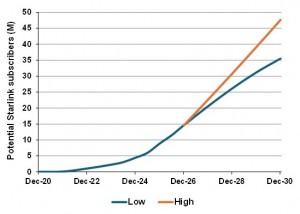
The report analyzes Starlink capacity density and terminal production and how these factors have constrained growth in recent years. It also discusses the limitations to future growth and how successfully Starlink will be able to compete with terrestrial alternatives in different countries. And the report compares the technology of Starlink and Amazon Leo to assess whether there is any realistic prospect of Amazon making significant inroads into Starlink’s subscriber base in the coming years.
Do you know the top 10 Starlink country markets (United States, Brazil, Canada, Argentina, Australia, Mexico, UK, Chile, France, Germany) and how many subscribers are in each country? Do you want to understand how Starlink’s growth in each country has changed since the price cuts in January, and why the price increases last month were so significant for Starlink’s future growth trajectory? You can even see why the various online estimates either significantly overestimate the subscriber base or get the regional distribution dramatically wrong.
This report will be followed up with a detailed set of projections for Starlink’s other business lines later this week, updating our previous company profile, and you can get both reports together at a discount. Or subscribe to the full research service and access our other reports from last year covering the D2D and professional satellite markets that Starlink competes in, plus all of our regular notes on key breaking news in the satellite sector for the next 12 months.
Permalink
02.08.26
Posted in Broadband, Financials, Operators, Regulatory, SpaceX at 2:29 pm by timfarrar
On Friday, redacted versions of two SpaceX financial forecasts, one from 2021 and the other from 2023, were disclosed in the Delaware litigation between SpaceX shareholders.
While only very limited numbers in the financial projections remain unredacted (beyond the expectation in the 2021 forecast that “government” revenue for Starlink would grow to $5B by 2027), there is enough that can be extracted to determine that Starlink has exceeded the 2021 revenue forecast, but Starship has fallen dramatically behind expectations even in 2023. The 2021 forecast helpfully used redactions matched to the number of characters, showing that Starlink was first expected to exceed $10B in revenues in 2026, while in actual fact Starlink passed $10B in 2025.
The projected valuations on the last page of this document also make it possible to back into the total company revenues forecast in 2021 and 2027: the $102.8B valuation was 25x revenues, implying a revenue forecast of $4113M for 2021. By 2027 this valuation was expected to have increased 4.9x, to around $500B, which was said to be 20x revenues, implying a revenue forecast of ~$25B for 2027. That again is slightly less than SpaceX’s likely total revenues in 2027, even if you remain skeptical about SpaceX’s ability to meet the current published 2026 forecast of $22B-$24B.
However, the 2023 forecast shows how SpaceX was expecting Starship to start launching Starlink satellites to orbit in 2024, with Falcon 9 phased out for Starlink launches in 2026. Now even on Musk’s optimistic timeline from December 2025, Starlink V3 launches on Starship aren’t expected “at scale” until “around Q4″ of this year. So Starship launches of usable payloads have now consistently remained 12 months out for nearly three years.
It’s also fascinating to me how the ongoing debate about orbital data centers tends to ignore launch constraints. SpaceX is just beginning to scale up to develop these “AI satellites”, but until now the emphasis for Starship has been on getting it ready to launch Starlink V3 in volume. That’s meant building extensive launch pad infrastructure in Florida and seeking permission for a high launch tempo there.
Florida is ideal for Starlink launches to 40 and 50 degree inclinations, which will be much more difficult in Boca Chica. However, Florida is a terrible location for sun synchronous launches, which is where these orbital data centers are supposed to go, to utilize maximum sunlight. Back in 2020, SpaceX conducted the first sun synchronous launch from Florida in more than 50 years, and has continued to launch some Transporter rideshare missions to sun synchronous orbits since then, but this requires a very fuel inefficient “dog leg” maneuver and so is only suitable for light payloads, not bulk launches of AI satellites.
Similarly, undertaking sun synchronous launches from Boca Chica would be extremely challenging (and potentially cause an international dispute), as these rockets would need to fly completely across Mexico, not over the open ocean. That’s why Vandenberg is typically used for sun synchronous missions, but SpaceX hasn’t even begun building a Starship pad there, and a high launch tempo is likely to be very politically controversial in California. So how exactly does SpaceX intend to get these AI satellites to the desired orbit?
Permalink
01.03.26
Posted in Broadband, D2D, Financials, Operators, Services, SpaceX at 11:52 am by timfarrar
The reactions to my comments last month on The Information’s TITV program about SpaceX needing a new story for its planned $1.5T IPO were fascinating, mainly because no one actually disagreed with the fact that SpaceX has consistently missed its targeted revenue growth over the last three years. Back in July 2023 SpaceX originally estimated revenues for the year would double to around $8B, before this whisper number was raised in November 2023 to $9B, with a forecast of $15B in 2024. That caused analysts such as Payload Space to come up with a figure of $8.7B for 2023, which is still often repeated as the actual figure, despite the NY Times finally confirming in August 2025 that SpaceX’s 2023 revenue was only $7.4B (with Starlink generating “roughly $8 billion” in revenue during 2024, implying a companywide total of ~$11B).
In 2025, SpaceX once again appears to have missed the revenue prediction of $15.5B that Musk stated publicly back in June, with Bloomberg reporting in its IPO coverage that “the company is expected to produce around $15 billion in revenue in 2025, increasing to between $22 billion and $24 billion in 2026.” That’s despite surging broadband subscriber numbers, which reached 9.2M by the end of the year as SpaceX dramatically cut the price of its terminals and reduced US residential service pricing to stimulate demand. Of course Starlink’s revenue growth is incredibly impressive, as is the speed with which it has come to dominate the satellite industry, but justifying an $800B current valuation (let alone a $1.5T IPO valuation), usually requires outperforming revenue guidance, not missing it.
Even so, it seems likely that SpaceX’s revenue target for 2026 will once again prove too optimistic, because ARPUs on those millions of customers are much lower than most analysts think (especially now there’s a $5 per month service option for suspended terminals). And the next generation D2D/DTC system won’t start launching in volume until “around Q4″ 2026 (at best since that depends on rapid progress with Starship), while SpaceX can’t access EchoStar’s AWS-4 spectrum until November 2027, so it can’t start offering a Band 70 DTC solution in the US with existing handsets until then.
It’s also undeniable that SpaceX needs more than just Starlink to justify a $1.5T valuation, given that even its expected lead investment bank, Morgan Stanley, only thinks Starlink revenues will get to $126B in 2040. So its understandable that the proposal for space-based data centers took center stage in last month’s reports of IPO preparations.
Curiously, however, data centers didn’t even rate a mention in Starlink’s end of year progress report, which focused instead on talking up the Starlink V3 satellites and the DTC constellation in particular as the key payload for Starship. And interestingly, in this progress report Starlink also modified the company’s September 2025 comments that “in most environments, [DTC] will enable full 5G cellular connectivity with a comparable experience to current terrestrial LTE service,” to instead promise that “in most environments [DTC] will enable full 5G cellular connectivity with a comparable experience to current terrestrial service.”
In many ways, Musk’s plan for space-based data centers offers a Rorschach test for potential SpaceX investors, just like Optimus does for Tesla investors. Both allow for near term demonstrations that look impressive but aren’t meaningfully revenue-generating, while allowing Musk to make long term projections of “infinite” revenues that can be (nearly) infinitely postponed.
In the case of Optimus, he’s claimed “humanoid robots will be the biggest product ever. Because everyone is gonna want one, or more than one,” while for space-based data centers, he’s claimed that “satellites with localized AI compute, where just the results are beamed back from low-latency, sun-synchronous orbit, will be the lowest cost way to generate AI bitstreams in <3 years. And by far the fastest way to scale within 4 years, because easy sources of electrical power are already hard to find on Earth."
Or put another way “Optimus and space data centers are two sides of the same coin…Optimus promises to provide all needed physical labor (and even better than a human!), while space data centers promise to provide all needed mental labor (and even better than a human!).”
But if you read yesterday’s WSJ piece on Optimus and think that Musk is simply lying again because “in public appearances, the robot is often remotely operated by human engineers” then you’ll believe the same is likely true of his plans for SpaceX’s space-based data centers. Conversely if you read that article and think that Tesla is making continued progress in opening up an untapped market opportunity where Adam Jonas “predicts that by 2050, humanoids will bring in $7.5 trillion in annual revenue across the industry globally,” you’ll probably have the same reaction about space-based data centers. And of course the latter are the investors that SpaceX actually wants for any IPO.
This is not to say that the market for either is non-existent: just like many companies are working on robots (with or without legs!), there is plenty of interest in space-based data centers. Both will also be particularly useful to the DoD, and especially in the space market the US government is seen as the best source of new revenue by many players right now.
And SpaceX has substantial advantages both in access to cheap launch, and in the ability to build a distributed network of data centers based on the Starlink V3 bus (which is a much better solution than a handful of extremely large space-based data centers several km in diameter, not least because achieving low latency requires the data center to be in view). However, that’s very different to saying revenue will be “infinite” or that this market can justify a $1.5T valuation for SpaceX.
But to return to my original interview, its particularly amusing to note the CEO of Starcloud suggesting in a subsequent TITV interview that this was “the dumbest thing I’d heard in a quite a long time”, because the dumbest thing I’ve heard in quite a long time is Starcloud’s business plan, which (if you take their story about launching huge arrays into space at face value) is essentially totally dependent on gaining access to Starship launches at cost.
Of course that means sucking up to Elon Musk is a necessity, but when one of SpaceX’s key competitive advantages for Starlink (and a key source of value in any IPO) lies in exploiting the huge difference between the cost and price of Falcon 9 launches, there’s no reason to believe that the same wouldn’t be true for Starship. In other words, SpaceX will be able to launch its own space-based data centers at a much lower cost, compared to the price of Starship launches for third parties, allowing SpaceX to gain far more scale than any other player at much lower cost, just as it has done with Starlink. In fact, I understand that all Starcloud has is some interesting in-space cooling technology, which only becomes valuable in extremely large arrays, and that’s unlikely to be useful if SpaceX’s distributed space-based data center architecture proves more cost effective.
Permalink
07.23.25
Posted in Broadband, Operators, Regulatory, Services, SpaceX at 12:12 pm by timfarrar
Last week, the Washington Post published an article about Starlink’s supposed capacity limitations, based on a paper from X-Lab. This is part of the larger fight over the future of BEAD funding and how much should be redirected from fiber to satellite, with a rival ITIF paper suggesting the opposite, that it’s a myth that “LEOs Don’t Belong in BEAD”.
SpaceX has also been lobbying hard on this topic, publishing a network update that notes speeds and latency have both been improving in the US, even with more than 2M active users, and regulatory chief Dave Goldman highlighting his conversations with the FCC, NTIA and others “about how Starlink will make gigabit speeds available to people across the country”. Countering that, several articles have been published suggesting that Starship might never succeed, which would mean SpaceX being unable to launch the larger V3 satellites that the company is “targeting to begin launching…in the first half of 2026″
As one might expect, the lobbyists take an extreme position and the reality is somewhere in the middle: fundamentally there must be some limit to how much it is worth spending on fiber deployment to the most rural and remote locations, when Starlink (and in the future hopefully Kuiper) can provide an high quality, cost-effective residential broadband service. But on the other hand, putting fiber in the ground is a long term investment and it is comparing apples and oranges to equate that to the cost of a Starlink user terminal that the company expects to have a useful life of three years.
The X-Lab paper suggests that Starlink shouldn’t be funded by BEAD in areas where the population density is more than 6.7 Broadband Service Locations (BSLs) per square mile (which corresponds to limiting the addressable market to just over 3M homes around the country). However, when Starlink had waitlists in parts of the US such as the Pacific Northwest in January this year (since replaced by “congestion charges”), these were in regions with an average of about 4-5 customers per square mile, based on Starlink’s estimated US subscriber base in the area deemed “sold out”.

Since not all households would be expected to actually subscribe to internet service, this suggests that Starlink has already seen plenty of demand in areas at or above the proposed 6.7 BSL per square mile density limit, and those customers certainly found it worth paying for, even if the uplink speeds often fell short of the BEAD benchmark. Regardless of when/if Starlink actually gets to orbit, even the current Falcon 9 launch tempo is allowing the capacity of the Starlink service to improve significantly over time, so this proposed cutoff seems too low in limiting where Starlink can usefully provide service.
More to the point, the calculations in the paper simply don’t match the actual constraints on the Starlink service. The assumption is that only one satellite can serve a given cell, but a Starlink user would realize that’s not how it works in practice because if you set up a portable Starlink terminal and take it down each evening, one day you may be told (by the app) to point it say northeast, and the next day you may be told to point it west. That’s because the system is load balancing across the multiple satellites serving a given cell.
At the moment, the primary constraint on the downlink is the FCC’s limit on spectrum re-use (known technically as Nco=1) which means Starlink can only serve a single cell once with a given channel across Starlink’s 2GHz of downlink spectrum (10.7-12.7GHz). While the efficiency of spectrum use varies (for example it’s lower for a Starlink mini than a regular terminal), a reasonable estimate is ~3-4bps/Hz. So 2GHz of spectrum would equate to a maximum of ~7Gbps in a cell, which isn’t too different to the 6Gbps assumed in the paper. However, the FCC has allowed Starlink’s Gen1 and Gen2 satellites to be counted separately for the purposes of the re-use limit, and so the current theoretical maximum downlink speed in a cell is actually twice this level. And now the FCC is consulting on loosening these limits further.
The X-Lab paper focuses more on the uplink capacity as the key density constraint and it is certainly the case that the amount of spectrum available to Starlink is more limited there, because only 500MHz of Ku-band spectrum is allocated to uplink (14.0-14.5GHz) compared to 2GHz for downlink. However, the primary determinant of uplink capacity for Starlink end users is the number of timeslots allocated to uplink transmission, because the network uses Time Division Duplex (TDD) and was originally only configured to support transmission up to 10% of the time. That was intended to ensure that the terminal cannot produce enough radiation to heat up the head of someone standing in front of it (what the FCC refers to as SAR limits). Over time SpaceX has been able to improve this percentage (now 15.5% of the time for uncontrolled use) and professionally installed terminals can go even higher. So there’s no reason to conclude that the supposed 0.4Gbps per beam assumed in the paper is a hard limit.
On the other side of the lobbying effort, the ITIF paper ignores the fact that the BEAD funding mechanisms are extremely poorly suited to fund satellite deployments, as I discussed in this thread on X/Twitter. BEAD has been set up so you bid for money to deploy infrastructure in a particular geographical area, regardless of how many customers actually sign up. That makes sense when funding fiber or even wireless infrastructure: if you build a tower or lay a fiber line, the only way to make a return is to sell service within that coverage area. However, if you fund a satellite operator to build more LEO satellites, then those satellites will spend only a tiny fraction of 1% of the time over that area as they go around the Earth, and can devote 99%+ of the orbit to earning money from more valuable customers. So there is no real incentive for a satellite operator to actually sell service to the unserved customers.
The best way to square this circle would be to provide affordability instead of deployment incentives (i.e. a subsidy for terminals and/or monthly service), so that the satellite operator only earns money when end users in these unserved areas actually sign up, which was how the Affordable Connectivity Program (ACP) was structured. Otherwise the satellite operator is getting paid for something they are already doing: Starlink has over 7000 satellites in orbit already and is launching dozens every week, why pay them to launch a few hundred more? One possibility is to structure reimbursement payments “based on the number of subscribers the provider serves and/or enrolls” rather than “in equal installments throughout the period of performance”.
And when it comes to bidding, why wouldn’t any satellite operator bid a very low amount for the right to deploy service in unserved areas? If they can prevent terrestrial broadband technologies like fiber and wireless from getting subsidies for deployment, then they have a captive market to themselves. Certainly if both Starlink and Kuiper are bidding against one another, and these reimbursements are independent of the number of customers served, it would be logical for their deployment bids to be particularly low, since the cost of simply making service available is essentially zero. We saw in the RDOF auction (when Starlink didn’t face any meaningful competition from other satellite operators) that SpaceX was able to undercut terrestrial technologies, but the fight over whether or not they actually were going to receive their $885M in winning bids, made absolutely no difference to the number of satellites that the company put into orbit.
So in conclusion, satellite has a great opportunity to enhance broadband service in rural areas, potentially in more places than the very lowest density parts of the country. But unless the BEAD payments are linked to the number of customers served, the program will not do a good job of helping consumers realize those benefits.
Permalink
07.14.25
Posted in Broadband, Financials, KVH, Maritime, Operators, SpaceX at 4:29 pm by timfarrar
As I told the Wall St Journal last week, the revenue growth reported in the newly filed accounts for Starlink’s international operations is amazing, in the context of a satellite industry that does not grow fast. In fact, Starlink’s near $2B of international broadband service revenues reported in 2024 compares to about $3B for all other satellite operators combined, a roughly 40% market share that has been obtained in only the third full year of Starlink’s operations.
However, that alone represents a warning sign: in order to grow further and faster, Starlink now needs to focus heavily on expanding the market beyond traditional satellite users, not just winning customers from other satellite operators (though of course they will do that too). And terminal prices are already getting lower and lower: Starlink’s consumer terminal revenues in these international markets averaged only about $230 per new terminal manufactured in 2024, so terminal subsidies in 2025 (with 5M terminals manufactured in the last 11 months) may end up being as high as $1B.
These accounts don’t represent the whole of Starlink’s business, they exclude direct US sales to individuals, businesses and the government, which account for more than half of Starlink’s revenues. We’ve just published a note giving a more detailed breakdown of these accounts by customer type and geography, as well as an assessment of the changes to our 100+ page Starlink profile that was published last October. Get in touch if you’re interested in subscribing to our research.
One additional area of interest in Starlink’s financial reporting is the large prepayments that the company has received, which have gone a long way to shoring up its cash position and allowing the company to claim it has $3B of cash on hand (at least before the company handed over $2B of that to xAI). At the end of last year Starlink’s international business had booked over $600M of deferred revenue from one or more counterparties and I’m sure there will be lots of speculation about the source of those payments.
One example of how (much smaller) prepayments work is given by KVH, which as a public company helpfully discloses this information, with enough granularity to allow all of the details to be worked out. We published a profile of KVH last November which discusses all of this, but as shown below, KVH entered into a purchase of 15PB of data for a total of $16.95M in June 2024 (i.e. a price of $1.13 per Gbyte), with the data to be consumed over 15 months (according to KVH’s 2025Q1 call, the “follow-on pool” will be renegotiated “at some point later this year”).
However, according to KVH’s Q1 results, the company is far short of this goal, only having consumed 30% of the total after 9 months, and even being generous in terms of future growth in KVH’s Starlink business, it will likely take until early 2026 for the data pool to be used up. So the question is what will Starlink and KVH do at the end of Q3? Roll the additional data into a new larger pool? Or forfeit perhaps $5M of prepaid capacity?

This highlights one of the challenges for Starlink distributors that commit to prepurchase large amounts of data at an attractive rate. Each time a distributor renews their capacity pool, they may end up more and more dependent on Starlink continuing to supply them with capacity, and less and less able to divert spending to other LEO systems, even if they want to be “network-agnostic.”
And what then for other competing LEO providers who are seeking distributors to sell their services? Which distributors will actually have any spare budget to divert to these other sources of capacity? And what about the risk that Starlink might someday decide not to rollover millions of dollars of unused capacity if a distributor looks elsewhere? That’s likely to add to fears that Starlink will dominate the satellite industry, as I discussed in an NPR podcast a few weeks ago.
Permalink
09.08.22
Posted in Broadband, Financials, Operators, SpaceX, Spectrum at 10:06 am by timfarrar
Up until 2020, I was very skeptical about the LEO broadband opportunity, and whether any of the planned systems would be able to raise enough money and build out a constellation that could deliver a service that is competitive with existing GEO operators. That skepticism seemed entirely justified after the failure of LeoSat in late 2019 and OneWeb’s spiral towards a bankruptcy filing in March 2020. SpaceX had also given wildly over-ambitious forecasts for Starlink’s revenue and timing, with projections for $6B of revenue in 2021, rising to over $30B in 2025.
But over the last two years, Starlink has launched a consumer broadband service that has upended the industry by providing vastly more capacity per subscriber than Viasat and Hughes, with a simple, easy to install terminal, and as of June 2022 already served over 400K users. Successfully developing such a system is an extraordinary technical feat when so many previous broadband constellation plans have failed. And after raising over $6B in the last 2.5 years at ever increasing valuations, SpaceX has been able to launch thousands of Starlink satellites and build scale that competitors will struggle to match.
I didn’t think that SpaceX would pull this off, but they did, and today too many people in the industry, who are rightly skeptical of Elon Musk’s litany of unfulfilled promises, remain far too complacent and are continuing to dismiss Starlink as just a consumer service that won’t threaten other parts of the satellite market, or are even suggesting that the network remains economically unviable and is doomed to failure.
However, the dam is starting to break for acceptance of Starlink amongst professional users, with Royal Caribbean’s recent move to deploy Starlink representing just the start of disruption in traditional satellite verticals. And SpaceX’s latest $2B in equity funding should see the company through to late 2023, by which time I expect Starlink to have captured around 1M users and have reached cash flow breakeven (even accounting for ongoing satellite replenishment costs).
That doesn’t mean Starlink (or SpaceX more broadly) will offer a positive return to those recent investors at the ludicrous valuation of $127B, because satellite will remain a last resort solution compared to terrestrial fiber, cable modem and even 5G fixed wireless options, but it does mean that there’s no reason to suppose that Starlink will cease to be an enormous competitive threat to the satellite industry in the foreseeable future.
One largely unrecognized issue in the LEO market is that there are significant benefits to scale, due to the virtuous circle that comes from adding more satellites to a constellation, as shown in the diagram below.

With more satellites in the sky, the user terminal antennas don’t have to scan as far to find a satellite to connect to, so they can be cheaper, with fewer antenna elements. And the altitude of the constellation can be lower, improving the link margin and capacity, and allowing the user terminal to operate at lower power. Capacity provisioning also becomes more uniform, as traffic loading can be averaged across multiple satellites, improving the quality of service. Starlink has been designed from the ground up to minimize the cost of the terminal, unlike traditional satellite systems (even recent designs like Telesat’s Lightspeed), which optimize the satellite and treat the terminal as an afterthought. Cheaper terminals and more capacity attract more users and generate more revenue, which can be fed back into building yet more satellites, making it ever harder for competitors to catch up.
So now we’re in a position where Starlink has clearly won the race for LEO broadband (at least for the next 4-5 years, since Amazon’s Kuiper won’t be completed before 2026-27), and is likely to become the largest satellite operator by revenue within that timeframe. Our new report on LEO broadband and the future of the satellite industry forecasts what this means for industrywide growth in revenue and traffic, and analyzes how satellite operators, distributors and equipment suppliers are likely to respond to what for many will represent an existential threat. The outcomes will include an acceleration of industry consolidation, decisions to exit, and even bankruptcies. The report also complements our June 2022 Starlink profile, which analyzes Starlink’s technology and forecasts Starlink’s revenue growth by segment. You can order one or both reports using the form here, or contact us to discuss subscription options for all of our industry analysis.
Permalink
04.05.20
Posted in Broadband, Financials, Operators, Regulatory, Services, SpaceX at 11:41 am by timfarrar
Eight and a half years ago, I wrote a blog post that got a lot of attention inside the FCC, comparing LightSquared’s request for a license that would give it a $10B windfall to the relatively small beer of the $535M Solyndra loan scandal. Despite knowing that LightSquared’s promise of an integrated satellite-terrestrial network was nonsense (not least because LightSquared had already told the FCC in November 2010 that the wholesale cost of its satellite data would be $10 per Mbyte), the FCC and White House offered strong backing for LightSquared right up until summer 2011 when political pressures became too great and their support was withdrawn.
Now it appears that the FCC’s LightSquared debacle could be exceeded by an even greater debacle in the satellite sector, because SpaceX is seeking to participate in the upcoming Rural Digital Opportunity Fund auction later this year, which will offer up to $16B of funding over 10 years to service providers that commit to offer voice and broadband services to fixed locations in eligible unserved high-cost census blocks. While the Wall St Journal highlighted competitors’ complaints a few weeks ago, SpaceX has now upped its demands even further, suggesting in a March 27 letter to the FCC that “the laws of physics” dictate that SpaceX should be allowed to bid in the highest performance tiers (which carry the most money per potential customer) because “far from [being] untested or hypothetical, SpaceX has already launched over 360 satellites and demonstrated that its network is capable of offering high-speed, low-latency service”.
That of course is complete nonsense, because the laws of physics aren’t the only factor determining the latency of a LEO constellation, especially one that is (or apparently was in SpaceX’s case) supposed to have onboard processing and crosslinks. For example, Iridium’s latency on voice calls is not actually much better than a GEO satellite network and certainly exceeds “the Commission’s 100-millisecond threshold for low-latency services” (this paper estimated it at “between 270-390 milliseconds”). In fact one should regard claims of extremely low (and improved) latency for Starlink’s current satellites as indicating that in reality some of the most important design features, such as onboard processing, have likely been discarded.
To date SpaceX has certainly not demonstrated anything whatsoever about the performance of its planned commercial voice and broadband services for consumers. Notably SpaceX has still not published details of its terminals (except to advise that the antennas will need mechanical steering, raising the cost significantly), and last year’s testing by the US Air Force onboard a plane did not even use a SpaceX antenna. Moreover, that test did not involve most of the operational elements needed to offer a scalable commercial service, such as provisioning and sharing of capacity between multiple users, because SpaceX simply dedicated an entire satellite to one user terminal.
In particular, SpaceX makes great sounding (but carefully worded) claims in its submission to the FCC that “SpaceX also specifically designed Starlink to provide high-speed broadband service, using advanced phased-array antennas that allow the system to automatically optimize service to certain locations and dynamically adjust its throughput per user” when in fact many features of the supposed “design” have not actually been implemented in practice. While some of those discarded design features, such as crosslinks, are well known, I’m told that to date the satellites also don’t have any ability to dynamically reallocate capacity between beams, because that was apparently “too hard”. Perhaps that’s not surprising, when SpaceX is writing the software itself, rather than looking to companies with actual experience in designing scalable satellite broadband networks, like Hughes and Viasat.
But what is truly outrageous in SpaceX’s submission is the suggestion that the FCC should now let SpaceX participate in an auction to win $16B of ratepayers’ money without ever providing service to a single consumer, because SpaceX has now pushed back the launch date until after the FCC’s planned October 2020 auction date. The latest letter states simply that (even if you are foolish enough to take Elon Musk’s ever-optimistic timelines at face value) “SpaceX will now begin to offer its Starlink broadband service for consumers—first in the United States and Canada—by the end of 2020″. Of course now that Starlink’s primary competitor, OneWeb, has gone into bankruptcy, the urgency of pushing Starlink forward as quickly as possible has diminished (not to mention SpaceX being short of money itself), and why would SpaceX now want to risk consumers experiencing a service that in the early days may not work very well, if at all, before the FCC auction takes place?
But as I pointed out a couple of weeks ago, bidders are not required to actually provide service to any specific number of customers at all in order to receive the RDOF funding, and instead are simply expected to use the funding to subsidize their buildout and make it available. So SpaceX could then take the FCC’s money, never provide service to a single customer that the money was meant to help, and reallocate its capacity to serve other users like the DoD anywhere within the country or even the rest of the world.
Perhaps the FCC and Congress, like the rest of us, are pre-occupied with the coronavirus, and think this issue should not be at the forefront of our concerns right now. But when Elon Musk has convinced many gullible people that Starlink will “catalyze enormous positive change, bringing, for the first time, billions of humans into our future global cybernetic collective” and so it would be “stupid to put one more federal dime into rural broadband when Starlink could solve the whole problem by later this year” it remains possible that SpaceX will be able to get away with this nonsense and walk away with billions of dollars of funding that were intended to help close the homework gap while we are all distracted.
Permalink
03.21.20
Posted in Broadband, Financials, Operators, Regulatory, Services, SpaceX at 12:36 pm by timfarrar
Over the last couple of months its been interesting to watch the maneuvering by SpaceX as it sought to raise its next funding round, in large part from a range of new investors with little or no knowledge of the satellite sector. My understanding is that the original ambition was to raise well over $1B, to be announced in conjunction with Elon Musk’s appearance at Satellite 2020, and attempt to flatten the competition as OneWeb struggled to complete its own planned $1B round.
SpaceX staffed up in anticipation of this new funding, doubling the staff in Boca Chica in February, which has increased the company’s burn rate even further. According to data disclosed at the time of the November 2018 debt funding round, SpaceX generated $270M of adjusted EBITDA in the 12 months to September 2018, but only by counting hundreds of millions of dollars of customer deposits, such as that paid by Japanese billionaire Yusaku Maezawa for his trip around the moon. As a result it seems clear that SpaceX was otherwise burning cash even in 2018, when its revenues were projected to be $2.5B+. And in 2019, revenues roughly halved as the number of launches fell from 21 to 13 (of which 2 were unpaid Starlink launches). So before the staffing ramp up in early 2020, SpaceX had already been burning over $100M per month in cash, and so far in 2020 four of the six launches have been unpaid Starlink launches, resulting in even less revenue now coming in the door.
In early 2020, a key objective was to raise enough money to last until the end of the year, when SpaceX anticipated that it would receive considerable funding from the DoD (we heard rumors that up to $1B was being sought) and planned to obtain billions more from the FCC’s Rural Digital Opportunity Fund auction (which was expected to start in October and will offer up to $16B of funding over 10 years to service providers that commit to offer voice and broadband services to fixed locations in eligible unserved high-cost census blocks). Importantly, bidders are not required to actually provide service to any specific number of customers at all in order to receive the funding, but instead are expected to use the funding to subsidize their buildout and make it available. While this is a rational approach for a terrestrial network that can only make a return on the investment to the extent that it is then able to win customers within the coverage footprint that has been built out, it makes no sense whatsoever for a satellite system that covers all customers immediately but can then reallocate its capacity anywhere within the country or even the rest of the world.
SpaceX downplayed expectations in February as rumors began to spread about its funding round, telling CNBC on February 21 that it was raising $250M to buy back employees’ shares (an obvious attempt to boost its hiring efforts), while hoping to maintain the element of shock and awe, just as happened in May last year when it launched 60 satellites, a far higher number than anyone had expected. As markets began to teeter, SpaceX had to be content with telling CNBC on March 9 that the company had “authorized” $500M in new shares, but when the Form D was filed on March 13 it became clear that investors had contributed far less than expected, with only $221M contributed to date and the round listed as just $250M. That’s no more than two months of cash burn at SpaceX’s current rate of spend.
Elon Musk’s appearance at Satellite 2020 didn’t go well, and was notable mainly for his comments that “zero LEO constellations haven’t gone bankrupt” and that he “just wanted to be in the not bankrupt category”. His obsession with the problems in closing the SpaceX funding round was also very evident from the fact that he was still tweeting about the market correction when he should have already been on stage.
So it’s hardly surprising that we now see reports that the Commercial Spaceflight Federation is asking for a bailout for SpaceX and other member companies and that Musk has adopted a high risk approach of criticizing the coronavirus as exaggerated and insisting that SpaceX remain open and working at full speed. But what articles suggesting that Tesla has the cash to weather the storm miss is that Musk’s most critical near term cash problem is now at SpaceX not at Tesla.
It’s hard to imagine the company changing course and abandoning either Starship or Starlink, which means the enormous cash burn will continue. However, the recent equity valuation of $36B is now completely untenable (especially if OneWeb collapses, as has been rumored this week), although a several hundred million dollar secured loan might still be a feasible option to tide the company over for several months. Nevertheless, unless Musk is proved right about the coronavirus and the markets improve quickly enough that new funding becomes available to SpaceX relatively soon, or alternatively the US government offers to bail him out (either publicly or with off the books money from the DoD), SpaceX is currently heading on autopilot towards a concrete wall of bankruptcy.
Permalink
12.12.19
Posted in Broadband, Echostar, SpaceX, Spectrum, ViaSat, VSAT at 4:47 pm by timfarrar
I was surprised to see last month that generally well informed observers like Om Malik were taking seriously (and even describing as “astute”) a blog post by Casey Handmer that suggests Starlink is a “very big deal” that will “catalyze enormous positive change, bringing, for the first time, billions of humans into our future global cybernetic collective.”
In order to justify that level of hype, Handmer claims that each satellite will cost $100K (which could “fall to $20k by the thousandth unit off the line”) and generate $30M in revenue during its five year lifetime, delivering “the ocean of gold needed to philanthropically build a self-sustaining city on Mars”. The first half of this claim is excessively optimistic unless the capabilities of the satellite are dramatically scaled down, which is already known to be the case.
For example, Starlink has abandoned crosslinks, at least for now, and would require a fundamental change in design and deployment in order to accommodate them: placing fragile movable RF antennas (let alone laser payloads which was the original plan) on the corners of the satellites would mean changing the current stacking and non-propulsive deployment mechanism and potentially implicate other characteristics like the stabilization of the satellite bus, due to the need for extreme pointing accuracy (especially for laser crosslinks). And the cost of a single phased array antenna on the ground can exceed Handmer’s supposed $100K cost for the entire satellite, which may be another explanation for why the current satellites are apparently operating in a fixed beam configuration.
But my primary focus is on the second half of the claim with regard to revenue, which is far easier to validate against terrestrial broadband benchmarks. In order to get to his $30M per satellite figure, Handmer assumes that a satellite will generate 100 beams capable of supporting 100Mbytes per second (800Mbps), i.e. a peak capacity of 80Gbps per second, with a loading factor of 100 seconds per 90 minute orbit (i.e. 1.85%) in order to carry 1000 GBytes of data per orbit. This peak capacity is significantly in excess of the figures in SpaceX’s own November 2016 FCC filing (which states an average aggregate downlink capacity of 20Gbps), and that filing doesn’t account for any reduction in capacity resulting from SpaceX being required to share spectrum with other satellite systems such as OneWeb.
However, Handmer’s assumed loading factor could be slightly on the low side (thought certainly not “ludicrously low” as he alleges), if Starlink was able to provide services all around the world. For example, Iridium’s (never filled) capacity for its first generation of satellites was just under 4% of the nominal peak capacity per satellite (1100 calls per satellite x 66 satellites = 38.2 billion minutes, but the system only had 1.5 billion minutes of saleable capacity per year).
On the other hand, SpaceX is planning to ignore the ITU spectrum priority rules (claiming merely that Starlink needs to initiate rather than complete coordination with other systens), which give OneWeb priority access to the NGSO spectrum and may block Starlink from gaining market access in many countries. And the low altitude of Starlink’s satellites, combined with the lack of crosslinks, means that providing services to ships and planes crossing the oceans and poles is not a feasible objective in the foreseeable future.
Combining these two factors, it appears that Handmer’s 1000Gbytes of saleable capacity per orbit will in reality be more like 250-500Gbytes per orbit (i.e. 2-4 times less), based on a peak capacity of up to 20Gbps (downlink plus uplink) and a loading factor per orbit of 2%-4%.
But the more important assumption is that this capacity will be sold at “a subscriber cost of $1/GB”. That figure is ludicrously overstated compared to the cost of broadband today. For example the average usage of Altice customers was 220Gbytes per month back in Q2 2018, while Charter’s median broadband usage in Q1 2019 was 200Gbytes with cord cutters averaging 400Gbytes per month. If we take a typical retail ARPU of around $60 then the retail price is $0.15-$0.30 per Gbyte and with consumer Internet data usage projected to increase by 160% between 2018 and 2022 (according to Cisco) the retail price of data on existing fixed broadband connections will soon be below $0.10 per Gbyte. So Handmer has overestimated the retail revenue potential per satellite for Starlink by at least 20-40 times.
Another, even more critical consideration is that the underlying cost of data delivery over fixed networks is much, much lower than the retail price. Back in 2016, Dave Burstein noted that it cost ISPs less than 1 cent per Gbyte to deliver internet traffic, and that figure is undoubtedly lower today. That’s the more appropriate basis for comparison with the cost of delivery for Starlink (unlike Handmer’s ridiculous comparison with an obselete 14 year old submarine cable, when most domestic internet traffic doesn’t even need to go outside the US), which (using our 250-500Gbytes per orbit figure above) would have a satellite capex cost alone of 0.7-1.3 cents per Gbyte over 5 years.
Then you need to add the cost of the ground segment and backhaul (certainly at least as high as the satellite capex), and most importantly, the cost of the user equipment, which will be much higher than the (less than $100) cost of a terrestrial cable modem and will far outweigh the cost of the satellites themselves. As CNN notes, “ground equipment may pose one of the biggest obstacles to success” and was probably the main reason why previous efforts like Teledesic folded.
Viasat spends $700 to acquire each satellite broadband customer of which roughly $300 is the end user equipment and installation adds another $150. But those are fixed dishes which do not need to track the satellites as they move across the sky. A Starlink terminal could easily cost $1000 or more, even with various compromises to reduce cost (such as narrowing the scan angle, though that will require a very large number of satellites, potentially several thousand, to be in orbit), before adding the cost of rooftop installation, let alone customer acquisition. And if each customer consumes say 500 Gbytes per month, then that will mean 250-500 terminals will need to be deployed to consume each satellite’s saleable capacity, implying incremental terminal costs of at least $250K-$500K per satellite (at $1000 per terminal).
To sum up, Handmer’s assessment that the satellites will generate revenue equal to 300 times their costs is fatally flawed. Even looking purely at retail revenues, then the revenues will be 20-40 times lower than he estimates, while the total system capex costs will be 4.5 to 7 times higher than he estimates (including ground segment costs of $100K per satellite and terminal costs of $250K-$500K per satellite). In the best case (and with unlimited demand!) that means retail revenues will be just over 3 times the capital costs, while in the worst case the retail revenues will only just cover the capital costs, ignoring ongoing operations, service and support.
When looking at the underlying costs of data delivery, it is also clear that Starlink’s costs will be meaningfully higher than the cost of terrestrial data delivery in areas with access to broadband, giving terrestrial rivals plenty of room to compete to retain their existing customer base (and ensuring that additional cost sensitive markets like cellular backhaul will remain out of reach).
So my conclusion is that while Starlink may be a “big deal” for the satellite industry (and for astronomers), it certainly isn’t a big deal for the terrestrial broadband market. In essence, under any plausible set of cost assumptions, Starlink’s bandwidth will cost more than current terrestrial broadband connections, and Starlink’s ability to disrupt a retail market where existing providers have existing infrastructure with enormous gross margins will be very limited. That’s nothing like Handmer’s nonsensical claims that “further launches will be funded entirely by providing better service to high density cities”.
Starlink may provide service for customers with no access to terrestrial broadband alternatives, but the satellite broadband market has fewer than 2M subscribers in North America and 1M users in the rest of the world combined, which Viasat, Echostar and others have spent the last decade trying to serve (and at least in North America have essentially saturated the market). So it seems unlikely that Starlink will do much better.
Permalink
« Previous entries Next Page » Next Page »