01.09.14
Posted in DISH, Financials, LightSquared, Operators, Regulatory, Spectrum, Sprint at 9:42 am by timfarrar

The announcement today that DISH is pulling its bid for LightSquared has thrown what was already a massively complicated and controversial bankruptcy case further into chaos, as we start the trial on whether Ergen’s purchase of LightSquared debt was illegitimate (and warm-up for a lengthy contested confirmation hearing over the next 3 weeks). Of course, the withdrawal of the bid completely undercuts LightSquared and Harbinger’s arguments that Ergen always knew DISH would come in and buy out his debt holdings and it will be interesting to see the effect on this part of the trial. Thus the withdrawal is certainly a logical move simply for that reason alone.
However, as we move forward into confirmation, there are two further possibilities to be considered. If DISH’s move is simply a strategic maneuver to undercut LightSquared’s lawsuit against Ergen, then it would be logical to expect DISH would ultimately give in when the debtholders attempt to force specific performance of the Asset Purchase Agreement (assuming the Ad Hoc debtholder reorganization plan is approved by the judge).
A second more intriguing alternative is that DISH and Sprint might be nearing a partnership deal, under which Sprint could use DISH’s satellite TV antennas (backhauled via a fixed wireless network using AWS-4 spectrum) for a 2.5GHz small cell hosting strategy in suburban and rural areas and DISH would resell Sprint wireless services. After all, if there is a near term deal to move forward with a wireless partner and an AWS-4 buildout, then the rebanding and delay associated with a DISH acquisition of LightSquared would probably cause more problems than it solves.
Certainly a hiatus in negotiations between DISH and Sprint seemed to be behind the leaks before Christmas that Sprint was planning a bid for T-Mobile and DISH’s rejoinder that it would consider a rival bid. Indeed one could view AT&T’s recent offer of a $450 incentive to T-Mobile customers as an attempt to kill any prospects of regulatory approval for a Sprint/T-Mobile tie-up. So from that point of view, Sprint’s only viable big move in the near term is a deal with DISH, and I’m told large scale deployment of such a network could double the total wireless network capacity available in the world today.
Another factor worth considering is that DISH’s move creates further uncertainty for the H-block auction as well, because (especially after Echostar’s purchase of Solaris, which has overlapping 2GHz band spectrum in Europe at 1995-2010MHz uplink and 2185-2200MHz downlink) the possibility that DISH will not decide to switch its AWS-4 uplinks to downlinks is back on the table.
Nevertheless, even if DISH doesn’t buy LightSquared, and no deal is ultimately worked out with Sprint, DISH could still come back and buy the 1695-1710MHz unpaired uplink spectrum in the FCC auction later this summer, likely at a lower price (and with rather less risk) than it would be taking with LightSquared – as unpaired uplink this band will probably sell for around $0.30 to $0.40/MHzPOP unless AT&T and DISH both bid aggressively against one another. So DISH certainly still has many spectrum options left on the table this year.
Today and tomorrow the LightSquared hearing will involve live testimony from both Ergen and Falcone about the debt purchases. Given that DISH’s maneuver has now undercut many of Harbinger’s arguments, and Ergen still seems to have plenty of cards up his sleeve, it will be interesting to see just how far Phil is out of depth in this great game.
Permalink
12.20.13
Posted in DISH, Financials, ICO/DBSD, LightSquared, Operators, Regulatory, Spectrum at 3:19 pm by timfarrar

As we head towards the holiday season, LightSquared’s attempts to find an alternative to being bought by Charlie Ergen are becoming ever more desperate, as the December 24 deadline to put forward an alternative plan approaches and the company takes a “time machine back to the summer…to formulate from scratch their own refinancing plan
…like the failed effort with Jefferies.”
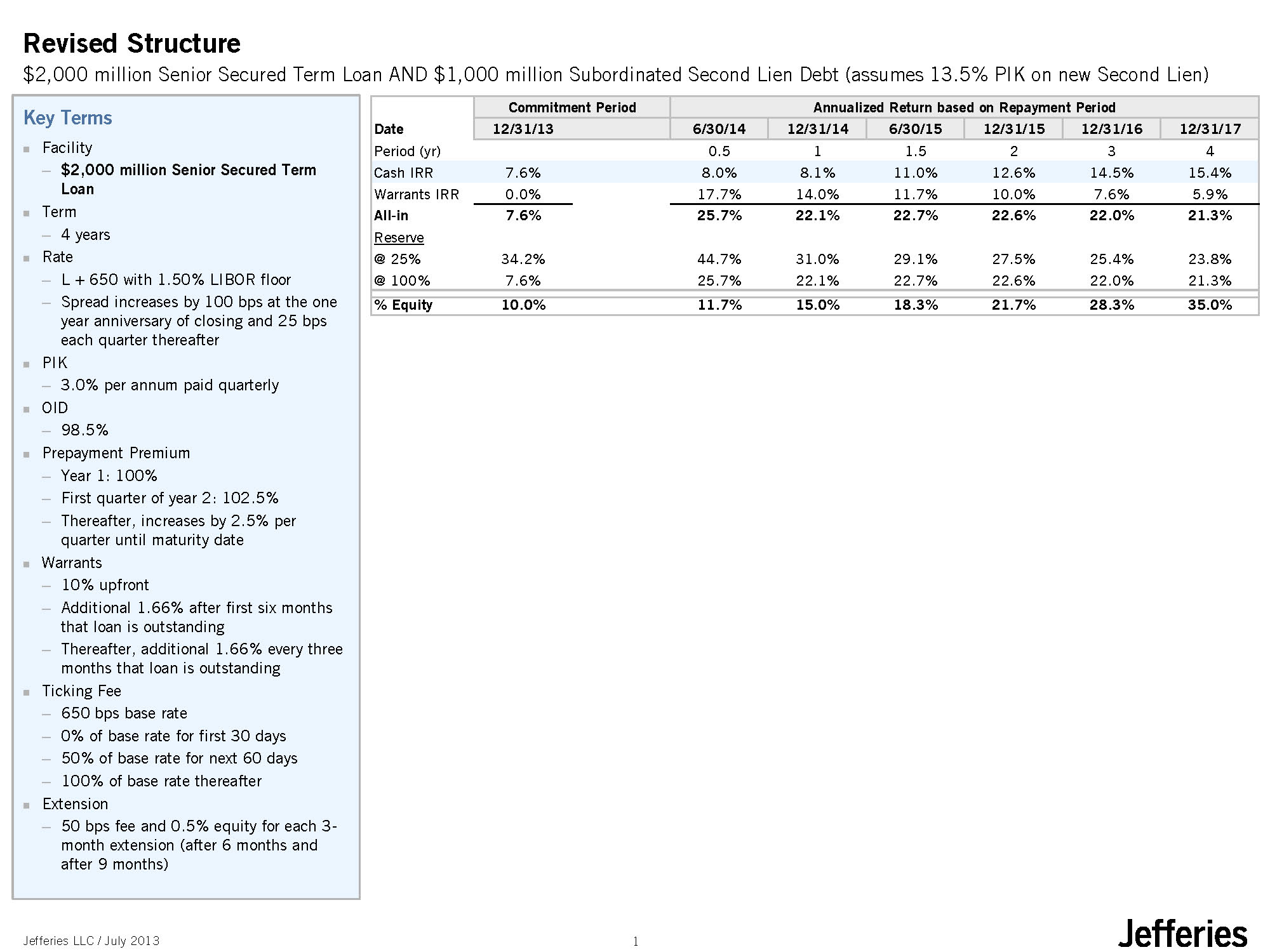
Reuters is reporting the terms of a $2B-$2.5B three year term loan to back a Fortress-sponsored exit plan as including 12% interest, all paid-in-kind, with an additional unspecified amount of equity injected into the company (presumably mostly achieved through rolling over existing investments). Unless a substantial amount of warrants are also included in this deal, the terms appear worse than those offered by Jefferies (and rejected by investors) back in July, which comprised mostly cash pay interest plus an ongoing ticking fee and substantial warrants.
We find it hard to imagine that the judge will be happy with a proposal which involves waiting another 6-9 months for an FCC decision, with no certainty at the end of the process, and which would presumably result in DISH terminating its non-contingent cash offer. Remember that there are numerous other uncertainties in the near future as well, including the resolution of LightSquared’s Mexican coordination negotiations, the Cooperation Agreement with Inmarsat, LightSquared’s difficult relationship with the DoD (which led to the termination of a contract accounting for one third of LightSquared’s total satellite revenue earlier this year) and most importantly the unprecedented amount of spectrum that will be auctioned by the FCC in 2014 and 2015. All of these issues are discussed in detail in our new 49 page LightSquared profile, released yesterday – please get in touch if you are interested in purchasing a copy.
The AWS-1 auction in 2006 provides one good example of how large amounts of new spectrum coming to the market can have a major effect on the perceived value of spectrum. Take for example ICO’s July 2005 Offering Memorandum, which suggested its spectrum was worth $1.64/MHzPOP, whereas after 2006, ICO had to use an AWS-1 benchmark instead (in that case the most optimistic number that could be justified was $0.73/MHzPOP for the 20MHz F-block spectrum).
One of the underrated issues that is still to play out in the bankruptcy (and a key sticking point in negotiation of DISH’s proposed Asset Purchase Agreement) was that DISH’s bid included acquiring all of the litigation rights of the LightSquared estate. The most obvious effect that would have is on LightSquared’s lawsuit against Ergen for buying up its debt. However, it would also have significant consequences for the suit against the GPS industry and potential litigation against the FCC: whereas LightSquared soon may have nothing to lose by employing scorched Earth tactics, we suspect DISH would look for a compromise that would be acceptable to all parties. Finally, DISH could even sue Harbinger on behalf of LightSquared investors who lost money as a result of the “guarantees” that there was no GPS interference problem whatsoever.
We should soon know if this will be Phil’s last gasp, so just like the Delorean above, he will find himself “OUTATIME” or if we will have many months more of uncertainty about the FCC process. Either way, it looks like it is no longer FCC Chairman Wheeler who will have an unhappy Christmas, but instead it will be Judge Chapman, who is charged with resolving the LightSquared bankruptcy case and now has to determine just how much of LightSquared’s “alarming and reckless” efforts to fend off DISH she will tolerate.
Permalink
12.11.13
Posted in DISH, LightSquared, Operators, Regulatory, Spectrum at 10:29 pm by timfarrar

Tomorrow FCC Chairman Wheeler plans to tell Congress that “we are not the Federal Courtesy Commission” with respect to the upcoming rulemaking on in-flight cellphone calls. However, that message could apply equally to the unwelcome prospect of Centerbridge’s bid for LightSquared, where the unexpected backlash over phones on planes may end up looking like a walk in the park compared to the renewed battle over approvals for LightSquared. After all, whichever way the FCC now rules will be “picking winners and losers” between DISH and Centerbridge and will undoubtedly end up making some people (including many politicians) very unhappy.
Earlier today I wondered what Centerbridge heard from the FCC during Reed Hundt’s lobbying meeting last week that gave them enough comfort to put together their $3.3B bid. However, it now appears that in fact Centerbridge’s bid is contingent on FCC approval of LightSquared’s so-called spectrum “swap” coming through very soon, presumably before the deal closes. Thus if the FCC doesn’t rule quickly in favor of LightSquared, the Centerbridge deal could fall through, and DISH would then be back in the driver’s seat with its original $2.2B bid.
Indeed, if the process is extended past February 15, then DISH’s offer could be withdrawn and LightSquared would be back at square one, so I suspect the bankruptcy court will require a firm commitment to be made by Centerbridge well before then. As a result, the FCC’s previous plan, to simply ignore LightSquared’s request and hope that it goes away after DISH buys the company, has now essentially become untenable.
So if Chairman Wheeler and his staff didn’t already have enough in their in tray (including ruling on DISH’s request for more flexibility in its use of the AWS-4 spectrum by the end of next week, in order to keep the H-block auction on track), he now has the prospect of spending the holiday period pondering whether to alienate the DoD, GPS industry and politicians opposed to a perceived spectrum “giveaway” to a reorganized LightSquared which will still count persona non grata (i.e. Falcone and Harbinger) amongst its major investors.
Given that Centerbridge’s plan is apparently simply to sell the LightSquared spectrum to AT&T or Verizon before the end of 2015 (when the new tranche of funding will run out), helping to make LightSquared viable is hardly going to do much to promote the FCC’s objective of more competition in the mobile market either (though who knows what will happen in reality, because Centerbridge will be trying to sell the spectrum in the midst of the most sustained period of major FCC spectrum auctions in history).
However, if approval is refused, then the alternative may be that the FCC has to face the prospect of LightSquared actually commencing its long threatened legal action against the Commission for blocking LightSquared’s ATC license. That’s because I assume that the LightSquared estate will now try to keep control of its causes of action rather than handing them to DISH if the Centerbridge deal falls apart, since the damages supposedly suffered by LightSquared investors as a result of adverse FCC action will now be much more explicitly quantifiable. Either way this decision is going to be tricky, and somehow I doubt Chairman Wheeler’s mood will be improved by the knowledge that several of his predecessors are already working for Phil Falcone.
Permalink
Posted in DISH, LightSquared, Operators, Regulatory, Spectrum at 10:07 am by timfarrar

Its rather ironic to see the headline in the WSJ today, proclaiming that “A Gold Rush Hits Wireless Spectrum” on the same day as LightSquared’s bankruptcy auction takes place. While I’ll address the gold rush silliness in another post (although I note that amazingly enough MAST apparently still wants to fight with Ergen over the H-block), behind the scenes of the LightSquared bankruptcy there’s been a lot of activity over the last three weeks, as LightSquared and Harbinger tried to pull together a consortium to keep the company out of DISH’s hands (and submit a more credible reorganization plan).
Just before Thanksgiving, the “interest” of Fortress and Centerbridge was leaked to the WSJ, in an attempt to persuade other firms to become involved and to pressure the FCC to move forward. The auction itself was even delayed until today, to give more time for an FCC ruling (or at least some sign that the FCC would rule on LightSquared’s request), because many potential investors thought it was simply too risky to participate without any signal from the FCC that the proposed spectrum “swap” had a chance of being approved.
However, the FCC appears unmoved, despite some last ditch in-person lobbying by former FCC Chairman Reed Hundt on Thursday Dec 5. That’s the second former FCC Chairman that LightSquared has sent to the FCC to lobby for them in recent months! This filing highlights that Centerbridge has been working hand in hand with LightSquared in order to try and outbid Ergen. The rationale behind Centerbridge’s interest is unclear, as I’m told they were not a previous investor in LightSquared, but appears to relate to a belief in the opportunities of the spectrum “gold rush”.
That’s different from Fortress, who own a substantial amount of LP Preferred Shares, which would be largely wiped out by DISH’s bid and so are likely motivated primarily to protect their existing investment. Fortress’s LP Preferred investment would receive only a modest recovery as a result of DISH’s bid, despite Ergen’s earlier agreement last April to purchase Fortress’s preferred shares at 95 cents on the dollar, as this purchase was blocked because SPSO is certainly an “affiliate” of DISH (the term used in the shareholder restrictions), even if its not a “subsidiary” (as used in the term loan restrictions). However, with the LP Preferred being next in line for a recovery, even pushing DISH’s bid up by $100M-$200M would provide a major benefit to Fortress.
UPDATED (12/11): It seemed that because everything had been so quiet in recent days, LightSquared might have been unable to gain enough backing for their bid, presumably because the FCC appeared to have been unmoved by Hundt’s entreaties. However, its now being reported by the WSJ that LightSquared postponed the auction to try and thrash out a deal with Centerbridge, which has resulted in a $3.3B tentative deal. I would expect that to include all of the company (and for Centerbridge to assume the Inmarsat Cooperation Agreement largely in its current form), so that Centerbridge would pay off the Inc holders and continue to pursue the spectrum “swap” with the FCC and the litigation against the GPS industry. Notably Harbinger could now potentially also stand to benefit substantially if Ergen’s $1B debt claim was ultimately disallowed as a result of the litigation, because there will be no debtholders ahead of them with higher priority bankruptcy claims.
If the $3.3B Centerbridge bid becomes firm, I wouldn’t expect DISH to bid even more, although it would remain the backup bidder through Feb 15 if the Centerbridge offer falls apart. DISH would have other options for uplink, including the 1695-1710MHz band which will be auctioned in 2014. However, if DISH did instead ultimately emerge as the winner, there would still need to be significant negotiations over the DISH Asset Purchase Agreement, which apparently has some areas of disagreement (not least over DISH’s request for certain releases (including for Ergen’s purchases) and for its purchase to include all causes of action of the LightSquared estates against the GPS industry, FCC, Inmarsat and Harbinger, etc.). If it came to that, I’d expect that issue in particular to require the intervention of the judge, and of course her ruling would therefore also determine whether LightSquared’s lawsuit against Ergen would continue as currently scheduled. In that event, a very interesting question would be whether DISH actually has an out in the event that no resolution is reached over the asset purchase agreement or whether the judge can force DISH to follow through with its bid, even if the final terms of the asset purchase agreement were not acceptable to DISH.
Despite all of LightSquared’s and Harbinger’s efforts, it would hardly be surprising if the FCC proves unwilling to act on LightSquared’s requests, because DISH has made it clear that it is not interested in the spectrum “swap” (see LightSquared’s recent motion for an extension of the use of cash collateral which states “As the Court is well aware, LBAC is not interested in LightSquared’s downlink channels or resolution on the series of applications LightSquared has filed with the FCC…LBAC is only interested in LightSquared’s uplink channels”).
Given that, why would the FCC give spectrum away for free to LightSquared (or even forgo an auction) when DISH would drop this request if it won the bidding, especially at a time when the FCC is under considerable pressure to raise as much money as possible from spectrum sales? Even selling the 1675-80MHz band of spectrum to LightSquared for the $300M assumed in the White House budget would inevitably lead to accusations of favoritism (because the price would be equivalent to only $0.20 per MHzPOP), so why wouldn’t the FCC simply auction this spectrum along with other bands, once the appropriate rules have been put in place?
On the other hand, Centerbridge must have come away from Friday’s meeting feeling somewhat comforted by the discussion with the FCC, so perhaps the compromise could be to auction the 1675-80MHz band along with AWS-3 and 1695-1710MHz next summer? Certainly the FCC is now in a much trickier political position if the Centerbridge bid goes through, compared to the prospects of DISH getting them out of the LightSquared mess.
Despite Phil’s efforts to hire the best lobbyists (and lawyers) that money can buy, even if the Centerbridge bid succeeds, it therefore seems like it will still be a struggle to put LightSquared together again. We’ll be publishing our latest report on LightSquared, DISH and the related spectrum issues later this week, including an analysis of why LightSquared suddenly lost one third of its total revenues earlier this year (hint: the DoD really doesn’t like them…). Contact me for more details if you are interested.
Permalink
11.01.13
Posted in DISH, Globalstar, Iridium, Operators, Regulatory, Spectrum at 7:52 pm by timfarrar

So, as many expected, Globalstar’s NPRM finally emerged from the FCC tonight, before the new Chairman, Tom Wheeler, is sworn in on Monday. It appears that Wheeler has had a strong influence on the rather subdued language in this NPRM, which takes a much more equivocal stance than similar NPRMs (and has even been toned down compared to previous drafts, or so I’m led to believe).
As the language perhaps reflects Wheeler’s more cautious stance compared to former Chairman Genachowski’s “full speed ahead” approach, it is hard to predict what this will mean for Globalstar’s potential approval process. However, it is clear that it will take some time, because the FCC is seeking detailed technical studies from commenting parties, and has set a relatively long comment deadline of 75 days after publication in the Federal Register (i.e. January or February 2014).
Nevertheless, it is instructive to compare the language to DISH’s AWS-4 NPRM in March 2012, especially as that is the model that Globalstar sought in its petition, which stated that “the Commission’s rulemaking proposal on terrestrial use of Big LEO spectrum should incorporate a number of the basic reforms proposed by the Commission in the 2 GHz NPRM”. As a starting point, the DISH NPRM set a comment period of 30 days after publication, but more notable is how definitive the DISH NPRM was about its intentions:
DISH: “In this Notice of Proposed Rulemaking, we propose to increase the Nation’s supply of spectrum for mobile broadband by removing unnecessary barriers to flexible use of spectrum currently assigned to the Mobile Satellite Service (MSS) in the 2 GHz band”
Globalstar: “By this Notice of Proposed Rulemaking (Notice), the Commission proposes modified rules for the operation of the Ancillary Terrestrial Component (ATC) of the single Mobile-Satellite Service (MSS) system operating in the Big LEO S band”
DISH: “With this proceeding we intend to fulfill the Commission’s previously stated plan to create a solid and lasting foundation for the provision of terrestrial services in 40 megahertz of spectrum in the 2 GHz band”
Globalstar: “For all the reasons stated herein, we believe that Globalstar’s proposal to deploy broadband access equipment should be further examined and a record developed to determine whether this proposal has the potential to enable more efficient use of Globalstar’s S-band spectrum and spectrum in the adjacent band. This action could potentially increase the amount of spectrum available for broadband access in the United States”
DISH: “According to Cisco Systems, North American mobile Internet traffic more than doubled in 2011 and is expected to grow over 15-fold in the next five years. This explosive growth is creating an urgent need for more network capacity and, in turn, for suitable spectrum”
Globalstar: “The rapid adoption of smartphones and tablet computers, combined with deployment of high-speed 3G and 4G technologies, is driving more intensive use of mobile networks. According to Cisco Systems, global mobile Internet traffic is expected to grow over 13-fold from 2012 to 2017″
DISH: “In this Notice of Proposed Rulemaking (AWS-4 Notice), we build on the Commission’s recent actions to enable the provision of terrestrial mobile broadband service in up to 40 megahertz of spectrum in the 2000-2020 MHz and 2180-2200 MHz spectrum bands. We propose terrestrial service rules for these spectrum bands that would generally follow the Commission’s Part 27 rules, modified as necessary to account for issues unique to the 2000-2020 MHz and 2180-2200 MHz spectrum bands. Given the proximity of these spectrum bands to spectrum bands previously identified as AWS, in our proposal we refer to these spectrum bands as “AWS-4″ or “AWS-4 spectrum”
Globalstar: “We believe that Globalstar’s proposal to deploy a low-power terrestrial system in the 2473-2495 MHz band should be examined to determine whether it is possible to increase the use of this spectrum terrestrially in the near term, without causing harmful interference to users of this band and adjacent bands, and without compromising Globalstar’s ability to provide substantial service to the public under its existing MSS authorization. If supported by the record, this action could potentially increase the usefulness for terrestrial mobile broadband purposes of 11.5 megahertz of licensed spectrum. As a result, these changes may induce increased investment and innovation throughout the industry and ultimately improve competition and consumer choice. Therefore, we propose to make the changes to Part 25 of the rules necessary to provide for the operation of low-power ATC in the licensed MSS spectrum in the 2483.5-2495 MHz band”
(note that Globalstar also sought to operate under Part 27, which the Commission rejected, and I’m told that an earlier draft of the NPRM also contained a proposed new name for this band, although not the “AWS-5″ designation that Globalstar had sought)
As far as the specifics of the NPRM proposal goes, it appears that the FCC has gone along with Globalstar’s requested TLPS power and OOBE levels, while highlighting that “significant concerns have been raised about potential detrimental impact on unlicensed devices, such as Bluetooth, that are currently used extensively for various wireless broadband services and applications”. However, there are a number of lurking issues, such as the process to be used for approving any changes to devices to use the new service (which will fall under Part 25 so would normally require a new FCC ID to be granted for an existing Part 15 device operating in the WiFi band).
In addition, proposed use of Part 25 along with a simple modification to the existing ATC rules to require TLPS to be permitted (so long as Globalstar can “demonstrate the commercial availability of MSS, without regard to coverage requirements”), could make it harder to get LTE approval in the future, especially in the L-band, where the FCC warned Globalstar that “Should we find it to be appropriate, the Commission reserves the right to consolidate this proceeding with any proceeding addressing Globalstar’s L-band proposal and Iridium’s petition for rulemaking” (creating a risk that some L-band spectrum could be reallocated to Iridium if Globalstar pushes for LTE authorization: the FCC quietly issued a public notice seeking comment on Iridium’s petition for reallocation of L-band spectrum on Friday as well).
So now the question is whether Wheeler will be prepared to work through these issues, face down the interference concerns and push through a final order approving TLPS, or if he will instead prioritize the 3.5GHz band, where a public notice was also issued today (with a much shorter comment cycle), seeking further comment on how “Priority Access” licenses (which as I’ve remarked before could be somewhat similar to TLPS) might be allocated for exclusive use.
UPDATE (11/3): Globalstar’s press release noted that the release of the NPRM “represents a seminal development and yet another step forward in Globalstar’s renaissance”. However, unlike in September, when the NPRM was circulated, its notable that the company didn’t say that it was “very pleased” with the FCC’s action. Globalstar’s comment that “We look forward to receiving the public’s comments and working towards a final order over the next several months” is also a curious description of a process where reply comments won’t even be received for 3.5 months after publication of the NPRM in the Federal Register.
Permalink
10.14.13
Posted in DISH, Financials, LightSquared, Operators, Regulatory, Spectrum, Sprint at 10:51 am by timfarrar

As others have noted, in order to get a 700MHz interoperability deal, which will largely benefit Verizon and AT&T (as AT&T are now the only plausible national user of the A block spectrum and are likely to acquire both Verizon and Leap’s spectrum holdings in this band), DISH has secured a pretty good deal in Washington from interim FCC Chairman Clyburn: in exchange for DISH agreeing to low power use of the 700MHz E block (and bidding $0.50 per MHzPOP in the H block auction), DISH appears set to obtain an option to reband its AWS-4 uplinks to downlinks and an extension of the AWS-4 buildout milestones.
UPDATE (11/13): T-Mobile is raising $2B for spectrum purchases and is now rumored to be contemplating a bid for Verizon’s 700MHz A block spectrum. This would only give T-Mobile a 5x5MHz LTE network, which would not add much capacity in urban areas, but if T-Mobile is seeking to improve its rural coverage then it would have to buy other A block licenses as well.
This gives DISH a significant advantage both in the upcoming LightSquared bankruptcy auction, where no-one really expects any alternative bidder to emerge for the L-band spectrum, because the FCC has all but guaranteed it will not propose the so-called spectrum “swap” that LightSquared has asked for: it’s understood that Ergen will simply drop the request when he buys LightSquared’s satellite assets, so there is no point in the FCC annoying those in Congress who would want to see the 1675-80MHz spectrum band auctioned instead.
More importantly, if DISH is given an option but not an obligation to reband the AWS-4 uplinks (DISH has asked for 30 months to decide, but I would expect the FCC to only allow 12-18 months at most), then it also has a huge advantage in the H-block auction, because if Sprint were to win the spectrum then DISH could hold up standardization of the band (and delay any ability for Sprint to use the H block to relieve capacity constraints in its PCS G block LTE network). After years of experience in being held hostage by Ergen, its therefore hardly surprising that the smart move for Sprint will be to let DISH have the H block at the reserve price. That will force DISH to drive the standardization efforts, and potentially even allow Sprint to put roadblocks in DISH’s way instead of vice versa.
UPDATE (11/13): Both T-Mobile and Sprint have now ruled out bidding for the H-block spectrum. So it seems that both have made the smart move by leaving Ergen to contemplate what to do with ~80MHz of spectrum and no partners.
Moreover, it will establish a low benchmark price for the rest of DISH’s spectrum holdings, well below the $1.00 per MHzPOP that many analysts have been touting recently, and Ergen will then have doubled his bets on spectrum to roughly $8B, when taking into account both the LightSquared and H-block spectrum, without any clear route to monetization. With AT&T focused on European expansion and Verizon encumbered by the debt from buying out Vodafone’s stake, Sprint could then hope to hold the whiphand in any partnership negotiations with DISH.
Indeed next year’s auctions of 70MHz of additional spectrum (AWS-3, 1695-1710MHz and J block) may further impact perceptions of spectrum value: a $0.50 per MHzPOP valuation will again be ample to cover the costs of clearance plus the $7B needed to fund FirstNet. That is the FCC’s key objective in the upcoming spectrum auctions, so it can limit AT&T and Verizon’s participation in the 2015 broadcast TV incentive auction and ensure that Sprint and T-Mobile gain sufficient low frequency spectrum to preserve a four player market after the next presidential election. Once no net revenues need to be raised from the incentive auction, then it won’t matter if AT&T and Verizon refuse to participate, as that would simply keep the price low for Sprint and T-Mobile (or ensure that not as much broadcast spectrum is cleared).
However, rather than negotiating with Sprint on their terms, I expect that Ergen will instead pursue a merger with DirecTV, as an alternative to any wireless partnership, and I still expect a commitment to build out a fixed wireless broadband network with rural coverage to be key to getting regulatory approval for such a deal. Nevertheless, if DirecTV doesn’t put as much value on DISH’s spectrum holdings as Ergen does, it may be difficult to reach agreement on the respective value of the two companies. As a result, while Ergen builds his tower of spectrum cards ever higher, it will be interesting to see whether investors stay confident that he can ultimately create substantial value from these holdings.
Permalink
09.23.13
Posted in DISH, Financials, LightSquared, Operators, Regulatory, Spectrum at 9:34 am by timfarrar

Tomorrow’s hearing in the LightSquared bankruptcy case was supposed to be the showdown at which the judge would decide between LightSquared’s own proposed bidding procedures (which attempt to reject Ergen’s $2.2B bid for the company) and the alternative bidding procedures which have now been proposed jointly by the LP and Inc secured creditors (and would accept Ergen’s stalking horse bid). However, LightSquared has appointed an independent committee of its directors (including a new member, Donna Alderman, who fought with DISH over the resolution to the DBSD case) and this committee (whose independence is disputed by the LP creditors) has requested that the hearing be delayed until September 30.
Of course, no-one is taking seriously the alternative plan proposed by Harbinger, which would simply keep the existing debt in place (converting it to PIK interest) and allow Harbinger to stay in charge, but LightSquared’s plan would allow it to deem a non-cash bid, contingent on FCC approval, superior to DISH’s cash bid, which could potentially further delay a resolution of the case. In contrast, under the secured creditors plan, any competing bid must be non-conditional on FCC approval, making it hard to see how any strategic buyer could emerge – although since potential bidders have already had two months to make an offer, and none have done so, it is likely that no-one else other than Ergen is actually interested.
LightSquared spent last week groveling to the FCC, suggesting that “The current stalking horse bid might be the only one submitted, if the FCC does not make its decisions quickly, because the company’s assets cannot be fully valued until the Commission acts on the pending modification applications.” However, the FCC’s recent grand bargain with DISH and AT&T over the 700MHz A and E blocks, AWS-4 downlinks, and the PCS H block auction makes it pretty clear that the FCC would prefer DISH as a buyer of the LightSquared assets, so that just the L-band uplinks would be used, rather than Harbinger getting a spectrum “swap” (which in reality would represent another windfall and lead to more criticism in Congress).
Given Phil’s troubles with the SEC, its hardly surprising that Chairman Mignon Clyburn would now choose DISH over Harbinger. That’s in contrast to my post last year asking if Phil was finally right about something with his comment that “Everyone knows Ergen is not going to build out a network. No one trusts him, including the FCC. They are not going to put their eggs in that basket because they know he will make them look foolish” (which prompted this response).
Harbinger’s attempt last month to sue the GPS industry for $1.9B also appears to have backfired, with LightSquared creditors pointing out that Harbinger was violating the bankruptcy exclusivity order by asserting claims of the estate. Moreover, this action, coming immediately after the FCC put LightSquared’s request for uplink approval on public notice, appeared likely to delay rather than expedite any regulatory approval from the FCC. Not only has Phil therefore caused further angst in the bankruptcy case, but I’m told that he is also struggling to find a credible plaintiffs firm to take the lawsuit forward, while the GPS industry have hired Boies Schiller to fight their side of the case. So perhaps now is the time to ask if Phil can get anything right?
Permalink
09.19.13
Posted in Financials, Globalstar, Handheld, Inmarsat, Iridium, Operators, Regulatory, Services, Spectrum at 9:32 am by timfarrar

Why didn’t Phil think of this first?
With MSS revenues in a bit of a funk this year, its not surprising that MSS operators are pursuing opportunities to attract consumers and expand the voice market outside the traditional verticals. We saw this first of all with Thuraya’s SatSleeve, announced at the Satellite 2013 conference in March. The SatSleeve connects via Bluetooth (and in the latest version WiFi) to an iPhone allowing the customer to use their iPhone contacts and touch screen interface. However, a key limitation is the need for compatibility of the sleeve with a particular phone form factor, and Thuraya has just launched a new version of the SatSleeve compatible with the slightly larger iPhone 5 handset rather than the original iPhone 4.
One way to overcome this handset compatibility issue is to use an external puck-like device, similar to a SPOT Connect or DeLorme inReach product, but offering voice and data capability in addition to simple messaging. This concept has been around for many years, and indeed was part of Craig McCaw’s new business plan when he bought ICO out of bankruptcy back in 2000: ICO told the FCC in its original ATC application in March 2001 that
“The use of already-permitted wireless technology such as Bluetooth or IEEE 802.11 could allow a whole range of consumer devices – standard terrestrial phones, PDAs, or laptop computers – to communicate with a satellite transceiver that houses the antennas, amplifiers, and other electronics unique and specific to the satellite link”.
Subscribers to my MSS research service heard 6 weeks ago about Iridium’s new handheld product, scheduled for launch at the end of the year, which is apparently exactly this puck-like device. It will be positioned to compete at the low end of the handheld market with a broadly comparable price to Thuraya’s SatSleeve (which was originally announced at $499 but is now selling for $599 to $799) and the Inmarsat and Globalstar handheld phones. I’m now told that Inmarsat is working on a similar device for release towards the end of next year, and meanwhile Globalstar has announced that it is “aiming to bring a $100 satellite device to market in 18 months time…to enter into a totally different market”.
I understand that Globalstar’s new device is likely to be the long-awaited two-way SPOT product, and may not be voice-capable like Iridium and Inmarsat’s new devices. It remains unclear whether the form factor will be a smartphone-connected puck (like SPOT Connect) or a standalone device: certainly the standalone device has sold much better for Globalstar to date, but equally well this might make it harder to expand beyond the current market of techie-focused backpackers and outdoorsy people (the vast majority of SPOT users are like me: 40-something relatively high income males with an interest in technology). Given the 18 month timetable stated by Globalstar, its also unclear whether this would be based on the new Hughes chipset or the current SPOT uplink plus a similar downlink channel, as the second generation ground segment upgrades are supposed to take about two more years to complete.
As Globalstar moves to raise its profile with investors, it seems the next stage will be a new round of fundraising (Globalstar noted in its 2013Q2 10-Q that “In June 2013, the Company entered into an agreement with Ericsson which deferred to September 1, 2013 or the close of a financing approximately $2.4 million in milestone payments scheduled under the contract”), presumably helping to reduce some of Thermo’s $85M backstop commitment (of which $40M had been provided by the end of July and $4.4M had been offset by receipts from termination of the 2009 share lending agreement). Indeed, it would be plausible for fundraising to go beyond this ~$35M level given the rise in Globalstar’s share price in the expectation of a positive outcome from the FCC, though it appears unlikely Globalstar will order more satellites anytime soon, given that the legal disputes with Thales are apparently still ongoing (Thales has “alleged that Thermo had failed to pay Thales $12,500,000 by December 31, 2012 as required by the Settlement Agreement“).
It seems Globalstar is highly confident that its NPRM will be issued by the time Chairman Clyburn leaves office, so it would be reasonable to suspect that this new financing is intended to take place in the next month or so, helping to cover payments of $20M+ due to Hughes between August 2013 and January 2014). Last week’s grand bargain over the 700MHz A&E blocks, DISH’s AWS-4 downlink waiver request and the H block auction, certainly indicates that I was too pessimistic in believing that Clyburn didn’t want to address spectrum issues and would leave these for Wheeler, and it would therefore now not be in the least bit surprising to see the Globalstar NPRM released at or around the time of the September FCC Open Meeting (when Clyburn will have what might be the last chance to trumpet her accomplishments as Chairman). Clyburn also appears less likely than Wheeler to pursue the “harm claim threshold” approach favored by the FCC’s TAC, which is good news for Globalstar in terms of how long it would take to issue an FCC order, although given that the FCC highlighted the speed with which it had moved to complete the DISH ruling last December (within 9 months of issuing the NPRM), it is still hard to imagine a final ruling on TLPS before early summer 2014.
So the key issues for Globalstar are likely to be how successfully it can build up its MSS business (note that the revenue projections given for the bank case in the new COFACE agreement generate just enough cash to cover debt, interest and capex payments through 2022 but little else) and more importantly whether Globalstar can find a partner to exploit its spectrum assets. We know about Amazon, but will there be other interest either from the cellular industry or (perhaps more plausibly) from non-traditional players? What are the best comparisons for spectrum valuation for TLPS and/or LTE authorization? I’ll be publishing my updated profile of Globalstar shortly and all of these issues will be discussed along with my revenue projections for the MSS business.
Permalink
09.12.13
Posted in Clearwire, DISH, Financials, Inmarsat, LightSquared, Operators, Regulatory, Spectrum at 3:39 am by timfarrar

DISH’s submission to the FCC earlier this week, offering concessions on 700MHz E block power limits (thereby securing support from AT&T), and the prospects of a bid of up to $0.50/MHzPOP ($1.5B) for the PCS H block, in exchange for the option to use the 2000-2020MHz AWS-4 uplink band for downlink operation, confirms that DISH’s plan is to use LightSquared’s L-band spectrum for uplink operations. That would presumably be paired with the 2180-2200MHZ AWS-4 downlink, which would give DISH the opportunity to offer the 2000-2020MHz band as supplementary downlink for PCS operators. It also confirms that DISH’s two targets for a potential partnership are now AT&T and Sprint, since they will be the two main LTE operators in the PCS band, and strongly suggests that DISH no longer has any interest in buying T-Mobile (though a deal with DirecTV remains plausible in 2014).
Its important to remember that now it hasn’t got access to the Clearwire spectrum, DISH is essentially offering a partnership under which it would host AT&T or Sprint’s mobile spectrum (most likely in the WCS and BRS/EBS bands respectively) on its planned fixed broadband wireless network (which would use the AWS-4 downlink and L-band uplink for backhaul). In other words, DISH becomes a tower company, offering small cell hosting for as little as $100-$200 per cell per month, because DISH’s wireless broadband subscribers will be providing the site (on their rooftop satellite TV antenna) and the power for free.
If DISH secures auxiliary PCS downlink spectrum then it will also have an even more attractive set of additional spectrum to lease to AT&T or Sprint for their macrocell rollouts. That’s in addition to the 700MHz E block spectrum which AT&T desperately wants (and will feel even more pressure to secure, now it will be able to move forward with the rollout of the Qualcomm D/E block spectrum). Stating that DISH will bid for the H block also puts additional pressure on Sprint to come to a deal, which would substantially reduce the cost of SoftBank’s planned small cell rollout in the 2.5GHz BRS/EBS band in suburban and rural areas.
UPDATE (9/13): With the FCC confirming plans for a Jan 2014 H-block auction this afternoon, with DISH’s proposed reserve price of $0.50/MHzPOP, it seems near certain that DISH’s deal is on a fairly smooth path to being approved by mid December (30 days before the auction starts), so DISH should have clarity in time for the LightSquared auction. It is possible that this could lead to other subordinated debt/preferred holders attempting to push up the price DISH will have to pay, but it is also important to note that DISH will have other potential choices (such as the 1695-1710MHz block) for uplink spectrum and will have the option but not the obligation to switch the AWS-4 uplink band to downlinks. Thus the timetable this time around is likely to be highly favorable for DISH: it will know about the FCC before the LightSquared auction wraps up, which comes before the H block auction, which comes before the 1695-1710MHz auction.
However, one key consideration for DISH is whether it will be forced to pay lease fees to Inmarsat for the LightSquared spectrum, starting next April, which would be around $90M-$100M p.a. if LightSquared’s application for 20MHz of terrestrial uplink authorization is ultimately approved. (Note that DISH is certain to drop LightSquared’s request for a purported “swap” of downlink spectrum in the 1675-80MHz band, as it only wants the L-band uplink in the near term, and this is an obvious concession to offer to the FCC).
I believe that DISH is unwilling to pay Inmarsat anything material in cash while it is waiting for a terrestrial deal, and therefore needs to gain leverage over Inmarsat in the run up to the April 2014 deadline for payments to resume. To do that I understand that EchoStar’s Hughes subsidiary is working on a dual mode L/S-band satellite phone, and Ergen is considering a roaming agreement/partnership with Thuraya, enabling Thuraya to gain access to the North American market via the TerreStar and/or LightSquared satellites. Alternatively, in order to entice Inmarsat into a deal, DISH is prepared to enter into a European S-band joint venture, using the TerreStar-2 satellite to secure Inmarsat’s S-band license (of course if Inmarsat refuses then DISH could instead partner with Solaris Mobile, the Eutelsat/SES joint venture).
So it now looks like we are set for a tense few months of dealmaking in the MSS industry, and investors will have to wait and see whether Inmarsat is prepared to compromise over the LightSquared Cooperation Agreement. Of course, if Inmarsat refuses, and the Cooperation Agreement lapses, then Inmarsat could prevent any terrestrial use of the L-band spectrum by DISH. However, that might not go down too well with the FCC, if it is relying on DISH to bring the additional spectrum into use soon (and provide rural broadband competition to boot), so it is far from clear who has the most leverage here.
In addition, I’m told that Inmarsat signed the contract with Boeing on Tuesday for the fourth GX (backup) satellite, so it now will incur an extra $150M+ of capex in the next few years (assuming that this satellite remains a ground spare, which is not a foregone conclusion in the medium term).
UPDATE (9/13): Inmarsat also told potential customers this week not to expect global GX coverage until Q1 or Q2 of 2015.
That could be an awkward message for Inmarsat’s investors, who have bid up the company’s shares substantially in recent months, if Inmarsat not only has to spend more money on satellites, but is also facing the prospect of no more cash from the L-band spectrum, the possibility of investment to exploit the European S-band license (if it does partner with DISH) and perhaps even additional competition for its core MSS services (if Inmarsat rejects DISH’s offer).
Permalink
09.09.13
Posted in Aeronautical, DISH, Financials, Globalstar, Inmarsat, Iridium, LightSquared, Operators, Orbcomm, Regulatory, Spectrum at 3:12 am by timfarrar
That seems an appropriate title, as I head off to London and Paris this week, to hear MSS and other satellite operators talk about their future opportunities. I found it interesting to note that Euroconsult released their updated MSS market assessment a couple of weeks ago, cutting their projection of future wholesale revenue growth from 7% p.a. (in the previous version of their analysis) to 5% p.a. over the next 10 years, getting back much closer to my forecasts from a couple of years ago.
However, by my estimate, MSS wholesale service revenues only grew at 2% in 2011 and 3% in 2012 (not 5% as Euroconsult estimates, perhaps due to double counting of Orbcomm’s revenue growth from resale of Inmarsat and now Globalstar services) and the majority of this growth in 2012 came from Inmarsat’s price rises. While it originally looked like 2013 was shaping up to see a bit better growth, Iridium has reduced its guidance, Globalstar’s second quarter results were nothing to write home about and Inmarsat is again seeing a significant part of its modest revenue growth being driven by maritime price rises. So its now far from clear that we will get even to Euroconsult’s lowered 5% growth projection in the near term.
While spectrum is a wildcard that could provide incremental revenues for Globalstar (through a potential deal with Amazon) and Inmarsat (through a resumption of lease payments from LightSquared), progress here may not be as fast as expected. Globalstar’s hoped for NPRM is not on the tentative agenda for the FCC’s September Open Meeting, presumably meaning that although the NPRM has now been placed on circulation this issue may be left for incoming Chairman Wheeler to finalize. The recent application by Oceus Networks for an experimental license to test TLPS for DoD users also suggests that a partnership with Amazon is far from set in stone as the way Globalstar will be able to realize value from its spectrum assets.
In contrast, it looks increasingly like DISH will succeed in its bid to buy LightSquared’s satellite assets later this year, and DISH has agreed to assume the Inmarsat Cooperation Agreement as part of its stalking horse bid. But buying LightSquared is a sign that DISH is unlikely to move forward quickly with its entry into the wireless market, because it would take until late 2014 or beyond before the FCC could approve any change to downlink use for the 2000-2020MHz AWS-4 uplink band. At the moment it seems that interim FCC Chairman Clyburn doesn’t want to take a decision even on LightSquared’s uplink band (let alone address the purported “swap??? of downlink spectrum, which Ergen doesn’t want or need – leaving MAST Capital Management stuck holding a largely worthless lease of the 1670-75MHz spectrum band), because the FCC will not receive reply comments until September 23 (shortly before Clyburn relinquishes the chairmanship). So even if DISH buys the satellite assets, and drops the request to get hold of the 1675-80MHz band, reaching any resolution of the current regulatory issues in the L-band will undoubtedly be a lengthy process.
Charlie Ergen hinted on DISH’s Q2 call that he doesn’t anticipate simply continuing the Cooperation Agreement in its current form, so it would not be at all surprising to see a fight between DISH and Inmarsat over renegotiation of the Cooperation Agreement in the early part of 2014. One possible compromise could be in the form of a partnership between DISH and Inmarsat to use the TerreStar-2 satellite to preserve Inmarsat’s S-band license in Europe, in exchange for further postponement of any cash payments under the Cooperation Agreement.
Despite (or perhaps because of) the challenges that the MSS market faces, M&A continues apace. Recent agreements include Inmarsat’s sale of its energy sector assets to RigNet and Rockwell Collins’ acquisition of ARINC. I understand a number of additional notable transactions are in the works. Rumors persist that SITA has put OnAir up for sale (only six months after buying Airbus’s stake in the business) and Honeywell appears to be the most likely buyer, while Orbcomm continues its acquisition of satellite M2M service providers and may now be in negotiations to buy Comtech Mobile Datacom.
UPDATE: According to an OnAir spokesperson “SITA has no intention to sell OnAir to Honeywell or to anyone else and remains OnAir’s sole shareholder.”
It will be particularly interesting to see the valuation put on OnAir, given the recent disastrous public offerings of Gogo and Global Eagle/Row44, because if OnAir attracts a much lower valuation than Gogo and Row44 it could be a sign that SITA is pretty pessimistic about the future of the inflight connectivity market. That would be a surprise to many, because after all inflight connectivity is seen as one of the major areas for growth in the MSS market going forward, but at present making an operating profit, let alone a return on investment, is a pretty distant prospect for most if not all of the service providers. So if now is the time for SITA to get out, will this turn out be the age of wisdom for the sellers and the age of foolishness for the buyers, or the reverse?
Permalink
« Previous Page — « Previous entries « Previous Page · Next Page » Next entries » — Next Page »