02.19.14
Posted in DISH, Financials, Inmarsat, LightSquared, Operators, Regulatory, Spectrum at 3:47 pm by timfarrar

LightSquared’s Valentine’s Day message to Charlie Ergen was neither short nor sweet, with the filing of an 883 page long third amended bankruptcy plan on Friday night. The new plan no longer requires FCC approval of LightSquared’s license modification application before emergence, because as I pointed out last month, the FCC’s intervention had made LightSquared’s previous contingent plan untenable.
LightSquared has instead delayed the assumed timetable for FCC approval until December 31, 2015, and at this stage plans to raise enough money to carry the company through the first quarter of 2016. That will include a new $1.65B DIP facility, which will be sufficient to pay off all of the existing creditors of LightSquared (including accrued interest) with the exception of Ergen/SPSO. The new DIP facility would be expected to close at the end of March 2014, so the creditors wouldn’t even have to wait for the company to emerge from bankruptcy.

Because of the lack of FCC approvals, LightSquared can’t raise enough new money to pay off all of its debts, and so the plan involves subordinating Ergen/SPSO’s debt in the form of a third lien 7 year note, paying PIK interest at 12%. Ergen’s debt would rank behind a $1B first lien exit facility (which could be increased by another $500M after FCC approval of the license modification) and a second lien LP facility which would include $930M from the planned $1.65B DIP financing.
Of course, there is little incentive for Ergen to agree to this proposal, and even if the judge decides to approve the plan, including the new DIP financing, I would expect that LightSquared’s emergence from bankruptcy could be delayed while appeals take place (the current expectation is for the plan to become effective on or before October 31, 2014).
Importantly, LightSquared won’t have to make any payments to Inmarsat until it emerges from bankruptcy, and the plan contemplates that “the Inmarsat Agreement shall have been amended in a manner acceptable to the Lenders, which amendment shall include an extension of the period for election of spectrum and corresponding deferral of payments in respect thereof acceptable to the Lenders.”
However, LightSquared’s attempts to subordinate SPSO’s debt holdings are not based solely on the pending adversary proceeding, in which Ergen and Falcone testified in January. Instead LightSquared is seeking to designate SPSO’s vote, based on the DBSD precedent, which of course also involved DISH (disclosure: I testified as an expert in that case).
That Second Circuit ruling was based on deterring “attempts to ‘obtain a blocking position’ and thereby ‘control the bankruptcy process for [a] potentially strategic asset’ (as DISH’s own internal documents stated)” although it “[left] for another day the situation in which a preexisting creditor votes with strategic intentions” (which SPSO might be, because at least some of its purchases were made before LightSquared filed for bankruptcy). In addition, DBSD doesn’t address whether a debtor is able to divide one class of its debt into two so that there is only one creditor in a subclass, who can be treated differently from the rest of the class once that creditor’s vote is designated. Importantly, if the vote of the sole creditor in a class is designated, then (under DBSD) there then is no need to provide that creditor with “the indubitable equivalent” of its claims, as would otherwise be required under the “(more arduous) cram-down standards of §1129(b)”.
That’s why LightSquared is presenting allegations in the new bankruptcy plan which attempt to match the DBSD findings as closely as possible, stating that:
“LightSquared and the Supporting Parties believe that Ergen Entities’ inequitable scheme – which was outlined to the DISH board in a May 2, 2013 presentation – began when SPSO, which is controlled by Ergen, acquired LightSquared LP secured bank debt and preferred stock to influence these Chapter 11 Cases. The parties further believe that the evidence at trial contradicted the Ergen Entities’ contention that SPSO purchased LightSquared LP’s debt solely as an investment. Rather, the evidence demonstrated that SPSO’s acquisition was a scheme to control LightSquared’s bankruptcy process and to facilitate a spectrum acquisition option by DISH. Among other things, Ergen’s and Stephen Ketchum’s testimony demonstrated that (a) the Ergen Entities paid a third percent (30%) premium on what Ergen believed the debt was worth in order to obtain a blocking position, (b) obtaining a blocking position was an early objective, and (c) the Ergen Entities’ equated the blocking position with facilitating the acquisition of LightSquared’s spectrum assets.
LightSquared and the Supporting Parties further believe that, in the next phase of the Ergen Entities’ concerted scheme, shortly after SPSO had acquired a blocking position, Ergen caused LBAC to make a bid for substantially all of LightSquared LP’s assets, a bid that Ergen designed to be particularly attractive to LightSquared LP’s other secured lenders by consisting of an amount sufficient to pay LightSquared LP’s secured debt in full, and conditioning payment only on Hart-Scott-Rodino approval. The Ergen Entities, however, were already contemplating ways in which they could pay less than the agreed purchase price for the LightSquared LP assets if no other bids materialized. This tactic – reverting at a later date with an altogether different bid – was also outlined in the May 2, 2013 presentation.”
So now the question is whether Judge Chapman will go along with LightSquared’s plan, agree to treat SPSO’s debt as a separate class and designate SPSO’s vote. One argument that SPSO is likely to make is that it should not be in a separate class from other LP debtholders (in which case designation of its vote would become irrelevant, because the LP debtholders are being paid in full in cash). And of course, we will certainly hear a very different explanation of the developments described above.
I also wonder if Ergen will make an offer to purchase LightSquared through SPSO in an attempt to provide an alternative for the judge, perhaps at a price of roughly $2B as he tentatively offered last summer (although a lower offer of say $1.7B, or face value for the debt, might be plausible in view of the regulatory risk that the FCC introduced with its intervention last month). Remember that Ergen testified last month that he had considered bidding himself, by borrowing against his stake in EchoStar.
However, an offer by DISH seems unlikely, in view of DISH’s focus on other opportunities, and the fact that it would complicate Ergen’s defense against LightSquared’s allegations of an “inequitable scheme…to pay less than the agreed purchase price”. Indeed the defense would be stronger if DISH entered an alternative deal, providing the judge with a coherent rationale for the abandonment of its LightSquared bid.
In summary, it looks like it will be at least another month before there is any certainty about what happens to LightSquared. In the meantime, the H-block auction has been fairly quiet, with only a very slow rise in the total bids (to reach just below $1.5B at the end of Round 96 today). This afternoon, the pattern of new bids has changed somewhat, suggesting that DISH is mostly bidding against itself right now, and its remaining opponent(s) may have as little as a few hundred thousand bidding units of eligibility left. Once the auction is complete (which may finish on Friday or drag on until early next week) then I expect we’ll hear a lot more speculation about what else DISH has in mind and perhaps even a deal ahead of the confirmation hearing on LightSquared’s latest plan.
Permalink
01.30.14
Posted in General, Spectrum at 6:03 pm by timfarrar
Today Cisco helpfully tweeted out one of the key statistics from their upcoming VNI report, which is scheduled for release on Feb 5, indicating that the “annual run rate” for mobile data traffic in 2013 was “less than 18 exabytes.” That’s even lower than last year’s report which forecast total traffic of 1.58EB/mo at the end of 2013. So I thought it would be interesting to examine how Cisco’s projection of global mobile data traffic for 2013 has evolved over the last six years of VNI reports.

The new figure also suggests that unless Cisco retrospectively reduced its estimate of global traffic in 2012 (which happened last year), then global traffic growth was only ~68% in 2013, rather than the 78% growth that Cisco forecasted in February 2013. Looking out to 2018, where an annual run rate of 190EB (i.e. monthly traffic of 15.8EB) is indicated, that would compare to a February 2013 projection for monthly traffic of 11.2EB at the end of 2017, or 42% growth in 2018 if the 2017 figure remained unchanged (in fact it may also come down slightly).
Sadly, we don’t have any CTIA benchmarks for traffic growth in the US in the first half of 2013, as that survey has been converted from a six monthly analysis to an annual effort, but its interesting to contrast these numbers with Chetan Sharma’s recent report suggesting that usage per consumer grew from 690MB to 1.2GB each month in the US in 2013 (74% growth) and from 140MB to 240MB per month globally (71% growth). Sharma’s numbers seem to be a little on the high side because obviously the number of smartphone users grew significantly during the year and there is tablet traffic to add in as well. One possibility is that Cisco is assuming there was little or no growth in laptop data traffic, which accounted for 46% of mobile data traffic in 2012 according to its February 2013 report.
We’ll obviously find out more next week, but it seems that despite evidence consumers are using more data on their smartphones when they upgrade to LTE, mobile data traffic growth worldwide is still slowing rather more rapidly than Cisco previously expected.
UPDATE (2/5): The released Cisco figures confirmed that traffic in 2012 is now estimated at 820PB/month, increasing by 81% to 1488PB/month in 2013. This represents a retrospective reduction of 7.3% in the 2012 estimate and 5.7% in the 2013 estimate. The trend for 2012, 2013 and growth between 2012 and 2013 is shown below.

Permalink
01.28.14
Posted in DISH, Financials, Operators, Regulatory, Spectrum at 2:22 pm by timfarrar
Although some guesswork is still required, today’s activity pretty much confirmed my view about where we stand with the H-block auction. In particular, I’m still convinced that there have been no significant bidders other than DISH since Round 1 and now there is no-one else left in the auction with more than a few million bidding units of eligibility at most. As a result, the auction should be completed, with DISH paying the minimum amount of $1.564B, by the end of this week or very early next.
Tomorrow or so we might still see the odd competing bid here and there, if one or two bidders jump into the few remaining blocks that have not yet received any bids, in order to preserve their remaining eligibility. However, DISH has made it very obvious to rivals that it will simply keep pushing up the price of licenses that receive competing bids (even raising its own winning bid) until any other bidder gives up. Moreover, in Rounds 16 and 17 there were no longer any competing bids whatsoever in the auction.
The table below shows the decline in the number of competing bids and how the last few remaining competitors switched to low priced licenses in the earlier rounds today, prior to stopping further bids. As I noted yesterday, it looks like someone other than DISH (probably a financial speculator) put in bids for NY and LA in Round 1, but then seeing how little competition there was, gave up on any more bidding. That’s logical, because unless there is a critical mass of other bidders, DISH can simply target its firepower on any smaller bidder until that player stops bidding (or is prepared to pay $0.50/MHzPOP plus for its target licenses).

Thus, by sometime tomorrow morning, it looks like no other players will have any remaining eligibility and it will be left to DISH to raise the price step by step to the $1.564B minimum price and the auction will be done. Indeed that seems to already be happening, with DISH renewing its bidding on NY and LA in Round 17 as any potential competition ebbed away. Then we will be able to move on to renewed speculation about DISH’s plans, and whether a deal with Sprint will be announced soon. After all, leasing the H-block to Sprint as part of that deal would be an entirely logical path for DISH to take.
UPDATE (1/29): Today’s bidding threw up a few more medium-sized licenses that had been held by other bidders since the early rounds of the auction, notably in Minneapolis and Las Vegas, which DISH turned its attention to after bidding up NY & LA in Rounds 17 and 18 and Boston, DC, Chicago, Dallas and SF in Rounds 19 and 20. The sequence of bids in these licenses is not incompatible with DISH and one other player bidding actively against one another, as some other commentators have suggested is the case. However, that would not be aligned with DISH’s signaling strategy in other licenses (of overbidding its own winning bid, until competitors got the message and gave up, seen in the chart as a yellow cell followed by one or more green cells) and would also require the competing bidder to have won both NY and LA in the first round (only 25% probability, due to the random allocation of licenses between equal bids).
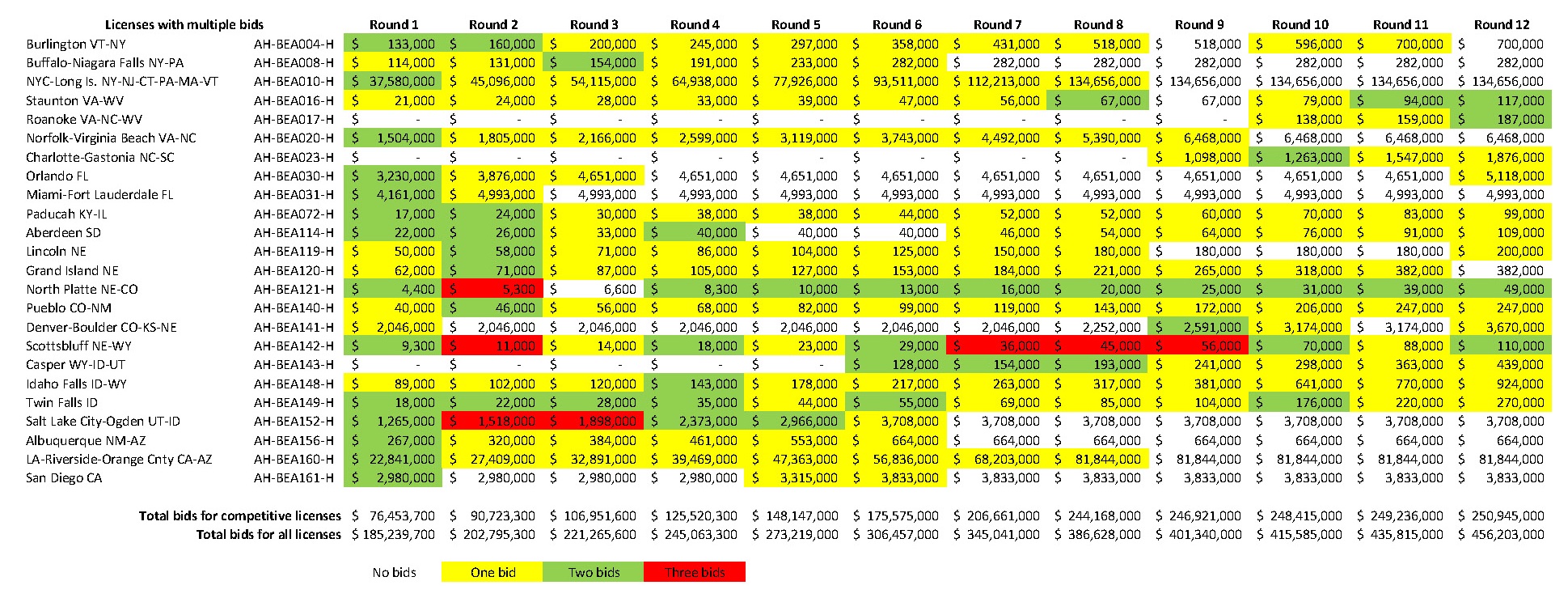
As a result, I conclude that it is more likely that DISH has been bidding against itself for most major licenses and has left a few winning bids from competitors alone until it has bid up the other desirable cities so far that it would be unappealing to switch to them. Now DISH is concentrating its firepower on a few smaller licenses, the increase in total bids (now at $781M) has actually been slower than yesterday, suggesting that it will take 3 or 4 more days before the auction finishes. The chart of licenses with multiple bids is as follows:

Many may now wonder if DISH’s spectrum (and that held by others such as LightSquared) should be revalued downwards, because of the low price of the H-block. That’s not unexpected (and indeed exactly what I predicted last month), but in my view DISH’s real asset value is in its potential “towers” (i.e. satellite TV antennas) not in the spectrum itself. DISH’s spectrum holdings may no longer be worth $10B, but if DISH can monetize its antennas (say 1M sites at $100/month) via a fixed broadband network deployment, then there is a very clear alternative source for $10B in incremental value.
Permalink
01.27.14
Posted in DISH, Financials, LightSquared, Operators, Regulatory, Spectrum at 3:10 pm by timfarrar
No, not LightSquared, although a renewed auction, with no contingencies associated with FCC approval, does now seem like the most plausible way forward for the company. The big issue is then whether Ergen/SPSO’s debt holding are subordinated as a result of the recent trial: if he is then it might not require much more than a $1.2B credit bid for the debtholders to take control of the company, although in those circumstances I’d still expect Ergen to come back with a rival (personal) bid for the assets so that he doesn’t lose his $700M investment. However, if there is no subordination, then we may not see anyone outbidding Ergen even at a price of $1.5B-$2B (which would not repay the secured debtholders in full).
Actually I’m more interested in the lack of competitive bidding in the H-block auction, which slowed even further today. So far, after Round 12, only $456M has been bid for the licenses on offer, or less than 30% of DISH’s minimum bid commitment of $1564M. The bidding is anonymous, so its hard to tell whether two different bidders are bidding in turn for many of the licenses or if DISH is bidding against itself in order to reach the minimum commitment.
However, the evidence now points increasingly to it being the latter situation, after bidding on the New York and Los Angeles licenses (which had accounted for $216.5M or 56% of the total bids) stopped at the end of Round 8. Then bidding resumed on several other large cities, including Boston, Washington, Chicago, Dallas, San Francisco, which had seen no bids since Round 1. The coordinated nature of this switching could mean that DISH faces a single large opponent, who ceased bidding on New York and Los Angeles and used its eligibility to bid for these other cities instead.
Instead, it seems more likely that DISH has been bidding against itself since the early rounds of the auction, because DISH has committed to bid $0.50/MHzPOP on average across the country and the bids have only reached $0.51 in New York and $0.41 in Los Angeles. Obviously any opponent would have had to have been prepared to bid rather more than $0.50/MHzPOP to win the licenses in NY or LA, and even if the objective of a DISH opponent was actually to pick up less expensive licenses in other cities, it would have been necessary to force DISH to bid more than $0.50/MHzPOP in NY and LA so that DISH could reach its committed minimum bid threshold without owning all of the licenses nationwide.
If we look at all of the 24 licenses that have attracted competing bids at any stage during the auction, as shown in the chart below, we can see that virtually all of the competitive bidding has been confined to a few small areas, notably in Colorado, Nebraska, Wyoming, Idaho and Utah, where 10 licenses (including Denver and Salt Lake City) have seen multiple bids. There has also been another smaller cluster of activity in Virginia, North Carolina and West Virginia.

It is particularly notable that DISH appears to have been deterring any rival bids through multiple rounds of incremental bidding, regardless of whether it holds the license (which is randomly assigned between equal competing bids), until any competitors have demonstrably given up, as seen in the repeated rounds of multiple bids (note competitors with no minimum bid requirement would not overbid themselves, but DISH would be happy to do that while it remains below the minimum bidding threshold).
My suspicion is that the same factor may have been in play in New York and Los Angeles, where a token competitive bid was mounted in the first round, and then DISH’s one or more major rival(s) dropped out of the auction, leaving only a handful of small regional players to fight a doomed battle with DISH over a few insignificant licenses like North Platte and Scottsbluff, NE. If that were not the case, then we would again have seen DISH make overbids when it held the NY or LA license itself and that would have manifested itself in two competing bids being made for these licenses if a competitor were present. The fact that no competing bids were offered in NY and LA after Round 1 strongly suggests that no competitors were bidding against DISH for these licenses after that point.
Even more significant than the slowing increase in overall bids (where the determining factor is clearly DISH bidding against itself), the increase in total bids for once contested licenses today has been only $1M-$2M per round, demonstrating that virtually no-one is still fighting against DISH. DISH therefore appears well set to capture all of the H-block licenses in the country that it wants, as it has enough spare eligibility to bid for all of these licenses (including those still held by the FCC) for many rounds to come. The fact that the FCC has now increased the pace of the auction to 5 rounds per day, starting Tuesday, also supports the view that DISH is the only bidder for most licenses and most other participants have dropped out.
Taking a wider view, many commentators will undoubtedly try and explain away the results of the H-block auction as an aberration, due to the lack of major competitors for DISH. However, even if you accept that view (and ignore the fact that an unprecedented amount of spectrum is being made available through auctions this year and next, which is likely to change the balance of demand and supply significantly), it still doesn’t give much comfort to those who believe that spectrum is a scarce, appreciating asset. After all, this auction has demonstrated that if, like LightSquared, you don’t have many buyers for your spectrum, you’re not going to be able to realize a high price for that asset.
Permalink
01.18.14
Posted in DISH, Financials, LightSquared, Operators, Regulatory, Spectrum at 6:16 pm by timfarrar

It seems that contrary to Phil Falcone’s testimony on Thursday, its not true that “if you talk to anybody, they’ll tell you LightSquared will get the FCC license” at least if that “anybody” is FCC Chairman Wheeler (who of course did talk to LightSquared just before Christmas). It seems he wanted to send that message loud and clear with a Friday evening court filing, telling Judge Chapman that:
“The FCC is not in a position to confirm whether it will able to complete the work required to act on each of the conditions specified in the FCC Exit Condition before December 31, 2014. It is also impossible to predict what decisions the Commission may reach on these matters.”
The filing went on to explain that the first Exit Condition in the LightSquared bankruptcy plan (which requires approval for use of LightSquared’s 20MHz of uplink spectrum) “is not solely within the FCC’s control” because “the FCC coordinates certain spectrum-related matters with the NTIA, which in turn consults with all federal stakeholders through the Interdepartmental Radio Advisory Committee.”
That’s particularly important in view of a Bloomberg article earlier this month which indicated that “The Transportation Department, whose concerns that the LightSquared network could affect airliner navigation helped kill the company’s original plan, is withholding assent from the Interdepartment Radio Advisory Committee.” So in effect, the FCC is saying that if the DoT/FAA veto is maintained (and remember they would have to walk back the prediction that LightSquared’s operations could cause 800 deaths), it will not approve LightSquared’s application.
In addition, the filing noted that with respect to the second Exit Condition (which requires LightSquared to have gained approval to use the 10MHz of downlink spectrum between 1670-80MHz) “the FCC will need to conduct a notice-and-comment rulemaking process…[which] will include issuing a Notice of Proposed Rulemaking (“NPRM”), seeking comments from the public and adopting a Report and Order to allocate, develop service rules for and assign the [1675-80MHz] spectrum. At this time, it is not possible to provide any assurances that the processes outlined herein will be completed by December 31, 2014.”
This intervention potentially throws the LightSquared bankruptcy into chaos, and could leave Judge Chapman in a near impossible position, because as the FCC emphasized “Under the Revised Second Amended Plan, if the Effective Date has not occurred on or before December 31, 2014, the Plan shall be null and void.” We’ve already had DISH withdraw its bid, and as I noted the other day, it looks very much like DISH has alternative deals in mind. Commitments were also due on the LightSquared exit financing on Friday, and the FCC’s intervention could make the status of that financing even more uncertain.
So the question now is whether there is any feasible plan for Judge Chapman to confirm at this point in time? If she decides there is not, perhaps she could order the company to resume the auction of assets, this time without any conditionality on FCC approval. Would that mean Ergen jumping back in with a personal bid at a lower price? After all he suggested on Monday that had been a possibility, backed by a loan against his stake in EchoStar. Would the other LP debtholders compete against him (and put up cash to buy him out) if they weren’t going to get paid off at par plus accrued interest as they expected a few days ago?
Worryingly for LightSquared’s own reorganization plan, if the FCC intervention, which few expected at this point in time, is regarded as a direct smackdown in response to Falcone’s comments in court, that again raises the question of how big a “Phil risk premium” needs to be attached to the regulatory process, if Falcone maintains a substantial ownership stake in the company (even if he is no longer involved on a day-to-day basis, which seems to be the intent of the Fortress-backed plan).
After all, Senator Grassley (who has been a vocal critic of how “the FCC nearly granted billions of dollars in taxpayer assets to someone accused by our nation’s financial regulator of having ‘victimized’ ‘clients and market participants alike’ and leading a ‘graduate school course in how to operate a hedge fund unlawfully’”) was only too happy to give a statement for Bloomberg’s recent story about the lack of progress in Washington, and I’m sure that he won’t remain silent about any future FCC approvals while Phil remains involved with LightSquared.
Permalink
01.16.14
Posted in DISH, Financials, Operators, Regulatory, Spectrum, Sprint at 5:27 pm by timfarrar
After all the back and forth in court this week, with testimony from Charlie Ergen and Phil Falcone about Ergen’s purchases of LightSquared debt, the casual reader could be forgiven for thinking that this is still a battle between the two of them for control of LightSquared. However, a court filing from LBAC today emphasized that DISH is withdrawing its bid and if their argument (that DISH’s bid is not locked-up) stands, it appears that the Ad Hoc Committee will have an uphill task in moving to confirm a plan based on sale of the assets.
Instead, if LightSquared can get sufficient commitments tomorrow so that the $2.5B of new debt needed to back its reorganization plan is in place (contingent of course on FCC approval), then both Ergen and DISH appear happy to step back and wait to see what happens. If the FCC did give LightSquared the approvals it wants, which Falcone has “a pretty good feeling about” (mirroring his confidence back in 2011 that GPS interference issues could easily be solved), then Ergen would get repaid with interest (assuming he wins the current trial), and if the FCC refused (or declined to rule), then he could come back with another (lower) bid later on.
What’s far more intriguing is why DISH now seems to regard LightSquared as dispensable, at least for the time being. Remember that Ergen testified DISH only became interested in LightSquared as a backup plan once it became clear DISH would not succeed in buying Sprint or Clearwire. In addition, rebanding the AWS-4 uplinks to downlinks and pairing with LightSquared’s uplinks would delay any network deployment by at least a couple of years.
So it seems highly likely that Ergen has another plan in mind, which DISH will move to implement soon after the H-block auction is complete. There are repeated rumors about a Sprint bid for T-Mobile and an expectation that DISH would mount a counterbid. But it still seems that Sprint would have a tough job getting regulatory approval.
BTIG seem to think that a asset sale by Sprint to DISH would be one solution (what assets this would be is unclear, but we suspect DISH’s main objective would be to get hold of Clearwire spectrum, not a retail wireless business, and Sprint doesn’t need to buy T-Mobile for its spectrum). But isn’t a direct Sprint/DISH partnership a simpler solution, with a Sprint bid for T-Mobile acting as a backstop option if a deal with DISH falls through?
Its surprising how few people really seem to have grasped what DISH’s key asset is, namely that its 14M potential towers (i.e. rooftop satellite dishes) are at least as valuable as its spectrum (and perhaps more so, since using the AWS-4 spectrum for a fixed wireless broadband network wouldn’t be a very high value use).
Consider for example, a wireless broadband network deployed to 20% of DISH’s current customer base (2.8M households), let along the 8.5M targeted in DISH’s April 2013 Sprint bid proposal. If DISH can rent even a fraction of this tower space for $100 per month (compared to the $1700 or so that is charged by traditional tower companies) to Sprint to host its 2.5GHz small cell buildout, then that could generate at least $1B per year of incremental cashflow, with little or no offsetting costs (remember the power and space is provided by the homeowner). Moreover, DISH’s best use of its money would then be to try and buy DirecTV, offering a national broadband fixed wireless competitor and ensuring that AT&T couldn’t gain a similar buildout opportunity via DirecTV’s satellite dishes.

We’ll see what happens in the H-block auction next week, but even that may not be particularly critical to DISH’s near term plans, and I’d expect DISH could be quite content to be outbid on many licenses by non-strategic investors. Then regardless of what happens to LightSquared in the next few weeks (and things may go at least somewhat quiet for much of this year while the company makes yet another effort to secure FCC approval), my bet is that we’ll be hearing a lot more about Ergen’s wireless plans in the next few months.
Permalink
01.09.14
Posted in DISH, Financials, LightSquared, Operators, Regulatory, Spectrum, Sprint at 9:42 am by timfarrar

The announcement today that DISH is pulling its bid for LightSquared has thrown what was already a massively complicated and controversial bankruptcy case further into chaos, as we start the trial on whether Ergen’s purchase of LightSquared debt was illegitimate (and warm-up for a lengthy contested confirmation hearing over the next 3 weeks). Of course, the withdrawal of the bid completely undercuts LightSquared and Harbinger’s arguments that Ergen always knew DISH would come in and buy out his debt holdings and it will be interesting to see the effect on this part of the trial. Thus the withdrawal is certainly a logical move simply for that reason alone.
However, as we move forward into confirmation, there are two further possibilities to be considered. If DISH’s move is simply a strategic maneuver to undercut LightSquared’s lawsuit against Ergen, then it would be logical to expect DISH would ultimately give in when the debtholders attempt to force specific performance of the Asset Purchase Agreement (assuming the Ad Hoc debtholder reorganization plan is approved by the judge).
A second more intriguing alternative is that DISH and Sprint might be nearing a partnership deal, under which Sprint could use DISH’s satellite TV antennas (backhauled via a fixed wireless network using AWS-4 spectrum) for a 2.5GHz small cell hosting strategy in suburban and rural areas and DISH would resell Sprint wireless services. After all, if there is a near term deal to move forward with a wireless partner and an AWS-4 buildout, then the rebanding and delay associated with a DISH acquisition of LightSquared would probably cause more problems than it solves.
Certainly a hiatus in negotiations between DISH and Sprint seemed to be behind the leaks before Christmas that Sprint was planning a bid for T-Mobile and DISH’s rejoinder that it would consider a rival bid. Indeed one could view AT&T’s recent offer of a $450 incentive to T-Mobile customers as an attempt to kill any prospects of regulatory approval for a Sprint/T-Mobile tie-up. So from that point of view, Sprint’s only viable big move in the near term is a deal with DISH, and I’m told large scale deployment of such a network could double the total wireless network capacity available in the world today.
Another factor worth considering is that DISH’s move creates further uncertainty for the H-block auction as well, because (especially after Echostar’s purchase of Solaris, which has overlapping 2GHz band spectrum in Europe at 1995-2010MHz uplink and 2185-2200MHz downlink) the possibility that DISH will not decide to switch its AWS-4 uplinks to downlinks is back on the table.
Nevertheless, even if DISH doesn’t buy LightSquared, and no deal is ultimately worked out with Sprint, DISH could still come back and buy the 1695-1710MHz unpaired uplink spectrum in the FCC auction later this summer, likely at a lower price (and with rather less risk) than it would be taking with LightSquared – as unpaired uplink this band will probably sell for around $0.30 to $0.40/MHzPOP unless AT&T and DISH both bid aggressively against one another. So DISH certainly still has many spectrum options left on the table this year.
Today and tomorrow the LightSquared hearing will involve live testimony from both Ergen and Falcone about the debt purchases. Given that DISH’s maneuver has now undercut many of Harbinger’s arguments, and Ergen still seems to have plenty of cards up his sleeve, it will be interesting to see just how far Phil is out of depth in this great game.
Permalink
12.20.13
Posted in DISH, Financials, ICO/DBSD, LightSquared, Operators, Regulatory, Spectrum at 3:19 pm by timfarrar

As we head towards the holiday season, LightSquared’s attempts to find an alternative to being bought by Charlie Ergen are becoming ever more desperate, as the December 24 deadline to put forward an alternative plan approaches and the company takes a “time machine back to the summer…to formulate from scratch their own refinancing plan
…like the failed effort with Jefferies.”
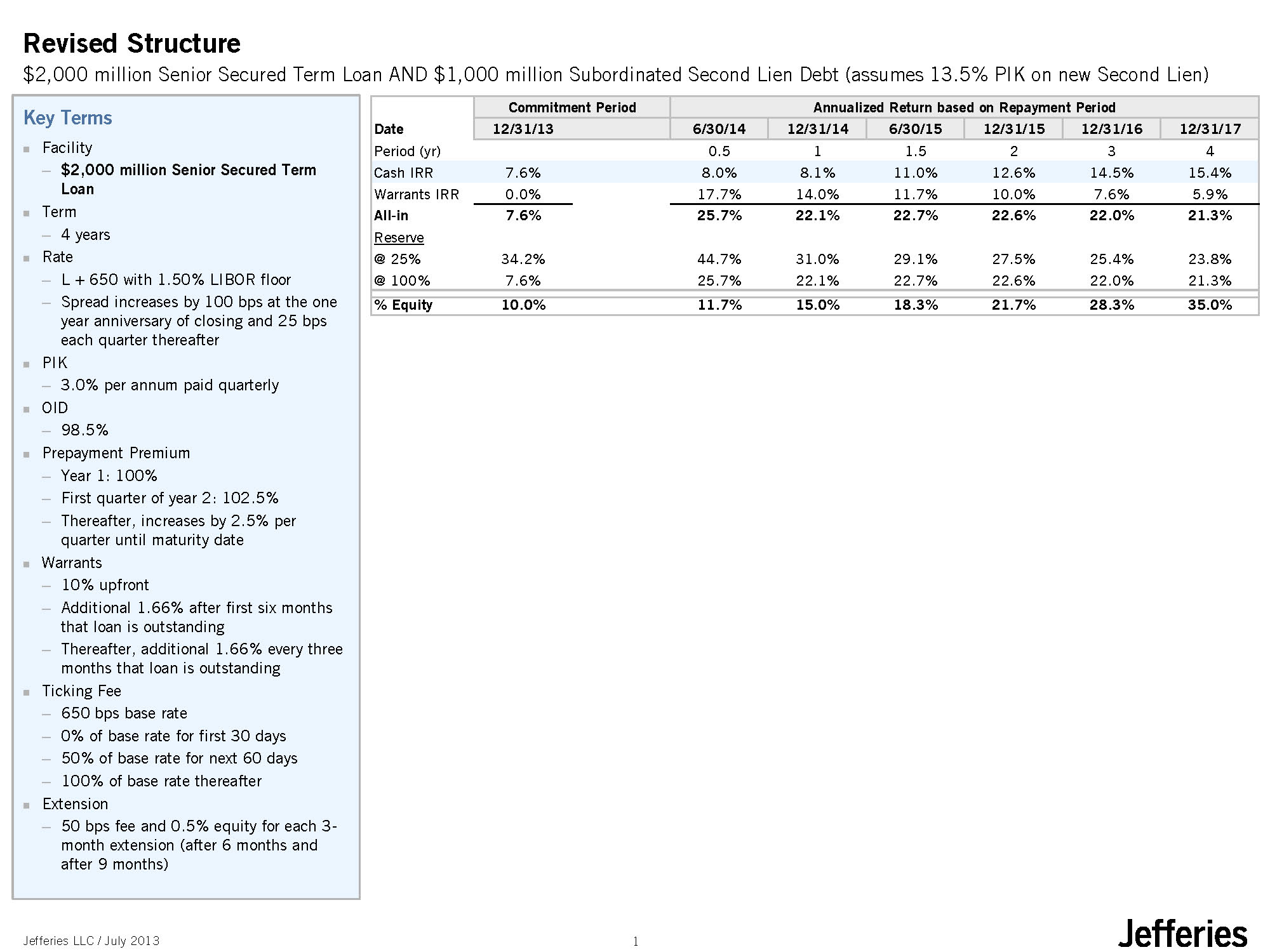
Reuters is reporting the terms of a $2B-$2.5B three year term loan to back a Fortress-sponsored exit plan as including 12% interest, all paid-in-kind, with an additional unspecified amount of equity injected into the company (presumably mostly achieved through rolling over existing investments). Unless a substantial amount of warrants are also included in this deal, the terms appear worse than those offered by Jefferies (and rejected by investors) back in July, which comprised mostly cash pay interest plus an ongoing ticking fee and substantial warrants.
We find it hard to imagine that the judge will be happy with a proposal which involves waiting another 6-9 months for an FCC decision, with no certainty at the end of the process, and which would presumably result in DISH terminating its non-contingent cash offer. Remember that there are numerous other uncertainties in the near future as well, including the resolution of LightSquared’s Mexican coordination negotiations, the Cooperation Agreement with Inmarsat, LightSquared’s difficult relationship with the DoD (which led to the termination of a contract accounting for one third of LightSquared’s total satellite revenue earlier this year) and most importantly the unprecedented amount of spectrum that will be auctioned by the FCC in 2014 and 2015. All of these issues are discussed in detail in our new 49 page LightSquared profile, released yesterday – please get in touch if you are interested in purchasing a copy.
The AWS-1 auction in 2006 provides one good example of how large amounts of new spectrum coming to the market can have a major effect on the perceived value of spectrum. Take for example ICO’s July 2005 Offering Memorandum, which suggested its spectrum was worth $1.64/MHzPOP, whereas after 2006, ICO had to use an AWS-1 benchmark instead (in that case the most optimistic number that could be justified was $0.73/MHzPOP for the 20MHz F-block spectrum).
One of the underrated issues that is still to play out in the bankruptcy (and a key sticking point in negotiation of DISH’s proposed Asset Purchase Agreement) was that DISH’s bid included acquiring all of the litigation rights of the LightSquared estate. The most obvious effect that would have is on LightSquared’s lawsuit against Ergen for buying up its debt. However, it would also have significant consequences for the suit against the GPS industry and potential litigation against the FCC: whereas LightSquared soon may have nothing to lose by employing scorched Earth tactics, we suspect DISH would look for a compromise that would be acceptable to all parties. Finally, DISH could even sue Harbinger on behalf of LightSquared investors who lost money as a result of the “guarantees” that there was no GPS interference problem whatsoever.
We should soon know if this will be Phil’s last gasp, so just like the Delorean above, he will find himself “OUTATIME” or if we will have many months more of uncertainty about the FCC process. Either way, it looks like it is no longer FCC Chairman Wheeler who will have an unhappy Christmas, but instead it will be Judge Chapman, who is charged with resolving the LightSquared bankruptcy case and now has to determine just how much of LightSquared’s “alarming and reckless” efforts to fend off DISH she will tolerate.
Permalink
12.11.13
Posted in DISH, LightSquared, Operators, Regulatory, Spectrum at 10:29 pm by timfarrar

Tomorrow FCC Chairman Wheeler plans to tell Congress that “we are not the Federal Courtesy Commission” with respect to the upcoming rulemaking on in-flight cellphone calls. However, that message could apply equally to the unwelcome prospect of Centerbridge’s bid for LightSquared, where the unexpected backlash over phones on planes may end up looking like a walk in the park compared to the renewed battle over approvals for LightSquared. After all, whichever way the FCC now rules will be “picking winners and losers” between DISH and Centerbridge and will undoubtedly end up making some people (including many politicians) very unhappy.
Earlier today I wondered what Centerbridge heard from the FCC during Reed Hundt’s lobbying meeting last week that gave them enough comfort to put together their $3.3B bid. However, it now appears that in fact Centerbridge’s bid is contingent on FCC approval of LightSquared’s so-called spectrum “swap” coming through very soon, presumably before the deal closes. Thus if the FCC doesn’t rule quickly in favor of LightSquared, the Centerbridge deal could fall through, and DISH would then be back in the driver’s seat with its original $2.2B bid.
Indeed, if the process is extended past February 15, then DISH’s offer could be withdrawn and LightSquared would be back at square one, so I suspect the bankruptcy court will require a firm commitment to be made by Centerbridge well before then. As a result, the FCC’s previous plan, to simply ignore LightSquared’s request and hope that it goes away after DISH buys the company, has now essentially become untenable.
So if Chairman Wheeler and his staff didn’t already have enough in their in tray (including ruling on DISH’s request for more flexibility in its use of the AWS-4 spectrum by the end of next week, in order to keep the H-block auction on track), he now has the prospect of spending the holiday period pondering whether to alienate the DoD, GPS industry and politicians opposed to a perceived spectrum “giveaway” to a reorganized LightSquared which will still count persona non grata (i.e. Falcone and Harbinger) amongst its major investors.
Given that Centerbridge’s plan is apparently simply to sell the LightSquared spectrum to AT&T or Verizon before the end of 2015 (when the new tranche of funding will run out), helping to make LightSquared viable is hardly going to do much to promote the FCC’s objective of more competition in the mobile market either (though who knows what will happen in reality, because Centerbridge will be trying to sell the spectrum in the midst of the most sustained period of major FCC spectrum auctions in history).
However, if approval is refused, then the alternative may be that the FCC has to face the prospect of LightSquared actually commencing its long threatened legal action against the Commission for blocking LightSquared’s ATC license. That’s because I assume that the LightSquared estate will now try to keep control of its causes of action rather than handing them to DISH if the Centerbridge deal falls apart, since the damages supposedly suffered by LightSquared investors as a result of adverse FCC action will now be much more explicitly quantifiable. Either way this decision is going to be tricky, and somehow I doubt Chairman Wheeler’s mood will be improved by the knowledge that several of his predecessors are already working for Phil Falcone.
Permalink
Posted in DISH, LightSquared, Operators, Regulatory, Spectrum at 10:07 am by timfarrar

Its rather ironic to see the headline in the WSJ today, proclaiming that “A Gold Rush Hits Wireless Spectrum” on the same day as LightSquared’s bankruptcy auction takes place. While I’ll address the gold rush silliness in another post (although I note that amazingly enough MAST apparently still wants to fight with Ergen over the H-block), behind the scenes of the LightSquared bankruptcy there’s been a lot of activity over the last three weeks, as LightSquared and Harbinger tried to pull together a consortium to keep the company out of DISH’s hands (and submit a more credible reorganization plan).
Just before Thanksgiving, the “interest” of Fortress and Centerbridge was leaked to the WSJ, in an attempt to persuade other firms to become involved and to pressure the FCC to move forward. The auction itself was even delayed until today, to give more time for an FCC ruling (or at least some sign that the FCC would rule on LightSquared’s request), because many potential investors thought it was simply too risky to participate without any signal from the FCC that the proposed spectrum “swap” had a chance of being approved.
However, the FCC appears unmoved, despite some last ditch in-person lobbying by former FCC Chairman Reed Hundt on Thursday Dec 5. That’s the second former FCC Chairman that LightSquared has sent to the FCC to lobby for them in recent months! This filing highlights that Centerbridge has been working hand in hand with LightSquared in order to try and outbid Ergen. The rationale behind Centerbridge’s interest is unclear, as I’m told they were not a previous investor in LightSquared, but appears to relate to a belief in the opportunities of the spectrum “gold rush”.
That’s different from Fortress, who own a substantial amount of LP Preferred Shares, which would be largely wiped out by DISH’s bid and so are likely motivated primarily to protect their existing investment. Fortress’s LP Preferred investment would receive only a modest recovery as a result of DISH’s bid, despite Ergen’s earlier agreement last April to purchase Fortress’s preferred shares at 95 cents on the dollar, as this purchase was blocked because SPSO is certainly an “affiliate” of DISH (the term used in the shareholder restrictions), even if its not a “subsidiary” (as used in the term loan restrictions). However, with the LP Preferred being next in line for a recovery, even pushing DISH’s bid up by $100M-$200M would provide a major benefit to Fortress.
UPDATED (12/11): It seemed that because everything had been so quiet in recent days, LightSquared might have been unable to gain enough backing for their bid, presumably because the FCC appeared to have been unmoved by Hundt’s entreaties. However, its now being reported by the WSJ that LightSquared postponed the auction to try and thrash out a deal with Centerbridge, which has resulted in a $3.3B tentative deal. I would expect that to include all of the company (and for Centerbridge to assume the Inmarsat Cooperation Agreement largely in its current form), so that Centerbridge would pay off the Inc holders and continue to pursue the spectrum “swap” with the FCC and the litigation against the GPS industry. Notably Harbinger could now potentially also stand to benefit substantially if Ergen’s $1B debt claim was ultimately disallowed as a result of the litigation, because there will be no debtholders ahead of them with higher priority bankruptcy claims.
If the $3.3B Centerbridge bid becomes firm, I wouldn’t expect DISH to bid even more, although it would remain the backup bidder through Feb 15 if the Centerbridge offer falls apart. DISH would have other options for uplink, including the 1695-1710MHz band which will be auctioned in 2014. However, if DISH did instead ultimately emerge as the winner, there would still need to be significant negotiations over the DISH Asset Purchase Agreement, which apparently has some areas of disagreement (not least over DISH’s request for certain releases (including for Ergen’s purchases) and for its purchase to include all causes of action of the LightSquared estates against the GPS industry, FCC, Inmarsat and Harbinger, etc.). If it came to that, I’d expect that issue in particular to require the intervention of the judge, and of course her ruling would therefore also determine whether LightSquared’s lawsuit against Ergen would continue as currently scheduled. In that event, a very interesting question would be whether DISH actually has an out in the event that no resolution is reached over the asset purchase agreement or whether the judge can force DISH to follow through with its bid, even if the final terms of the asset purchase agreement were not acceptable to DISH.
Despite all of LightSquared’s and Harbinger’s efforts, it would hardly be surprising if the FCC proves unwilling to act on LightSquared’s requests, because DISH has made it clear that it is not interested in the spectrum “swap” (see LightSquared’s recent motion for an extension of the use of cash collateral which states “As the Court is well aware, LBAC is not interested in LightSquared’s downlink channels or resolution on the series of applications LightSquared has filed with the FCC…LBAC is only interested in LightSquared’s uplink channels”).
Given that, why would the FCC give spectrum away for free to LightSquared (or even forgo an auction) when DISH would drop this request if it won the bidding, especially at a time when the FCC is under considerable pressure to raise as much money as possible from spectrum sales? Even selling the 1675-80MHz band of spectrum to LightSquared for the $300M assumed in the White House budget would inevitably lead to accusations of favoritism (because the price would be equivalent to only $0.20 per MHzPOP), so why wouldn’t the FCC simply auction this spectrum along with other bands, once the appropriate rules have been put in place?
On the other hand, Centerbridge must have come away from Friday’s meeting feeling somewhat comforted by the discussion with the FCC, so perhaps the compromise could be to auction the 1675-80MHz band along with AWS-3 and 1695-1710MHz next summer? Certainly the FCC is now in a much trickier political position if the Centerbridge bid goes through, compared to the prospects of DISH getting them out of the LightSquared mess.
Despite Phil’s efforts to hire the best lobbyists (and lawyers) that money can buy, even if the Centerbridge bid succeeds, it therefore seems like it will still be a struggle to put LightSquared together again. We’ll be publishing our latest report on LightSquared, DISH and the related spectrum issues later this week, including an analysis of why LightSquared suddenly lost one third of its total revenues earlier this year (hint: the DoD really doesn’t like them…). Contact me for more details if you are interested.
Permalink
« Previous Page — « Previous entries « Previous Page · Next Page » Next entries » — Next Page »