12.07.09
Posted in ICO/DBSD, LightSquared, Operators, Regulatory, Services, Spectrum, TerreStar at 10:41 am by timfarrar
On Friday Dec 4 we attended an FCC discussion of the National Broadband Plan here in Menlo Park, at which Carlos Kirjner and Blair Levin presented on various issues being addressed in development of the National Broadband Plan. The most interesting part of the presentation was the assertion that “at least 150MHz” of TV spectrum could be freed up by relocating over the air TV broadcasters to a smaller portion of the UHF band “while keeping all major channels on the air”.
Its been widely discussed how the broadcasters might be incentivized to move, perhaps by offering them a share of the future auction proceeds, so at the end of the presentation I asked if a similar arrangement would be available for other spectrum bands, such as MSS. Blair Levin confirmed that other bands, including MSS-ATC spectrum, were also under review and that historic band allocations may no longer be optimal to meet future wireless spectrum demand. As part of the FCC’s review of Harbinger’s proposed purchase of SkyTerra, the FCC has also asked some very detailed questions about SkyTerra’s progress towards an ATC deal, and the discussions that they have had with different parties.
Will the National Broadband Plan provide an alternative way for MSS operators such as SkyTerra, ICO/DBSD and TerreStar to monetize their spectrum, as it does not look like any of these operators are going to move forward with ATC deployment in the near future? Globalstar’s ATC lease agreement with Open Range is seeing more progress, but is limited to a few million rural consumers (and the Open Range terrestrial rollout is being supported by USDA loan guarantees).
Certainly in the 2GHz band (unlike the L-band) there are no existing satellite services which would prevent operators returning their spectrum to the FCC for re-auction. The National Broadband Plan is due to be published in February 2010, so we will soon see whether the FCC is going to come up with a plan to make sure that MSS spectrum is put to use in terrestrial networks in a more timely manner.
Permalink
10.16.09
Posted in Globalstar, Handheld, Iridium, Services, TerreStar at 12:07 pm by timfarrar
At the SATCON conference in New York this week, TerreStar was showing its Elektrobit Genus phone. The company had conducted live demos of calls over the satellite at the IACP conference in Denver the previous week (with reportedly very good results in terms of call quality), but unfortunately a similar opportunity wasn’t available in New York. Nevertheless a few interesting facts emerged about the phone.
Firstly you have to switch manually into satellite mode (via a menu selection) in order to use either voice or data over the satellite. This was not necessary from a technical perspective (the phone could have roamed automatically since the satellite is basically treated like an international GSM network), but was insisted on by AT&T so that users know they will incur roaming charges, and that they will not be able to get the same quality of service that they would expect from a terrestrial network (i.e. they will have to stand outside, and not be inside a building or a car).
Secondly, as shown in the picture below, there is an external antenna port, enabling a cradle-type device with an external antenna to be connected, so that adequate link margin is available in Northern Canada and Alaska. The external antenna is a quad helix antenna about 0.3 inches in diameter (about the size of the Thuraya antenna) and 3 inches in length which swings up from the back of the cradle in the same manner as the rotating antenna on the old Iridium 9505 phone. These cradles will be sold separately (pricing is unclear but we’d guess in the $100-$200 range) and will increase the handset volume by about 60%.

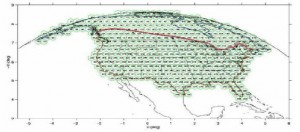
In the lower 48 states and southern Canada (i.e. below the red line in the map above) the Genus phone uses an internal patch antenna located at the right upper corner of the phone in the picture above. It will be particularly interesting to see how sensitive the call quality is to the orientation of the phone when it is being used in practice – users are instructed to hold the phone so that their fingers do not obstruct the link (per the sticker on the back of the phone), but if you are moving around, then inevitably your head will come between the phone and the satellite some of the time. TerreStar’s very large (i.e. very sensitive) satellite antenna will certainly help to close the link, but given how many arguments there have been on conference panels we’ve chaired in the past between proponents of getting the antenna clear of the head (i.e. Globalstar, Inmarsat and Iridium) and those who don’t believe an external antenna is needed (i.e. TerreStar and SkyTerra), this will be one of the first things to examine when the phones become available for testing.
Permalink
09.30.09
Posted in Financials, Handheld, Operators, Spectrum, TerreStar at 4:38 pm by timfarrar
TerreStar and AT&T have now announced that AT&T will distribute TerreStar’s Genus (Elektrobit) phone to “government, first responders, public safety, energy, utility, transportation and maritime users” and given additional details of the expected pricing for this satellite-cellular roaming service. The phone will cost $800 to $900 (subsidies were not mentioned, which is perhaps not too surprising given that the service is not being targeted at consumers initially), and then in addition to a standard voice plan, subscribers will need to pay $24.99/month for satellite access and an additional usage fee for satellite roaming (in the United States) of $0.65/minute for voice and $5/Mbyte for data.
TerreStar and AT&T are basically targeting the existing handheld MSS market, but expect that the phone will be deployed more widely, because it will become an “everyday” phone for end users, rather than being a shared phone which is kept in a cupboard for emergencies. In our view, the size of the potential addressable market is probably not too far off that for Land Mobile Radio, where we estimate there are around 2.5M to 3M handsets in use in the US today, with about half in public safety and the rest in other government and private sector market segments (parks, utilities, railroads, energy, etc.). Of course only a fraction of those users also carry a employer-provided cellphone, and at this point in time, TerreStar’s solution is more likely to be a replacement for that device rather than for an LMR radio itself. So let’s assume AT&T and TerreStar are targeting a potential market of say 1M people. For comparison, today there are about 170K MSS phones in use in the US and Canada (including many Globalstar phones with limited two-way service at present), of which probably just under 100K are in the lower 48 states (and remember that the TerreStar phone is unlikely to work as reliably as Iridium or Globalstar in Alaska or Northern Canada).
In that context, TerreStar would be doing amazingly well if it could gain 50K subscribers by the end of 2010 and 100K-150K subscribers by the end of 2011 (when SkyTerra also expects to be offering next generation services, and Globalstar will be back in full two-way service). Remember also that in 1999-2000, despite massive advertising (at least in Iridium’s case), Iridium and Globalstar only managed to gain a few tens of thousands of users on a global basis in their first year of commercial service. TerreStar will probably share the end user revenue about 50/50 with AT&T (Iridium and Inmarsat expect to get about 70% of retail revenue but AT&T would likely want a bigger incentive to promote the service) and monthly retail ARPUs (including the satellite access fee but excluding any terrestrial voice plan) might be expected to be between $40 and $50. So let’s assume TerreStar receives $25 per user per month. If there are (in the most optimistic scenario) an average of 20K subs in 2010 (assuming deployment ramps up towards the end of the year) and 100K subs in 2011, then that would generate service revenues for TerreStar of $6M in 2010 and $30M in 2011. There would presumably be additional equipment revenues (although we doubt TerreStar is looking to make a profit on equipment sales) and perhaps revenue from some other services like M2M data (once chipsets are available, which means only a limited amount of revenue could be produced even in 2011).
However, its pretty clear that TerreStar is going to need to raise additional funds to cover its operating costs in the near future, since its cash burn rate even before going into full commercial service is about $25M per quarter, and excluding the money purchase agreement for the second satellite (not part of this $25M cash burn), TerreStar had $110M of cash at the end of June 2009. Thus regardless of what happens to the $430M of preferred shares (which must be redeemed or converted next April), TerreStar will need to raise more money by mid 2010. From mid 2011, TerreStar will also need to begin paying cash interest on its debt, at an annual rate of more than $150M per year in 2012.
Given the relatively limited opportunity in professional markets (at best a few hundred thousand subscribers for TerreStar, once the overall market is shared with SkyTerra and other MSS operators), TerreStar will eventually need to either achieve considerable success in consumer markets (requiring a dramatically different price point for both equipment and airtime) or find a strategic partner interested in buying or leasing the company’s 20MHz of spectrum for a terrestrial ATC deployment (which doesn’t look likely in the near term, not least because TerreStar doesn’t even have an ATC license as yet). In this context, its probably most appropriate to look at TerreStar’s initial service offering as a proof-of-concept (and a means to justify further funding) for one of these two longer term possibilities, rather than as the means to generate an immediate financial return on its own. We’ll see over the next 12 months whether TerreStar is able to provide the proof that both the financial markets and potential strategic partners will be looking for.
Permalink
09.09.09
Posted in Globalstar, Handheld, Inmarsat, Iridium, Operators, Services, TerreStar, Thuraya at 12:43 pm by timfarrar
Unfortunately its not new services, but the prices of current and future satellite phones and airtime that seem to be headed upwards. The last year has seen Iridium introduce its new, improved 9555 handset at a higher price than the 9505A that it replaced, with phones now selling for about $1500, while Thuraya has “simplified” (i.e. increased) its airtime pricing and introduced the more expensive ruggedized XT phone. Inmarsat admitted in June that its new GSPS handset may sell for up to $750 at launch in 2010, compared to the $500 retail price point it suggested previously. Even TerreStar has now indicated that its new handset may cost up to $800, with airtime pricing at “less than $1 per minute”.
We’ve commented before on how satellite phone revenues have been falling since 2005, and competition has certainly diminished as Globalstar has experienced problems with its two-way services over the last couple of years. However, it seems the consensus amongst current participants in the handheld MSS market is that there is little if any growth potential still left in satellite phones, and the actions of Iridium and Thuraya appear to indicate that their remaining customers are relatively price insensitive.
Even more surprising is that so far, at least, the new entrants do not seem to be particularly keen on shaking up the existing “premium price” paradigm for satellite phones. In the case of TerreStar this is rather worrying, given that their objective is to greatly expand the satellite phone market, and bring satellite-cellular roaming to a mass market, which seems very unlikely to happen with an $800 phone. Is TerreStar simply trying not to give too much away about its future pricing plans, while it focuses on developing all the other elements needed for a commercial service, such as distribution channels, billing systems, etc.? Will TerreStar actually be able to convince a cellular operator to subsidize its phone (which would require a significantly greater commitment from a partner than its current roaming agreement with AT&T)? We should find out soon, as TerreStar intends to launch commercial services at the end of 2009.
Permalink
07.20.09
Posted in Financials, ICO/DBSD, Operators, Spectrum, TerreStar at 3:20 pm by timfarrar
On July 9, DISH Network filed a letter in the ICO North America (DBSD) bankruptcy case, indicating that it had purchased all of the $43.7M of first lien secured debt from the pre-petition lenders.
The first lien lenders had been objecting to ICO’s proposed restructuring which their financial advisers (Chanin Capital Partners) characterized as “a ‘plan’ that is doomed to fail, due to lack of financing, overwhelming debt and inability to move the company from the developmental (non-revenue producing) stage into an operating, revenue producing one”, while DISH Network stated in its letter that it “adopts those objections in their entirety and is prepared to prosecute the objections…”
According to Chanin, ICO/DBSD’s plan “seeks to put the Debtors in a holding pattern in the hope that the capital markets will become more accessible in the future. During this time the Debtors have no intention of furthering their business”.
However, with Echostar already holding a significant stake in TerreStar, ICO’s 2GHz rival, which just launched its own satellite earlier this month, could this development provide renewed impetus to the long rumored merger of the two companies and provide an alternative way forward for the development of MSS and ATC services in the 2GHz band?
Permalink
07.01.09
Posted in Financials, Globalstar, Handheld, ICO/DBSD, Inmarsat, Iridium, LightSquared, Operators, Services, Spectrum, TerreStar at 10:25 am by timfarrar
With apologies to the Eagles…its a lovely place, for MSS consumers at least. However, for MSS operators it seems to be somewhere you can check out [or go bankrupt] anytime you like, but you can never leave.
Today we’ve seen confirmation that Globalstar is now fully funded to complete the construction and launch of its first 24 second generation satellites by the end of 2010, while TerreStar has launched its new S-band satellite from Kourou, French Guiana and intends to initiate commercial services at the end of this year. Iridium also looks increasingly likely to complete its deal with GHL, since GHL’s shares and warrants are now trading well above the $10 value that would be refunded to investors if they voted down the deal. While there has been much speculation about potential mergers in the last two years, these now look less, rather than more, likely to occur in the near future (with the sole exception of SkyTerra’s Harbinger-backed bid for Inmarsat, which should be decided one way or another later this year).
Thus by early 2011, it looks like we will have at least four and more likely six voice and data MSS systems providing service in North America (Inmarsat, Iridium, Globalstar and TerreStar plus ICO and SkyTerra) and four systems (Inmarsat, Iridium, Globalstar and Thuraya) providing service in most of the rest of the world. With new advanced satellites, consumers will benefit from improved data capabilities and smaller, cheaper handheld satellite phones.
However, the development of at least three new systems (ICO, TerreStar and SkyTerra) and to some extent Globalstar as well (based on financial analysts’ comments at the time of its IPO in November 2006) has been justified largely by the value of MSS spectrum, due to the FCC’s rules enabling deployment of Ancillary Terrestrial Components (ATC), rather than by the intrinsic potential of the market for mobile satellite services itself. Thus, unless and until demand for MSS spectrum and ATC materializes, we run the risk of overcapacity for land-based MSS services, particularly in North America. This will certainly benefit end users, and price reductions (especially in conjunction with cheaper, more attractive terminals) may help to stimulate significant market growth, but it remains to be seen whether this will enable all the MSS operators to deliver a return for their investors or whether we’ll see more of them “checking out” with a bankruptcy filing as ICO North America did in May this year.
Permalink
06.29.09
Posted in Financials, ICO/DBSD, Operators, Regulatory, Spectrum, TerreStar at 9:23 am by timfarrar
In a recent Report and Order, released on June 12, 2009, the FCC addressed the issue of when ICO and TerreStar can offer commercial service in North America, which has been delayed by the need to clear their uplink band (2000-2020MHz) of existing Broadcast Auxiliary Service (BAS) users, who are being transitioned to frequencies above 2025MHz. In the Order, the FCC removed the requirement that ICO and TerreStar must wait until all of the top 30 broadcast markets have been transitioned before they can launch service. However, ICO and TerreStar will have to coordinate with BAS users if they are to operate in uncleared markets, and Sprint Nextel now has until February 8, 2010 to complete the transition. As a result, though TerreStar intends to begin offering service in late 2009, it looks likely that national service will not be available until several months later.
More importantly, as part of the order, the FCC initiated a Further Notice of Proposed Rule Making (FNPRM) related to the sharing of costs for the BAS transition (which Sprint Nextel has paid but is seeking to reclaim from other operators who will use the spectrum). The FCC “tentatively conclude[d] that MSS operators and future AWS licensees will have an obligation to share, on a pro rata basis, in the costs associated with the relocation of BAS incumbents if they “enter the band??? prior to the BAS sunset date of December 9, 2013″ and “tentatively conclude[d] that an MSS operator “enters the band??? and thus incurs an obligation to share in the costs associated with relocation of BAS incumbents when its satellite is found operational under its authorization milestone”. In April 2009, Sprint Nextel estimated these costs at $100M each for ICO and TerreStar. ICO and TerreStar have previously argued that they should not be liable for any of these transition costs, so if confirmed, the FCC’s tentative conclusions would be a significant additional cost for both companies. However, it is uncertain if the recent bankruptcy of ICO North America will affect Sprint Nextel’s claim, including whether the ICO Global parent company (which was not part of the bankruptcy filing) will avoid this liability.
Permalink
05.14.09
Posted in Financials, ICO/DBSD, Inmarsat, Regulatory, Spectrum, TerreStar at 2:07 pm by timfarrar
The European Commission has announced the result of the S-band MSS selection process: as expected the two winners are Solaris Mobile and Inmarsat, with ICO and TerreStar’s applications rejected.
In response to the announcement, Inmarsat said it was “delighted to be the recipient” and “will look to pursue the commercial partnerships necessary to ensure that the returns from the required investment in our S-band programme will generate acceptable returns on capital without undue risks or uncertainties”.
However, it may not have much time to establish these partnerships, since the EC has stated that “within 30 working days of the publication of the list of selected applicants they shall inform the Commission in case they do not intend to use the radio frequencies”. If applicants decide to move forward (i.e. do not return the license) then they “will be bound by the commitments that they have undertaken, including commitments made concerning consumer and competitive benefits and geographic coverage” and all new systems must have “development and deployment completed” by May 2011 “at the latest”. A two year deadline for deployment is extremely tight, and Inmarsat would have to start spending serious money in the very near future (probably close to $100M in the next 12 months and $300M over the next two years) to complete and launch a satellite in this timeframe.
It will be very interesting to see if Inmarsat can find partners to come up with this amount of money (or enter into some alternative form of capacity purchase contracts) in the next 30 days. Given that Solaris already has a satellite in orbit (albeit with more limited coverage) and has not yet announced any meaningful capacity commitments, it would be quite a surprise if Inmarsat was successful, especially in the midst of an economic downturn.
It remains unclear what sanctions the EC can impose on operators who fail to live up to their “commitments” and ultimately do not complete an S-band satellite on the promised schedule. We would have thought it unlikely that fines or other monetary penalties would be imposed, but coming a day after Intel was fined more than 1 billion Euros by the EC’s Competition Directorate, this may not be a good time to get on the wrong side of the Commission.
Permalink
04.30.09
Posted in Globalstar, ICO/DBSD, Inmarsat, Iridium, LightSquared, Spectrum, TerreStar at 10:44 am by timfarrar
On Monday, the Wall St Journal revealed that Harbinger plans to push ahead with “a multibillion-dollar plan to build an international satellite-cellphone business” which would “complement existing cellular networks with satellite coverage, and…use new chips that could fit inside affordable, mainstream phones, keeping costs down for consumers”. This is quite different from the original plan of SkyTerra, TerreStar and ICO to build out Ancillary Terrestrial Components (ATCs) – basically a new terrestrial cellphone network using their satellite frequencies. Instead, subscribers will simply rely on their existing cellphone networks and only use the satellite services of these companies as a roaming partner when they are in uncovered areas. From that perspective, the new plan is much more similar to the business plans of Iridium and Globalstar in the late 1990s, that business travelers would rely on satellite networks to fill in the gaps in cellular coverage. For example, here’s a description from the Economist in June 1998:
“By far the largest number of subscribers is likely to come from the “cellular roaming” market. These are users of land-based cellular phones who want to be able to extend the range of their handsets when they are travelling through areas of poor or incompatible coverage. MSS subscribers will be equipped with a dual-standard phone that will switch to a satellite when a ground connection is unavailable (Iridium’s first offering is a soon-to-be-superseded $3,000 half-kilogram brick). Subscribers will pay a higher standing charge to their normal cellular operator and a premium on MSS calls. Numbering will not change and unified billing will be standard. This week Iridium said it had recruited 200 distribution partners among cellular companies.”
Of course there are many advantages that the new and very capable satellites being built by SkyTerra and TerreStar will offer over the 1990s technology of Iridium and Globalstar. Most obviously, the extra power and sensitivity of their satellites will allow the satellite service to be added to mainstream cellphones with little or no penalty in size and weight, as opposed to the ‘brick’-sized handsets produced by Iridium and Globalstar in 1998 and 1999. In addition, SkyTerra, TerreStar and ICO have signed agreements with Qualcomm to incorporate satellite technology into Qualcomm’s next generation cellular chipsets, which are likely to be used in a wide range of handsets.
However, there is a major difference between the principal sources of revenue for an ATC and a satellite roaming business plan. In the ATC case, a cellular operator would pay to lease the satellite spectrum to provide terrestrial services over a new terrestrial base station network, thereby enabling it to add capacity or new broadband services to its network. Satellite services, while available, would be a minor component of the overall revenue stream for the satellite operator. On the other hand, a satellite roaming business plan relies on the satellite services themselves to generate revenue, with perhaps some incremental benefit to the cellular partner through reduced churn, if the satellite service is sufficiently compelling to subscribers.
Even more importantly, the decision maker who will produce these revenue streams is very different: in the ATC case, it is simply a matter of convincing the cellular operator to lease the spectrum, whereas in the satellite roaming case, the end user must decide to buy the satellite service. Many people who were intimately involved in the launch of Iridium and Globalstar’s services remain convinced that it will be very difficult to explain the limitations of satellite service to a mass market: those services were sold as enabling coverage “anywhere”, and so there were numerous complaints about the inability of satellite service to work reliably in buildings, cars and urban areas. For most people, their experience of cellphone coverage limitations is in precisely these areas: in the Bay Area there are 375K riders of BART each WEEKDAY (where coverage in the underground parts of the transit system has only recently started to be deployed) compared to less than 200K visitors to Pinnacles National Monument each year (the location where we most recently spent an extended period of time outside cellular coverage). Remember also that even the new phones almost certainly won’t switch beween terrestrial and satellite modes in the middle of a call, so will likely drop an ongoing call if the user moves through a cellular (or satellite) deadzone. As the Wall St Journal explained in July 1999:
“At its core, Iridium is struggling with an incongruity between its design and its market ambitions. It was originally intended for millions of globe-trotting business travelers, and it was launched with a $180 million world advertising campaign last year aimed at that market. But when Motorola began operating the system on Nov. 1, the Iridium handsets weren’t powerful enough to work within buildings or urban areas. As a result, a vast network intended for a mass market was usable only by niche groups, such as mariners, oil-rig workers or the military. Iridium faces a tough struggle to cover its huge costs in such relatively small markets.”
Indeed there are about 150,000 Iridium and Globalstar satellite phone subscribers within these niche markets in North America at the moment, generating about $100M in retail service revenues per year (excluding international users like the DoD). New smaller, cheaper handsets from SkyTerra and TerreStar should increase the size of this “professional” MSS niche significantly (including amongst “police, fire and ambulance personnel”). In addition, a low cost “satellite backup” service might appeal to several million consumers, particularly in earthquake or hurricane-prone areas such as California or the Gulf Coast, if it is explained properly: as an emergency service for use outdoors in the event that other communications are unavailable. In order to achieve this level of take-up, cellular carriers will not only have to sign roaming deals with the satellite networks, but also ensure that satellite connectivity is included in the phones they sell and support large scale distribution of the phones themselves. Even then, it may be hard to explain properly: there were reports after Hurricane Katrina that first responders were unable to get their satellite phones to work, and it was later discovered that some were trying to use the phones in a basement conference room or inside the Superdome. Although gaining several million subscribers would be a great achievement for the MSS sector, in view of these challenges we remain skeptical that there will ever be “vast global demand for the network [Harbinger] envisions”.
In contrast, we are more positive about the long term potential of ATC: cellular operators will ultimately need more spectrum to cope with the surge in wireless broadband data demand and will use up the stockpiles of 700MHz and AWS spectrum which they have purchased in recent years. At that time ATC will be one of the most obvious sources of supplementary spectrum, and there is no technical reason why it can’t be made to work. Indeed many of the developments being put in place to enable satellite roaming (such as the Qualcomm chipset) are precisely those needed as a pre-requisite for ATC deployment. The only problem is how long it may take before major cellular operators feel a pressing need to use MSS spectrum for their terrestrial operations – it is likely to be several years off at a minimum. Indeed, if WiMAX struggles, then Clearwire’s spectrum may be sold off to other players, pushing out the timeframe in which ATC might be considered even further into the future.
Permalink
03.12.09
Posted in ICO/DBSD, Inmarsat, Regulatory, Spectrum, TerreStar at 1:43 pm by timfarrar
Although the European S-band spectrum allocation process is well underway, its looking increasingly possible that there might never be more than one satellite system actually built to use this spectrum, namely the Solaris payload to be launched on Eutelsat W2A later this year. Amongst the other three entrants to the spectrum allocation process, ICO and TerreStar’s financial situation already makes it difficult to see them being able to fund construction and launch of new European satellites, although ICO maintains its legacy claim to the spectrum (by virtue of the MEO satellite launched in 2001), and has vigorously protested Ofcom’s planned cancellation of its registration in the ITU’s Master Frequency Register.
On Inmarsat’s results call today, the company was explicit about its intention not to “put its balance sheet at risk” to build its proposed EuropaSat S-band satellite, and when the CEO was asked about whether he would adopt a “build it and they will come” approach, he replied “absolutely not”. Inmarsat instead plans to seek external investors to fund the project, and ultimately to spin it off as a separate company. The contrast between Inmarsat’s description of its Alphasat project as bringing more capacity in the EMEA region, more spectrum and more redundancy to support future growth, and EuropaSat as a “non-core” project, was particularly striking.
While Inmarsat highlighted that EuropaSat could have interesting prospects in satellite radio as well as mobile TV, Ondas (which now looks to be the most likely vehicle for satellite radio development in Europe) has been growing closer to Solaris in recent months. This comes despite SES’s earlier skepticism about the prospects for satellite radio in Europe, and presumably reflects the very dim outlook for satellite-delivered mobile TV in Europe and elsewhere. Its therefore far from clear where Inmarsat might find the partners needed to fund EuropaSat, especially in such difficult economic times, and we believe it is now plausible (and perhaps even likely) that even if Inmarsat is awarded a license by the EU later this year, the EuropaSat satellite may never be built.
Ironically, the EU’s allocation rules don’t appear to envisage such an outcome, focusing instead on how to resolve a spectrum shortage and restricting any one operator to at most half of the 2x30MHz of spectrum available. In these circumstances it is quite possible that some of the spectrum might eventually end up being reallocated to terrestrial 3G networks instead of satellite services, as happened in North America back in 2003.
Permalink
« Previous Page — « Previous entries « Previous Page · Next Page » Next entries » — Next Page »


