06.19.09
Posted in Broadband, Government, Inmarsat, Services, Spectrum at 11:27 am by timfarrar
We’re not referring to hybrid satellite-terrestrial (ATC/CGC) networks, but to the details of Inmarsat’s long term satellite development plans for its Inmarsat-5 constellation revealed at today’s investor meeting in London. Though its fifth generation satellites are not due to be launched for nearly ten years, Inmarsat is already actively developing plans for satellites which include both L-band and higher frequencies, not just a “cheap and cheerful” low cost evolution of its current satellites.
Inmarsat doesn’t plan to develop what it characterized as “high risk” L-band satellites with ground-based beamforming (which is being employed by ICO, TerreStar and SkyTerra, with no apparent problems that we can discern), but instead is looking at including other frequency bands in the I5 constellation. In addition to indicating that S-band is not needed for its core business (but would instead be used mainly for terrestrial applications), Inmarsat suggested that standard FSS frequencies (i.e. Ku-band) were not particularly interesting. Thus we conclude Inmarsat may have a preference for including military Ka and/or X-band capacity on the I5 satellites. With the US government deploying its own Wideband Global System (WGS), there will be many thousands of DoD terminals in the field capable of using these frequency bands by the time the I5 constellation is launched.
Potentially the I5 satellites could provide surge capacity for the DoD (and other defense agencies) to supplement the government-owned WGS satellites, and provide incremental revenue opportunities for Inmarsat. Alternatively, Inmarsat could carry a hosted WGS-derived payload, in the same way as Intelsat recently agreed to carry a hosted UHF payload for the Australian Defense Force. According to figures provided at the conference, Inmarsat already receives 37% of its revenues from government services, and either approach would cement or even increase the proportion of revenues from government in the future.
Permalink
06.15.09
Posted in Financials, Globalstar, Handheld, Inmarsat, Iridium, Operators, Services at 11:53 am by timfarrar
As Inmarsat moves towards commercial launch of its new Global Satellite Phone Service (GSPS) some time in 2010, expectations have been building in the analyst community about the potential of GSPS to gain 10%+ of the $500M satellite phone business. In reality, the $500M market estimate (given by Inmarsat in 2006 when it acquired ACeS) represents retail service revenues and is an overestimate given the significant revenue declines experienced by Globalstar and Thuraya, two of the three principal handheld satellite phone providers, in 2007 and 2008. By our estimate, Globalstar, Thuraya and Iridium generated only about $270M in wholesale service revenues from handheld satellite phones in 2008, including a significant amount from Iridium’s US government contract.
While Inmarsat will start to compete in this market during 2010, what appears to have been completely overlooked by analysts are the significant limitations of the GSPS handset. As with the current SPS phone (see p17 of the user guide), we believe that customers will be advised to use the handsfree earpierce and physically point the phone antenna at the Inmarsat satellite. Some level of user cooperation in using satellite phones is not unprecendented, since Thuraya advises customers to ensure the antenna is pointed at the satellite when operating at low elevation angles, such as in south east Australia. However, Thuraya has never achieved much success in areas where this level of user cooperation is required, and the feedback we’ve heard on the first generation SPS phone that’s in use today has been pretty negative.
Inmarsat will certainly be able to improve the performance of the GSPS service within the EMEA region, to a level comparable with Thuraya, once its more capable Alphasat satellite is launched in 2012. However, Inmarsat will be constrained in the size of the antenna that it can use on future satellites, due to the need to maintain its existing levels of maritime coverage, so Inmarsat is unlikely to be able to extend similar levels of handheld performance globally without very substantial incremental capital expense.
Thus it does not appear that GSPS will be a realistic challenger to Iridium as a global satellite phone, and it may not be easy for Inmarsat to reach its target of a 10% market share within two years of launching the product, especially if Globalstar completes its next generation system and re-enters the market as a low cost handheld provider by early 2011. More importantly, as Iridium seeks to fund its next generation system (a prospect of which Inmarsat has been openly scornful), it will be able to make a very strong argument to the US government that Iridium NEXT is a necessity to maintain support for global handheld satellite services, on which US soldiers are increasingly reliant.
Permalink
Posted in Aeronautical, Services, VSAT at 10:56 am by timfarrar
So how many passengers will be willing to pay for in-flight Wi-Fi service on domestic routes? We’ve always agreed that there is “‘there is zero proof’ that a significant number of passengers are willing to pay for in-flight Wi-Fi service on domestic routes”, as noted in a recent NY Times article?
Certainly airlines are “rushing to install Wi-Fi” but its far from clear that they are “banking on a viable market” since it is rumored that Aircell is funding most if not all of the cost of installations. Instead its clear that airlines see very positive passenger reactions to WiFi availability and want to gain a competitive advantage, especially amongst high revenue business travelers. It appears that airlines are receiving a share of revenues, but unless a substantial part of these payments are being held back until the equipment costs have been covered, then the number of planes needed for Aircell to reach break even may be even higher than the 2000 planes previously indicated.
Current usage largely reflects take-up confined to this business traveler segment, with Virgin America reporting that “20 to 25 percent of its passengers use it on the San Francisco-Boston route, heavily used by business travelers” with an across the board “average of 12 to 15 percent”. That’s slightly better than our experience of 15%-20% take rates (20-25 users) on cross country daytime flights between San Francisco and Washington DC with only a handful of users on short West Coast flights, and its not clear if Virgin America is including night flights in its overall estimate. Although WiFiNetNews suggests “that’s not a bad ROI”, even if 25% of the revenue goes to covering the installation costs it will still take at least a couple of years before these have been covered, and Virgin has by far the best selection of routes (about 50% of flying hours cross country) and airplanes (all with at-seat power) and this ignores the fuel cost of flying the equipment around.
For Delta, it remains far more doubtful whether a fleet-wide installation makes economic sense (although it appears the risk is likely to be borne by Aircell rather than Delta) given the prevalence of short flights in most network carriers’ schedules. Indeed, Aircell is now experimenting with lower prices on these short flights ($5.95 on one recent flight we took from San Diego to San Francisco) in an attempt to stimulate demand. As a result, as the NY Times highlights, incremental revenues from Internet-enabled smartphones may be important to closing the Aircell business plan. However, we remain skeptical as to whether it will be possible to attract substantial usage from the average consumer, unless through consumption of video entertainment, which would likely overload the Aircell network, and its far from clear what is the compelling reason to consume sports or movies, which are already available from the entertainment system built into Virgin America’s planes.
Even if it proves difficult to generate a return on its original investment, Aircell is likely to dominate in-flight communications in North America, simply because its capex is a sunk cost and it is going to be installed on 1000+ commercial aircraft in the next 18 months. We hold out far less hope for VSAT-based services such as Row44, which believe will struggle to gain critical mass and justify their rather more expensive terminal installations. The most interesting airline to focus on will be Southwest, which is currently trialling the Row44 solution. Will it decide to proceed with fleetwide installation of in-flight WiFi, and if so will it decide to switch to the much lower cost AirCell solution?
Permalink
05.18.09
Posted in Inmarsat, Maritime, VSAT at 7:22 pm by timfarrar
In January 2009, we questioned whether KVH and Viasat could afford the investment needed to complete their 2009 coverage expansion plans, as shown below.

Now the planned coverage expansion shown on KVH’s website has changed, with the South Pacific coverage expected in Q4 2009 dropped (at least for now), and the East Asian expansion delayed. Is the current economic slowdown beginning to impact miniVSAT demand, or is it just that with other parts of KVH’s business suffering, the company is now trying to be more cautious with its investment?
Although Inmarsat has not yet seen any impact from the downturn, we should find out in the next few months how widely the current economic pain is going to be felt in the maritime satcom market. Given the high capital cost of maritime VSAT equipment, it wouldn’t be surprising if VSAT suffered more than Inmarsat from any slowdown in maritime communications spending.
Permalink
03.04.09
Posted in Globalstar, Handheld, Inmarsat, Iridium, LightSquared, TerreStar at 11:52 am by timfarrar
Its been revealed today that EMS has taken a $3.4M charge to terminate its work on the Inmarsat next generation satellite phone, and that Inmarsat will be assuming “more control over production phases of the product development”. This is the latest in a long line of setbacks for the ISatPhone, with the first generation phone failing to achieve any meaningful traction and repeated delays in completion of the next generation phone since Inmarsat acquired the ACeS customer base two and a half years ago.
In our view, a key reason for the failure of the original phone was its poor performance on the Inmarsat I4 satellite, with users advised to use a hands-free kit and keep the phone antenna pointed at the satellite! It remains unclear if EMS had solved these technical challenges with the new phone (which are caused by the smaller 9m antenna on the I4 satellites, compared to the 12m antennas used by Thuraya and AceS), and therefore it is quite possible that serious constraints may still apply to the usability of Inmarsat’s new handheld, a concept model of which is shown below. Certainly we expect that it will be difficult if not impossible for Inmarsat to ensure satisfactory handheld performance in Alaska and much of Canada.

The launch of the new phone had already been pushed back from early 2009 to the end of the year, with features such as packet data dropped to save time and money. Now it looks like Inmarsat will experience a further delay until well into 2010, and yet another increase in costs, adding to a development program which already totals around $100M. We will be looking with interest at whether Inmarsat maintains its stated intention to sell the phone for around $500 retail, thereby making it even harder to recover its investment in handset development. Notably, this price point has already met with pushback from potential distributors, who would be unable to realize the margins they make today on the sale of other satellite phones.
The clear winner is Iridium, who will have even more time than they had expected to capitalize on the lack of handheld competition from Inmarsat, and who managed to complete the development of their new 9555 phone on time and at a cost of less than $10M. Other current and potential satellite handheld providers, such as Globalstar, Skyterra and TerreStar, who have faced a barrage of criticism from Inmarsat in recent months, will also be rubbing their hands with glee at Inmarsat’s embarrassment.
Permalink
01.28.09
Posted in Inmarsat, Maritime at 2:45 pm by timfarrar
On Monday, Thrane & Thrane announced an agreement with KVH Industries to distribute KVH’s TracPhone V7 mini-VSAT product. At first sight, this seems to be an expression of confidence in the potential of maritime VSATs, with Thrane noting that “the market for Ku-band equipment for maritime satellite communication is expanding strongly” by about 1500 terminals per year. However, Thrane’s original plan was to pursue development of its own maritime Ku-band VSAT product and service, the SAILOR 900, announced last June, which has now been cancelled.
The Ku-band maritime VSAT market has grown dramatically in recent years, taking market share amongst high end users, who can afford the expensive terminals (typically $50,000+) and need the flat-rate, always-on connectivity that Inmarsat cannot provide with its L-band satellites. However, the Achilles heel of Ku-band systems has always been coverage: as Connexion-by-Boeing found out in 2006, the cost of leasing a global Ku-band network far outweighs the near term revenue that can be gained in what is a very fragmented business, with the largest players (Vizada/Marlink, SeaMobile/MTN, Caprock and ShipEquip) each having a market share of less than 20%. As a result, providers have to date offered C-band systems to customers requiring global coverage, and focused Ku-band solutions on intra-regional users.
KVH and Viasat have promised to change this model with their mini-VSAT network, building out global Ku-band coverage for both aeronautical and maritime applications, along similar lines to the concept envisaged by Connexion (though with smaller, cheaper terminals costing around $30,000). Thrane’s decision to join with KVH is an acknowledgement that even a company such as Thrane, with it’s very strong maritime brand, is unable to justify the costs of establishing global Ku-band coverage on its own. The question now is whether KVH and Viasat can afford the investment needed to complete their 2009 coverage expansion plans.
Orders have remained strong for maritime VSATs, even in recent weeks, but in the current financial climate, maritime VSAT looks far more vulnerable than Inmarsat to ship operators seeking to cut back their communications spending: it generally has a high fixed cost every month (compared to Inmarsat’s pay-by-the-use) and is usually sold on the basis of getting “ten times more data for double Inmarsat’s cost”, not on the basis of saving money over current expenditures. Most importantly, in many cases it is seen primarily as an investment in crew welfare: when there are few jobs going either at sea or on land, crew retention in 2009 will be much less of a problem than in 2008. As a result, Thrane looks amply justified in getting cold feet over pursuing its own VSAT product.
Permalink
01.15.09
Posted in Aeronautical, Financials at 10:03 am by timfarrar
United has now joined the North American airlines signing up to fit the Aircell service for in-flight Internet connectivity. Similar to American, it is initially just installing the service on its P.S. business-oriented cross country flights between JFK and LAX/SFO (though American also includes some 767 flights to MIA). Undoubtedly this is a great boon for business travelers, and our experience of the service was excellent. However, to date it looks like overall usage levels are very low, since few leisure travelers are willing to pay $12.95 even for a five hour flight.
On a American SFO-JFK afternoon flight last October, we decided to walk the plane and count the number of users: the result was 8 out of 34 business and first passengers were using it, but only 2 out of about 110 economy passengers. I’m sure American is pleased with this – since the high revenue customers at the front of the plane are happy, but the amount of money flowing to Aircell is far from enough to pay for the network. We understand that to date Aircell has installed the equipment for free, so the only cost to the airline is the fuel to fly it around.
Based on the usage levels we saw, gross Aircell revenue is probably only ~$60K-$80K per plane per year, less even than the $100K seen by Connexion-by-Boeing back in 2006. Connexion had many of the same characteristics – giving away equipment, a high fixed cost network (in that case global satellite capacity leases rather than a national tower network), a large staff, and was also a great service for passengers and airlines. There are a few differences, most notably that the Connexion equipment was much heavier and more expensive than the Aircell terminals, but also that Aircell can supplement its passenger revenues with installations in the business jet market. However, Boeing ultimately decided it couldn’t afford to continue to run the service, as did Claircom, Airfone and others with their earlier voice services. In the current financial climate, we wonder if Aircell’s network will be able to avoid the same fate? Certainly they seem a long way from the prediction of 2000 equipped aircraft by the end of 2009 made by Aircell’s CEO last summer.
Permalink
09.15.08
Posted in Globalstar, Services at 9:41 pm by timfarrar
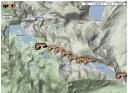
I went camping with my seven year old twins in the Desolation Wilderness near Lake Tahoe over Labor Day weekend and took my SPOT satellite tracker with me as a test. It proved pretty useful for my wife to keep an eye on our progress and I certainly felt reassured to know that we could summon help in an emergency. While it might not attract millions of users, there certainly seems to be a good niche for the product both in the outdoor market and also for keeping track of (for example) your elderly parents when they go on a long drive. I even know a colleague who uses it to keep track of where her teenage son is going in the car – I wonder how long it will take him to realize how she knows he’s not where he said he was going to be.
I wonder when we’ll see the first two way version of this device – either from Globalstar or its competitors – since it would be great to have at least an acknowledgement that your message had been delivered.

Permalink
08.14.08
Posted in Aeronautical, Inmarsat at 11:28 am by timfarrar
According to a recent Economist article Air France has found that “On a typical flight about 100 text messages were sent or received and ten megabytes of data transferred by a dozen BlackBerry users”. This level of usage seems very high, given that Blackberries can usually synchronize with 100kbytes or less of data and the usage level given here is 800kbytes per Blackberry. We questioned OnAir’s PR representatives and they confirmed that the data (which comes from the first phase of the Air France trial, before introduction of voice) was quoted correctly.
Inmarsat also stated on its Aug 6 results call that initial Air France trials had seen usage levels of around 300 minutes per day, so combined this would produce total end user revenues of well over $1000 per plane per day, significantly in excess of our expectations (and the Qantas trial which had data only usage of $100-$150 per day). However, we have heard from another source that usage revenues (for voice and data combined) on the Air France aircraft in the second phase of the trial were at a rather lower level of around $400 per day, very close to (or even below) our expectations.
We’re waiting to see if any more data emerges to clarify likely usage. As we’ve noted before, this is critical to determining the rate of installation, particularly on short haul aircraft, since airlines need to see a minimum usage of about $800 per day to make a profit after paying for the equipment and cost of flying it around. Only then will financially strapped airlines be willing to push forward with fleetwide installations in the current economic climate.
Permalink
« Previous Page « Previous Page Next entries »


