05.14.10
Posted in Financials, Handheld, Operators, Services, Spectrum, TerreStar at 10:26 am by timfarrar
Back in March, I was lucky enough to try TerreStar’s Genus phone at the Satellite 2010 conference. At that time it was clear that the phone needed further work to get it ready for commercial service, and recent filings from TerreStar indicate that the company is now working with HNS on an “ATT-QoS Workaround” to address some “APN Issues” (APN or Access Point Node relates to data services, which I did not try to use back in March).
UPDATE: I’m told by a technical expert in this area that the GMR1-3G protocol used by TerreStar treats all information as packet data, including voice (which has the highest QoS). Given that AT&T’s terrestrial network carries voice over GSM and does not normally provide an equivalent voice over packet data service at this point in time, it appears quite plausible that the workaround relates to an attempt to optimize voice performance rather than being an issue for TerreStar’s data services.
However, my concerns about the viability of the Genus phone relate much more to whether the orientation-sensitivity of the phone will actually be acceptable in real world usage conditions. To use the phone you need to know where the satellite is located (roughly southwest when you are on the East Coast) and have clear visibility in that direction. Though that was simple at the Satellite conference, where this direction was out over the Potomac river, it certainly won’t always be the case in rural areas, unless its a desert or a prairie. I still remember only too well the joke I was told by a Globalstar engineer ten years ago – that their system was designed for a “man out standing/outstanding in his field”. More to the point you also need to stand still and not turn around – very different to the situation with Iridium and Globalstar handsets, where the extending antenna goes above your head and allows you to “walk and talk”.
If orientation-sensitivity does prove to be a big problem for potential users, as I think it will, then TerreStar is faced with an unpalatable choice: design a phone with an extending antenna, which will work fine, but would have no mass market appeal, or sell a phone like the Genus, which could conceivably have wider appeal, but won’t provide acceptable performance in satellite mode. Fundamentally, I therefore don’t see any reason to change the opinion I expressed last year during the DBSD bankruptcy, that “the part of TerreStar’s business plan directed to a mass market service is very unlikely to succeed”.
However, there has been one important change in the environment for TerreStar over the last six months, because the FCC has now held out the possibility that 2GHz MSS spectrum holders will be able to participate in an incentive auction, which would potentially allow them to return their spectrum to the FCC for re-auction as terrestrial spectrum without any ATC restrictions. Given the difficulty in realizing value from a satellite roaming business plan, then unless Harbinger negotiates a lease agreement for TerreStar’s satellite spectrum, as part of its planned L-band ATC deployment, it seems likely that this would be the best exit TerreStar could hope for. However, given that the FCC would only give TerreStar a proportion of the proceeds from the auction, and it would probably take a couple of years before that auction even happened (during which period TerreStar will have to raise more money to keep its satellite in operation), it is hard to imagine that the proceeds could exceed the secured debt load that TerreStar has accrued to date. Even if TerreStar did enter some sort of lease agreement with Harbinger (some details of the draft term sheet for the Spectrum Pooling Agreement, which appears to contemplate a “potential purchase of the S-band Spectrum” as one option, but not a takeover of TerreStar itself, have also been publicly filed), then it seems implausible that this payment would exceed the value of SkyTerra’s lease agreement with Inmarsat, which calls for payments of $115M per year, and it could very well be much less. Unfortunately even $115M per year would be insufficient to pay the interest on TerreStar’s secured debt, when it becomes cash pay next year. Remember also that if TerreStar stays out of bankruptcy, it will at some point have to pay Sprint’s spectrum clearing expenses, which Sprint has claimed exceed $100M for each of TerreStar and DBSD.
At this point in time, the future for TerreStar therefore looks pretty uncertain. More importantly for the rest of the MSS market, it is far from clear whether the Genus phone will provide meaningful competition to other handheld MSS providers, and even whether AT&T will actually go ahead with any large scale commercial launch of the handset. I’m sure everyone will be watching with interest to see what news emerges over the next few weeks.
Permalink
03.17.10
Posted in Financials, Handheld, LightSquared, Operators, Regulatory, Services, Spectrum, TerreStar at 8:27 pm by timfarrar
This morning I had a brief chance to try TerreStar’s new Genus phone before the MSS CEO panel at Satellite 2010/MSUA-7. As pointed out in previous posts, the link is quite sensitive to phone orientation (remember not to turn around during a call). In addition, the phone software is still being optimized to address various issues such as the delay in establishing a voice channel after a call is answered, and the registration time necessary to switch from cellular into satellite mode. However, satellite SMS appears to work well (both to and from the phone) and may end up being more important to TerreStar than originally anticipated. It will therefore be interesting to see to what degree TerreStar is able to take customers away from Iridium and other MSS providers (as TerreStar’s CEO indicated was his ambition) once the phone enters commercial service in the next few months.
While some questions remain about TerreStar’s satellite service, more clarity is emerging about Harbinger’s likely ATC plans after the release of the National Broadband Plan yesterday. As we noted a few weeks ago, it appears that a consortium is being put together by Harbinger (and a team of executives recruited) to build a new entrant LTE-based mobile broadband network, using a mixture of spectrum in the L-band, 2GHz band, 1.4GHz band and 1670-75MHz band, along with substantial vendor financing. The Broadband Plan indicates that the FCC is likely to be supportive of moves to accelerate the deployment of an ambitious ATC network, though Harbinger’s network would probably not require any substantive changes to current FCC regulations. It has been suggested to us that the network would ultimately require $4B of capex and another $4B in funding for subscriber acquisition and other costs, indicating a similar scale of ambitions to Clearwire, which is targeting a subscriber base of 30M users over a 10 year period. Such a plan would certainly be a transformative move for the entire MSS industry (even if its focus is almost entirely on terrestrial services), and so all of us will be waiting with bated breath to see whether Harbinger realizes its plans, something that now seems more likely than not to become clear in the very near future.
Permalink
02.18.10
Posted in Financials, Handheld, Inmarsat, LightSquared, Operators, Regulatory, Services, Spectrum, TerreStar at 8:05 pm by timfarrar
The FT’s Alphaville blog has highlighted various documents filed by SkyTerra with the SEC as part of its going private transaction with Harbinger, and suggested that Harbinger is still focused on the acquisition of Inmarsat that it originally proposed back in July 2008.
However, in our view these documents actually indicate the opposite, that although Harbinger is actively attempting to put together a consortium to fund an ATC network deployment, this is unlikely to include a bid for Inmarsat. The UBS analysis for Harbinger in July 2009, suggests three possible strategic options after the privatization of SkyTerra (Sol), namely:
(a) Acquire Inmarsat (Ignis)
(b) Pursue the Inmarsat (Ignis) Coordination Agreement
(c) Lease TerreStar (Taurus) Spectrum.
Over the last several months, it is clear that Harbinger has in fact pursued options (b) and (c) rather than option (a) (although admittedly it would not be able to launch a bid for Inmarsat prior to the SkyTerra takeover):
- SkyTerra declared the Inmarsat Coordination Agreement effective in December 2009 (prior to the two year deadline for this action); and
- TerreStar announced in January 2010 that it had entered a 90 day exclusive negotiation period to lease its satellite spectrum to Harbinger in exchange for an advance of $30M against its prior terrestrial (1.4GHz) spectrum lease to Harbinger.
While the Inmarsat coordination agreement (including its payment of $250M to Inmarsat to fit filters to existing Inmarsat terminals) is a necessity to make use of SkyTerra’s spectrum in any ATC network, in our view the potential Harbinger-TerreStar satellite spectrum lease is a direct alternative to pursuing a takeover of Inmarsat (albeit one which may not give access to European S-band spectrum, unless TerreStar is successful in its challenge to the European S-band process, or either Inmarsat or Solaris give up their licenses for this spectrum).
Similarly, while we understand that Harbinger is attempting to raise money from a consortium of investors over the next month or two, using this new funding to acquire Inmarsat would mean that it could not be used to fund a near term buildout of an ATC network. In fact, given the rise in Inmarsat’s stock price over the last year, it appears plausible that Harbinger might even decide to sell off some of its Inmarsat shares in order to provide funding for an ATC deployment, especially if Inmarsat decides to go down the route of spending its cashflows on a new I5 constellation with Ka-band capabilities.
There would be two ways in which an ATC network deployment could happen: if the buildout was funded by an existing wireless operator as a way to add capacity to its existing network, or as a (self-funded) standalone 4G new entrant to the US wireless market. We believe that Harbinger is pursuing the second of these alternatives at present, because the (less expensive and risky) first option is simply not open to it for the foreseeable future. As SkyTerra notes in its preliminary proxy statement:
“The Company had been actively pursuing a major strategic partner for a considerable period of time. In addition, during early to mid 2009 the Company had pursued and encouraged such parties to submit indications of interest to make an investment in and/or acquire the Company. No such partnering efforts were successful and no bona fide offers were received. In the judgment of Morgan Stanley, it was unclear that there was a short-or-medium term need for additional spectrum by ATC companies who were potential strategic partners. In addition, potential strategic partners had sources of spectrum other than through a partnership with SkyTerra, including via spectrum auctions by the FCC, and sales from SpectrumCo, Clearwire or from other entities in the satellite sector.”
Thus the pressing question is whether Harbinger will now be able to convince prospective partners/investors that a new entrant wireless business plan (presumably similar to that of Clearwire but based on LTE) would make sense. Though some funding might be available from (for example) an equipment vendor who would like to demonstrate its 4G technology (as has happened with Clearwire), it is less obvious who might be interested in providing distribution. Most importantly, with doubts persisting about whether Clearwire (with significant backing from wireless and cable operators) will be able to develop a sustainable 4G business, Harbinger will need to demonstrate a compelling reason why customers should choose its service over those of more established wireless providers. The only credible differentiator for such a wireless network lies in the satellite roaming capabilities that will be available (and mandated) in an ATC network deployment (and which Mr Falcone suggested to the Wall St Journal back in April 2009 would attract “vast global demand”). Thus potential partners’ attention will need to be focused on the TerreStar Genus phone (which now looks like it will come to market sometime in the second quarter of this year, after the deadline for Harbinger to complete its potential satellite spectrum lease with TerreStar), and whether they believe it can provide a compelling demonstration of competitive differentiation and market demand, based on this satellite roaming capability.
Permalink
01.05.10
Posted in Financials, Handheld, Operators, Regulatory, Spectrum, TerreStar at 4:39 pm by timfarrar
There’s a lot happening with TerreStar at the moment, as the company tries to complete the exchange offer to extend the maturity of its preferred shares. The deadline has now been pushed back until early February, while in a separate development, Echostar’s representatives have resigned from TerreStar’s board, effective December 31, 2009.
In the meantime, all eyes will be on the FCC, which needs to approve TerreStar’s ATC application (made back in the summer of 2007) before January 20, 2010 to prevent TerreStar defaulting on its loan agreement for the second satellite, which TerreStar’s deputy GC described in an October 2009 submission to the FCC as an event that “would likely be catastrophic to the company”. TerreStar will certainly be hoping that the FCC’s indications that it is taking another look at MSS allocations as one of the options to free up more spectrum for wireless broadband will not cause them to delay approval of TerreStar’s ATC application beyond this deadline.
Jan 13 update: TerreStar has just received its ATC license, and can look forward to launching commercial service in the “first or second quarter” of 2010 (per its recent statement to Satellite News) once the current testing phase is complete and the company has completed its Preferred Stock Exchange Offer and raised additional funding.
We’re planning to publish our new profile of TerreStar later this month, including forecasts of the market opportunity for both MSS and ATC services, and are also looking forward to trying out the TerreStar Genus phone when its demonstrated at the SATELLITE 2010 show in Washington DC in March. Its going to be fascinating to see whether TerreStar can succeed where others have failed in creating mass market demand for two-way MSS.
Permalink
10.16.09
Posted in Globalstar, Handheld, Iridium, Services, TerreStar at 12:07 pm by timfarrar
At the SATCON conference in New York this week, TerreStar was showing its Elektrobit Genus phone. The company had conducted live demos of calls over the satellite at the IACP conference in Denver the previous week (with reportedly very good results in terms of call quality), but unfortunately a similar opportunity wasn’t available in New York. Nevertheless a few interesting facts emerged about the phone.
Firstly you have to switch manually into satellite mode (via a menu selection) in order to use either voice or data over the satellite. This was not necessary from a technical perspective (the phone could have roamed automatically since the satellite is basically treated like an international GSM network), but was insisted on by AT&T so that users know they will incur roaming charges, and that they will not be able to get the same quality of service that they would expect from a terrestrial network (i.e. they will have to stand outside, and not be inside a building or a car).
Secondly, as shown in the picture below, there is an external antenna port, enabling a cradle-type device with an external antenna to be connected, so that adequate link margin is available in Northern Canada and Alaska. The external antenna is a quad helix antenna about 0.3 inches in diameter (about the size of the Thuraya antenna) and 3 inches in length which swings up from the back of the cradle in the same manner as the rotating antenna on the old Iridium 9505 phone. These cradles will be sold separately (pricing is unclear but we’d guess in the $100-$200 range) and will increase the handset volume by about 60%.

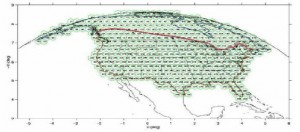
In the lower 48 states and southern Canada (i.e. below the red line in the map above) the Genus phone uses an internal patch antenna located at the right upper corner of the phone in the picture above. It will be particularly interesting to see how sensitive the call quality is to the orientation of the phone when it is being used in practice – users are instructed to hold the phone so that their fingers do not obstruct the link (per the sticker on the back of the phone), but if you are moving around, then inevitably your head will come between the phone and the satellite some of the time. TerreStar’s very large (i.e. very sensitive) satellite antenna will certainly help to close the link, but given how many arguments there have been on conference panels we’ve chaired in the past between proponents of getting the antenna clear of the head (i.e. Globalstar, Inmarsat and Iridium) and those who don’t believe an external antenna is needed (i.e. TerreStar and SkyTerra), this will be one of the first things to examine when the phones become available for testing.
Permalink
09.30.09
Posted in Financials, Handheld, Operators, Spectrum, TerreStar at 4:38 pm by timfarrar
TerreStar and AT&T have now announced that AT&T will distribute TerreStar’s Genus (Elektrobit) phone to “government, first responders, public safety, energy, utility, transportation and maritime users” and given additional details of the expected pricing for this satellite-cellular roaming service. The phone will cost $800 to $900 (subsidies were not mentioned, which is perhaps not too surprising given that the service is not being targeted at consumers initially), and then in addition to a standard voice plan, subscribers will need to pay $24.99/month for satellite access and an additional usage fee for satellite roaming (in the United States) of $0.65/minute for voice and $5/Mbyte for data.
TerreStar and AT&T are basically targeting the existing handheld MSS market, but expect that the phone will be deployed more widely, because it will become an “everyday” phone for end users, rather than being a shared phone which is kept in a cupboard for emergencies. In our view, the size of the potential addressable market is probably not too far off that for Land Mobile Radio, where we estimate there are around 2.5M to 3M handsets in use in the US today, with about half in public safety and the rest in other government and private sector market segments (parks, utilities, railroads, energy, etc.). Of course only a fraction of those users also carry a employer-provided cellphone, and at this point in time, TerreStar’s solution is more likely to be a replacement for that device rather than for an LMR radio itself. So let’s assume AT&T and TerreStar are targeting a potential market of say 1M people. For comparison, today there are about 170K MSS phones in use in the US and Canada (including many Globalstar phones with limited two-way service at present), of which probably just under 100K are in the lower 48 states (and remember that the TerreStar phone is unlikely to work as reliably as Iridium or Globalstar in Alaska or Northern Canada).
In that context, TerreStar would be doing amazingly well if it could gain 50K subscribers by the end of 2010 and 100K-150K subscribers by the end of 2011 (when SkyTerra also expects to be offering next generation services, and Globalstar will be back in full two-way service). Remember also that in 1999-2000, despite massive advertising (at least in Iridium’s case), Iridium and Globalstar only managed to gain a few tens of thousands of users on a global basis in their first year of commercial service. TerreStar will probably share the end user revenue about 50/50 with AT&T (Iridium and Inmarsat expect to get about 70% of retail revenue but AT&T would likely want a bigger incentive to promote the service) and monthly retail ARPUs (including the satellite access fee but excluding any terrestrial voice plan) might be expected to be between $40 and $50. So let’s assume TerreStar receives $25 per user per month. If there are (in the most optimistic scenario) an average of 20K subs in 2010 (assuming deployment ramps up towards the end of the year) and 100K subs in 2011, then that would generate service revenues for TerreStar of $6M in 2010 and $30M in 2011. There would presumably be additional equipment revenues (although we doubt TerreStar is looking to make a profit on equipment sales) and perhaps revenue from some other services like M2M data (once chipsets are available, which means only a limited amount of revenue could be produced even in 2011).
However, its pretty clear that TerreStar is going to need to raise additional funds to cover its operating costs in the near future, since its cash burn rate even before going into full commercial service is about $25M per quarter, and excluding the money purchase agreement for the second satellite (not part of this $25M cash burn), TerreStar had $110M of cash at the end of June 2009. Thus regardless of what happens to the $430M of preferred shares (which must be redeemed or converted next April), TerreStar will need to raise more money by mid 2010. From mid 2011, TerreStar will also need to begin paying cash interest on its debt, at an annual rate of more than $150M per year in 2012.
Given the relatively limited opportunity in professional markets (at best a few hundred thousand subscribers for TerreStar, once the overall market is shared with SkyTerra and other MSS operators), TerreStar will eventually need to either achieve considerable success in consumer markets (requiring a dramatically different price point for both equipment and airtime) or find a strategic partner interested in buying or leasing the company’s 20MHz of spectrum for a terrestrial ATC deployment (which doesn’t look likely in the near term, not least because TerreStar doesn’t even have an ATC license as yet). In this context, its probably most appropriate to look at TerreStar’s initial service offering as a proof-of-concept (and a means to justify further funding) for one of these two longer term possibilities, rather than as the means to generate an immediate financial return on its own. We’ll see over the next 12 months whether TerreStar is able to provide the proof that both the financial markets and potential strategic partners will be looking for.
Permalink
09.09.09
Posted in Globalstar, Handheld, Inmarsat, Iridium, Operators, Services, TerreStar, Thuraya at 12:43 pm by timfarrar
Unfortunately its not new services, but the prices of current and future satellite phones and airtime that seem to be headed upwards. The last year has seen Iridium introduce its new, improved 9555 handset at a higher price than the 9505A that it replaced, with phones now selling for about $1500, while Thuraya has “simplified” (i.e. increased) its airtime pricing and introduced the more expensive ruggedized XT phone. Inmarsat admitted in June that its new GSPS handset may sell for up to $750 at launch in 2010, compared to the $500 retail price point it suggested previously. Even TerreStar has now indicated that its new handset may cost up to $800, with airtime pricing at “less than $1 per minute”.
We’ve commented before on how satellite phone revenues have been falling since 2005, and competition has certainly diminished as Globalstar has experienced problems with its two-way services over the last couple of years. However, it seems the consensus amongst current participants in the handheld MSS market is that there is little if any growth potential still left in satellite phones, and the actions of Iridium and Thuraya appear to indicate that their remaining customers are relatively price insensitive.
Even more surprising is that so far, at least, the new entrants do not seem to be particularly keen on shaking up the existing “premium price” paradigm for satellite phones. In the case of TerreStar this is rather worrying, given that their objective is to greatly expand the satellite phone market, and bring satellite-cellular roaming to a mass market, which seems very unlikely to happen with an $800 phone. Is TerreStar simply trying not to give too much away about its future pricing plans, while it focuses on developing all the other elements needed for a commercial service, such as distribution channels, billing systems, etc.? Will TerreStar actually be able to convince a cellular operator to subsidize its phone (which would require a significantly greater commitment from a partner than its current roaming agreement with AT&T)? We should find out soon, as TerreStar intends to launch commercial services at the end of 2009.
Permalink
07.01.09
Posted in Financials, Globalstar, Handheld, ICO/DBSD, Inmarsat, Iridium, LightSquared, Operators, Services, Spectrum, TerreStar at 10:25 am by timfarrar
With apologies to the Eagles…its a lovely place, for MSS consumers at least. However, for MSS operators it seems to be somewhere you can check out [or go bankrupt] anytime you like, but you can never leave.
Today we’ve seen confirmation that Globalstar is now fully funded to complete the construction and launch of its first 24 second generation satellites by the end of 2010, while TerreStar has launched its new S-band satellite from Kourou, French Guiana and intends to initiate commercial services at the end of this year. Iridium also looks increasingly likely to complete its deal with GHL, since GHL’s shares and warrants are now trading well above the $10 value that would be refunded to investors if they voted down the deal. While there has been much speculation about potential mergers in the last two years, these now look less, rather than more, likely to occur in the near future (with the sole exception of SkyTerra’s Harbinger-backed bid for Inmarsat, which should be decided one way or another later this year).
Thus by early 2011, it looks like we will have at least four and more likely six voice and data MSS systems providing service in North America (Inmarsat, Iridium, Globalstar and TerreStar plus ICO and SkyTerra) and four systems (Inmarsat, Iridium, Globalstar and Thuraya) providing service in most of the rest of the world. With new advanced satellites, consumers will benefit from improved data capabilities and smaller, cheaper handheld satellite phones.
However, the development of at least three new systems (ICO, TerreStar and SkyTerra) and to some extent Globalstar as well (based on financial analysts’ comments at the time of its IPO in November 2006) has been justified largely by the value of MSS spectrum, due to the FCC’s rules enabling deployment of Ancillary Terrestrial Components (ATC), rather than by the intrinsic potential of the market for mobile satellite services itself. Thus, unless and until demand for MSS spectrum and ATC materializes, we run the risk of overcapacity for land-based MSS services, particularly in North America. This will certainly benefit end users, and price reductions (especially in conjunction with cheaper, more attractive terminals) may help to stimulate significant market growth, but it remains to be seen whether this will enable all the MSS operators to deliver a return for their investors or whether we’ll see more of them “checking out” with a bankruptcy filing as ICO North America did in May this year.
Permalink
06.15.09
Posted in Financials, Globalstar, Handheld, Inmarsat, Iridium, Operators, Services at 11:53 am by timfarrar
As Inmarsat moves towards commercial launch of its new Global Satellite Phone Service (GSPS) some time in 2010, expectations have been building in the analyst community about the potential of GSPS to gain 10%+ of the $500M satellite phone business. In reality, the $500M market estimate (given by Inmarsat in 2006 when it acquired ACeS) represents retail service revenues and is an overestimate given the significant revenue declines experienced by Globalstar and Thuraya, two of the three principal handheld satellite phone providers, in 2007 and 2008. By our estimate, Globalstar, Thuraya and Iridium generated only about $270M in wholesale service revenues from handheld satellite phones in 2008, including a significant amount from Iridium’s US government contract.
While Inmarsat will start to compete in this market during 2010, what appears to have been completely overlooked by analysts are the significant limitations of the GSPS handset. As with the current SPS phone (see p17 of the user guide), we believe that customers will be advised to use the handsfree earpierce and physically point the phone antenna at the Inmarsat satellite. Some level of user cooperation in using satellite phones is not unprecendented, since Thuraya advises customers to ensure the antenna is pointed at the satellite when operating at low elevation angles, such as in south east Australia. However, Thuraya has never achieved much success in areas where this level of user cooperation is required, and the feedback we’ve heard on the first generation SPS phone that’s in use today has been pretty negative.
Inmarsat will certainly be able to improve the performance of the GSPS service within the EMEA region, to a level comparable with Thuraya, once its more capable Alphasat satellite is launched in 2012. However, Inmarsat will be constrained in the size of the antenna that it can use on future satellites, due to the need to maintain its existing levels of maritime coverage, so Inmarsat is unlikely to be able to extend similar levels of handheld performance globally without very substantial incremental capital expense.
Thus it does not appear that GSPS will be a realistic challenger to Iridium as a global satellite phone, and it may not be easy for Inmarsat to reach its target of a 10% market share within two years of launching the product, especially if Globalstar completes its next generation system and re-enters the market as a low cost handheld provider by early 2011. More importantly, as Iridium seeks to fund its next generation system (a prospect of which Inmarsat has been openly scornful), it will be able to make a very strong argument to the US government that Iridium NEXT is a necessity to maintain support for global handheld satellite services, on which US soldiers are increasingly reliant.
Permalink
03.04.09
Posted in Globalstar, Handheld, Inmarsat, Iridium, LightSquared, TerreStar at 11:52 am by timfarrar
Its been revealed today that EMS has taken a $3.4M charge to terminate its work on the Inmarsat next generation satellite phone, and that Inmarsat will be assuming “more control over production phases of the product development”. This is the latest in a long line of setbacks for the ISatPhone, with the first generation phone failing to achieve any meaningful traction and repeated delays in completion of the next generation phone since Inmarsat acquired the ACeS customer base two and a half years ago.
In our view, a key reason for the failure of the original phone was its poor performance on the Inmarsat I4 satellite, with users advised to use a hands-free kit and keep the phone antenna pointed at the satellite! It remains unclear if EMS had solved these technical challenges with the new phone (which are caused by the smaller 9m antenna on the I4 satellites, compared to the 12m antennas used by Thuraya and AceS), and therefore it is quite possible that serious constraints may still apply to the usability of Inmarsat’s new handheld, a concept model of which is shown below. Certainly we expect that it will be difficult if not impossible for Inmarsat to ensure satisfactory handheld performance in Alaska and much of Canada.

The launch of the new phone had already been pushed back from early 2009 to the end of the year, with features such as packet data dropped to save time and money. Now it looks like Inmarsat will experience a further delay until well into 2010, and yet another increase in costs, adding to a development program which already totals around $100M. We will be looking with interest at whether Inmarsat maintains its stated intention to sell the phone for around $500 retail, thereby making it even harder to recover its investment in handset development. Notably, this price point has already met with pushback from potential distributors, who would be unable to realize the margins they make today on the sale of other satellite phones.
The clear winner is Iridium, who will have even more time than they had expected to capitalize on the lack of handheld competition from Inmarsat, and who managed to complete the development of their new 9555 phone on time and at a cost of less than $10M. Other current and potential satellite handheld providers, such as Globalstar, Skyterra and TerreStar, who have faced a barrage of criticism from Inmarsat in recent months, will also be rubbing their hands with glee at Inmarsat’s embarrassment.
Permalink
« Previous Page « Previous Page Next entries »


