05.26.11
Posted in Financials, LightSquared, Operators, Regulatory, Spectrum at 12:24 pm by timfarrar
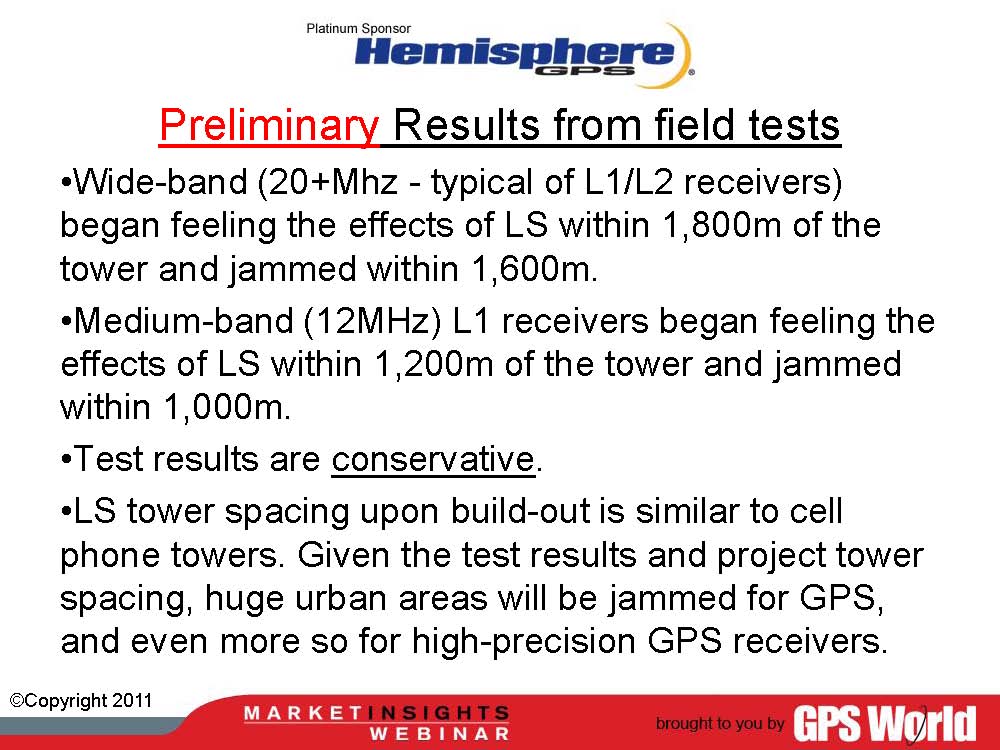
Over the last week, a clearer picture has begun to emerge of LightSquared and the GPS industry’s respective strategies, as interference tests continue in Las Vegas. Some data is now emerging from these tests, with a GPS World webinar this morning citing that in a rural test case (see presentation), high precision receivers were impacted up to 1800m from the base station (although the radius of interference would obviously be less for narrowband GPS receivers and for more urban environments with higher levels of clutter).

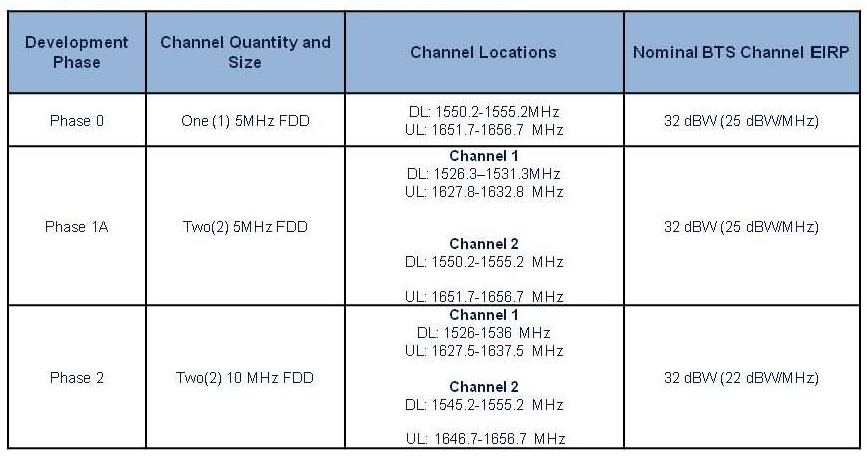
Given that the problem is mainly caused by transmissions in the upper channel (Phase 0 spectrum) closest to the GPS frequencies, LightSquared is already indicating that it will offer to operate only below 1545MHz, until the FCC introduces receiver standards and old GPS equipment is phased out (a process that will take many years to complete). As Jeff Carlisle of LightSquared commented in a May 23 Space News article: “If the most efficient and fair solution is not to do a receiver-side solution, we haven’t taken any of the possible transmission solutions off the table. We can look at ways of implementing our service, how we do it, when we do it, using what spectrum”. Indeed LightSquared has just paid Inmarsat another $40M to speed up the availability of the Phase 1A spectrum, and moved back its commercial deployment timeline into the first half of 2012 for precisely this reason.
However, as problems have emerged with the testing in Las Vegas, it appears that the GPS industry will demand that significant additional testing must be carried out, before LightSquared is given permission to launch commercial service even in the lower part of the band. As Alan Cameron of GPS World put it on this morning’s webinar, LightSquared does not have the full software [needed to operate its base stations in the way it plans to do commercially] so the current testing is premature. A letter sent to the FCC last week, signed by 33 senators, even asks the Commission to “rescind LightSquared’s waiver until this demonstration [of non-interference with GPS] is made”. Of course, as everyone should know, a demonstration of total “non-interference” is impossible.
Next week we should expect to see more data on the government’s testing of interference in New Mexico, based on the charter of the National Space-Based PNT Systems Engineering Forum, which was tasked to produce a final report “in a publicly releasable version” by May 31, 2011. Indications to date are that this testing certainly does not demonstrate “non-interference” with GPS (and the report itself will written by proponents of GPS not LightSquared), so this is likely to intensify the political firestorm aimed at LightSquared and the FCC.
UPDATE: The FAA report is also scheduled to be released on June 3 and, according to a report in FlightGlobal, the conclusions also appear to be problematic for LightSquared, notably a statement that “From an aviation perspective, operations at Phase 0, 1 and 2 spectral deployments, the upper channel [frequencies above 1536MHz] should not be permitted”.
FURTHER UPDATE: The FlightGlobal article has now been taken down, but is still available here and a more complete report on the study is available here. Also the House of Representatives has now passed the National Defense Authorization Act (NDAA), with strengthened language apparently requiring that the FCC should not provide “final authorization for LightSquared operations until Defense Department concerns about GPS interference have been resolved”. If that bill passes the Senate and is signed by the President, then it would seem likely to stop any prospect of near term commercial operations by LightSquared.
Of course, a requirement for more testing and a further delay to LightSquared obtaining permission to commence service (at best) or a withdrawal of the waiver (at worst) could very easily derail the LightSquared venture completely. I’m told that LightSquared had been hoping to raise money from private equity sources and then undertake an IPO in July, after signing a provisional network sharing agreement with Sprint. This new funding is a pre-requisite for Sprint to move forward with any buildout under the network sharing agreement, because of the upfront costs that it would incur, and so Sprint needs to be convinced that LightSquared will be able to reimburse these costs, either with cash or spectrum rights.
With Sprint expected to announce its plans for Network Vision this summer, LightSquared therefore needs to achieve some certainty about its spectrum position very soon, or risk missing that boat. Ominously, at a New America Foundation event in Washington DC two weeks ago featuring LightSquared’s CEO, Sprint noted that it would be able to host other spectrum on its Network Vision platform, including “possibly Clearwire, possibly public safety”, but conspicuously failed to include LightSquared on that list.
Permalink
05.18.11
Posted in LightSquared, Operators, Regulatory, Spectrum at 7:10 pm by timfarrar
Today, it was reported that LightSquared has revised its deployment plans, and now expects “field trials in the third and fourth quarter this year in Baltimore, Las Vegas and Phoenix” followed by “a ‘full-blown commercial’ launch…scheduled for early next year” rather than “by the end of this year” as was indicated in April. Even that was slower than in January, when LightSquared suggested that it was “testing LTE in Baltimore, Denver, Las Vegas and Phoenix now” and was “expected to launch up to nine Midwest markets this year”.
Back in January, LightSquared was granted a waiver by the FCC, based on commitments that the company was “confident that this [GPS interference] issue can be resolved without delaying deployment of wireless broadband, generally, or the LightSquared network specifically” and that “LightSquared was cognizant of this issue when we made the buildout commitments that served as the basis for the Commission’s own requirements in its March 2010 Order”. Indeed LightSquared also indicated that it would not “continue to roll out our network and meet the rigorous construction timetable that the Commission has made a condition of our authorization” unless the FCC takes “quick, favorable action” to approve its updated business plan.
However, despite the FCC acceding to LightSquared’s waiver request, based on these assurances, it now seems that LightSquared will delay the rollout of its network and blame the GPS interference issue, saying that “the company is watching the FCC before fully rolling out its ground-based network”. It would be understandable if in these circumstances the FCC was becoming somewhat impatient with LightSquared’s progress, and LightSquared’s CEO has recently been doing the rounds of FCC Commissioners, presumably with a view to shoring up LightSquared’s support at the FCC.
UPDATE: LightSquared has told DSLReports that “they’ve always planned their first commercial launch to be in early 2012″. Of course that’s not what LightSquared told the FCC in March 2010, who quoted as part of their public interest rationale for approving the Harbinger takeover that “Service will begin in two trial markets with a commercial launch commencing before the third quarter of 2011, providing service for up to 9 million POPs”.
Looking at LightSquared’s latest statements in more detail, it also appears that Denver has been dropped from the original deployment plan (indeed back in March 2010 LightSquared told the FCC that “service will begin in two trial markets, Denver and Phoenix, with a commercial launch before the third quarter of 2011 providing service to up to 9 million POPs”). It isn’t terribly surprising that the initial rollout will now take place in Las Vegas, because that is basically the easiest major city in the entire US to cover with a wireless network, due to the lack of foliage and the flat terrain. Indeed, ICO (now DBSD) was able to cover the city very well (albeit without the intention to provide indoor coverage) with only 3 base stations, during trials of its MIM service in 2008, as shown in the diagram below.

In Phoenix, I’m told that LightSquared’s site acqusition partner shut down its operations back in January, and at that point the tower companies were no longer being paid rent for the 20 site leases that had been signed. In Baltimore I understand that only a very limited proof of concept deployment was planned (with a handful of base stations at most), to determine the extent of interference with Inmarsat’s maritime safety services. Given this information, unless something significant has changed in the last few months, it seems that at best only a minimal deployment effort is taking place ahead of the potential network sharing agreement with Sprint, and associated contract with Ericsson, that everyone expects to emerge soon (and which today’s Clearwire agreement with Ericsson presumably provides a template for).
Permalink
Posted in LightSquared, Operators, Regulatory, Spectrum at 9:04 am by timfarrar
As more information starts to emerge from real world testing into whether LightSquared’s terrestrial network will interfere with GPS receivers, the news appears to be fairly bad for LightSquared on both the technical and political fronts. In addition to Qualcomm’s comments last week, suggesting that the filters in their A-GPS chipsets might need to be upgraded, New Mexico state officials have submitted a letter stating that their testing “substantiate[s] concerns that the LightSquared network will cause interference to GPS signals and jeopardize 911 and public safety nationwide”. Meanwhile the FCC has been asked by Sen. Chuck Grassley (R-Iowa) “for more information on its review” of LightSquared’s plans, including “all communications between the FCC and Falcone or any other Harbinger Capital and LightSquared employees [and] all internal FCC communications regarding LightSquared or Harbinger Capital” and language has been included in the National Defense Authorization Act (NDAA) that “requires the U.S. Secretary of Defense to notify Congress if he determines that widespread interference with the military’s use of the GPS is caused by a commercial communications service”.
What I’ve always found intriguing is that this issue apparently came out of nowhere to potentially derail the whole LightSquared buildout plan. LightSquared has highlighted that terrestrial use of the L-band has been anticipated since 2003, and that the GPS Industry Council negotiated several agreements with LightSquared (previously SkyTerra and before that MSV) on out-of-band emissions into the 1559-1610MHz band, starting in 2002 and extending right up until August 2009. Indeed in March 2004, the GPS Industry Council urged “the Commission to grant the above referenced [ATC] applications of Mobile Satellite Ventures Subsidiary LLC (“MSV???), and to do so as soon as possible”, commending MSV “for its proposal to use its spectrum in a responsible manner that ensures the continued utility of GPS receivers operating in the vicinity of MSV ATC stations”.
However, it appears that the GPS Industry Council never recognized the potential for GPS receiver overload from transmissions within LightSquared’s own L-band frequencies. Given their comments above, it seems plausible that they were lulled into a false sense of security by LightSquared’s cooperation over out-of-band interference, including limiting the PSD to -100dBW/MHz or less, a very aggressive commitment, giving a high level of protection to GPS receivers. Of course, LightSquared also benefited from that commitment, because to filter LightSquared’s emissions to this level requires about 3-4MHz of separation between the edge of the GPS band at 1559MHz and LightSquared’s terrestrial transmissions at 1550-1555MHz. When similarly challenging constraints were imposed on Globalstar at 1610MHz, it meant that Globalstar would be less able to operate high power terrestrial transmissions at the bottom edge of its L-band frequencies, restricting Globalstar’s ability to support ATC in its more limited Big LEO L-band allocation (and thereby hampering potential competition to LightSquared).
Given the complexity of these issues and how critical their resolution was in obtaining LightSquared’s ATC license, it is hard to believe that no-one at LightSquared was aware of the possibility of GPS overload interference until it was raised in December 2010. Indeed, in an offhand comment in March 2011, even Mr. Falcone’s wife apparently suggested that “this type of interference has always been a potential issue for GPS”. Nevertheless, it appears that no mention is made of such problems in the risk factors section of SkyTerra’s 10-K filings with the SEC, and the 2009 10-K filing basically states the opposite, noting that “We have also agreed to comply with requirements on our user terminals and base stations that we negotiated with the GPS industry to provide additional protection to GPS receivers, beyond existing mandatory limits. Our compliance with these limits is a condition of our ATC license. All of our broadband wireless system designs take into account these requirements and specifications. We believe that they do not materially limit our network deployment or our ability to achieve our business plan”.
Summing up, it seems that the GPS Industry Council clearly dropped the ball when it came to analyzing the potential impact of LightSquared on GPS receivers. However, they may very well feel that they were the victim of a bait and switch play, thinking that MSV/SkyTerra was being extremely cooperative with its expressed intent to “ensure the continued utility of GPS receivers operating in the vicinity of MSV ATC stations”, when in reality out-of-band interference was not most important issue to consider.
Permalink
05.10.11
Posted in Inmarsat, LightSquared, Operators, Regulatory, Spectrum at 3:04 pm by timfarrar
As testing continues into whether LightSquared will interfere with GPS signals, Qualcomm has filed the results of its own initial cellphone testing with the FCC. Of course, LightSquared is depending on Qualcomm as its principal supplier of chipsets and developer of the GMSA/S-EVDO air interface for its satellite services, so it might have been expected that Qualcomm would confirm the position asserted by LightSquared supporters, that cellphones won’t need to use filters to prevent interference with their A-GPS location chips. However, in fact Qualcomm has come to the initial conclusion that “additional rejection of 30dB may be required” and that the current filters used in its A-GPS chipsets may need to be upgraded, in view of how close the upper part of the LightSquared downlink band (the Phase 0 spectrum at 1550-1555MHz) is to the GPS band. Given that most people agree that the interference problem will likely be much worse for other types of GPS receivers, this is not an encouraging result for LightSquared.
LightSquared may therefore be unable to use the Phase 0 spectrum unless receiver standards are imposed on GPS receivers, as the FCC suggested in its recent 2GHz ruling, which indicated that “incumbent users…must use receivers that reasonably discriminate against reception of signals outside their allocated spectrum”. However, Inmarsat indicated yesterday that on April 25, it signed an amendment to its Cooperation Agreement with LightSquared, and received an additional payment of $40M to accelerate the clearing of the Phase 1A spectrum (i.e. to free up the additional 2x5MHz block at the bottom of the L-band, which under the original agreement would have been made available sometime between February and November 2012). Thus it appears that even LightSquared may be acknowledging that the top part of its frequency band will be largely unusable for the foreseeable future, unless and until receiver standards are imposed on the GPS community, requiring a multi-year program of equipment upgrades and recertification, with all of the additional costs and delays that would imply.
Permalink
04.07.11
Posted in Regulatory, Spectrum at 12:08 pm by timfarrar
As I noted when AT&T announced its deal with T-Mobile a couple of weeks ago, one of the most interesting facts in AT&T’s presentation was that it included significant detail on the traffic growth experienced on AT&T’s wireless network. Back in January, T-Mobile also put forward its own expectations that traffic would grow at 60% p.a. between 2010 and 2015.
If we compare these figures (assuming T-Mobile’s figure holds for 2009 as well) and look at the ratio of 2014 data traffic to that in 2009 then the Cisco projections are a striking outlier, and the AT&T and T-Mobile expectations are dramatically lower than any of the analyst forecasts. It should also be noted that the AT&T network traffic estimates appear to include the acquisition of TMO, so the actual growth in traffic per subscriber is even lower – AT&T states that its expectation is for 8-10 times growth between 2010 and 2015, very much in line with TMO’s growth projection. Even if data traffic on other wireless networks grows faster than on AT&T’s network, it hardly accounts for a factor of two difference in overall growth, let alone a factor of 4-5 as Cisco estimates.

So why do we hear so much from the FCC Chairman about the Cisco forecast as justification for the FCC’s actions to save us from the supposed “spectrum crisis”? As commentators have pointed out, it is after all primarily a sales brochure for Cisco’s network equipment. As an aside, the latest Feb 2011 Cisco forecast even appears to overestimate current wireless traffic, estimating North American wireless data traffic was 49Pbytes per month in 2010, when an extrapolation from AT&T’s figure of 12Pbytes per month at the end of 2010 (assuming AT&T is 40% of US traffic, and the US is 90% of North America) would indicate that the actual traffic is closer to 33Pbytes per month. Why also is the FCC basing policy on its deeply flawed October 2010 paper, which assumes 35 times growth between 2009 and 2014?
In my conversations with knowledgeable observers since the AT&T/T-Mobile deal, there seems to be an increasing recognition that the “spectrum crisis” is exaggerated and that there is no near term shortage of spectrum. If the FCC wants to make the case that we need more spectrum by 2018 or 2020 then that’s fine, and maybe it is true that political action is needed on incentive auctions now so that broadcast TV spectrum can be brought into use by 2018. However, basing your arguments on projections that are hugely exaggerated risks the whole edifice tumbling down once these errors are exposed.
Permalink
04.06.11
Posted in LightSquared, Operators, Regulatory, Spectrum at 10:50 am by timfarrar
One of the key issues for LightSquared is that the downlink transmissions from its base stations are expected to interfere with a wide range of GPS devices, which operate in adjacent frequencies. LightSquared will be using part of the L-band downlink frequencies (1525-1559MHz), while GPS (and GLONASS) operate within the 1559-1610MHz band. Though LightSquared’s base stations will be fitted with filters which cut off the signal abruptly at the top of the L-band, so LightSquared’s signals do not leak into the GPS band, the filters on most GPS devices do not have such a strict cutoff at the bottom of the GPS band, and so can be overwhelmed by the very high power LightSquared terrestrial transmissions in the adjacent L-band frequencies. A good illustration of the impact is given in this chart from a Deere & Company submission to the FCC:

As this chart shows, the types of receivers that are most affected are high precision receivers used in applications such as farming and surveying, although lower precision receivers such as those incorporated in automobile navigation and even in cellphones may be impacted closer to the LightSquared base stations. Aeronautical navigation is an area of particular concern, given the safety critical nature of this application. Testing is now ongoing to determine the extent of interference, and early estimates of the impact vary greatly, ranging from a few hundred meters or less up to several miles for low precision receivers, and potentially tens of miles for high precision receivers.
It appears that LightSquared expects that GPS manufacturers should “fix” their devices, in order to mitigate these interference issues, although unsurprisingly this is being resisted strongly by the GPS community, because the costs would be very significant. PRTM estimates that it will only cost 30 cents per device to fit filters to the “40M standalone GPS devices” made worldwide each year for a total of $12M. PRTM also assumes that no additional filters will be needed for the much larger number of GPS-enabled cellphones sold each year, despite Qualcomm telling the FCC in January 2011 that it plans to use a filter to prevent self-interference in L-band enabled cellphones, and had “not determined whether this filter provides sufficient protection to avoid interference to the GPS receiver from LTE base stations operating on the L band.”
In reality, whether or not cellphone manufacturers ultimately decide an additional filter is needed to protect their GPS receivers, the overall cost impact would be far, far greater than PRTM indicate. To take a directly analogous situation, LightSquared is paying Inmarsat $250M to fit filters to its L-band satellite terminals on up to 10K aircraft and perhaps 50K ships. If we assume these filters cost $30 rather than 30 cents each, then following PRTM’s calculations the cost of solving the problem would be less than $2M. However, Inmarsat expects to spend the vast majority of the $250M it is receiving on actually fixing the problem, and the filters themselves are less than 1% of the total cost. Instead, the bulk of the expenditure will go on securing approvals (including from safety authorities) for replacement equipment, then going out and fitting this equipment on ships and aircraft.
Across the GPS industry the same considerations would apply – dramatically increased costs for testing, safety approvals, retrofits of existing equipment, etc. not to mention the markups that would apply to the filter component costs as they flow through to an increased total cost of the devices sold. Many of these costs would be concentrated in lower volume and safety critical applications such as the aeronautical market, and if some GPS users experienced a permanent loss of accuracy, then there could be additional indirect costs to consumers (e.g. reduced crop yields leading to higher food costs). Just to give one example, the National Association of Wheat Growers indicated that its members have invested $3B in GPS equipment for precision farming, in order to increase the productivity and efficiency of farm processes.
Thus it is more credible to look at the total cost impact on manufacturers and consumers as being of order $1B+ per year over the next decade, as tens of billions of dollars of equipment needs to be upgraded or replaced. As in the Inmarsat situation, PRTM’s estimate of the filter hardware costs (for what was in any case only a subset of the overall GPS equipment market) likely represents no more than 1% of the total bill. Given that such a large cost impact might well outweigh the value of freeing up additional L-band spectrum, it would be very interesting to see a detailed cost-benefit analysis of these issues, so that economic rationality can play some part in the ultimate decision.
Nevertheless, despite the significant cost impact on the GPS industry and end users, the FCC might still decide to impose “receiver standards” on future GPS devices. However, it would still take considerable time before these standards became effective. For example, the FCC could easily take 12-18 months (or longer) to decide on what receiver standards to mandate, and then it might require that all new GPS receivers manufactured after say the end of 2014 were capable of withstanding potential interference. Then there would need to be several more years for older devices to be replaced or updated, with a sunset date perhaps as late as the end of 2018 or 2019 (or beyond).
Assuming that this is the path the FCC decides to follow, it is still unclear what spectrum LightSquared would then be able to use for its network in the near term. The Phase 0 spectrum which is currently available to LightSquared has its downlink between 1550 and 1555MHz, which is the channel closest to the GPS band, and so its use would likely be heavily restricted or completely prohibited until GPS receiver standards came into force. LightSquared gains access to an additional 2x5MHz channel (the Phase 1A spectrum) sometime between February and November 2012, depending on how quickly this is cleared by Inmarsat. This channel is at the bottom end of the band (1526-1531MHz downlink) and so is the least likely to interfere with GPS. LightSquared then adds 2x10MHz of additional spectrum (Phase 2) with downlinks at 1531-1536MHz and 1545-1550MHz at the end of July 2013. However, it is uncertain whether and under what conditions the use of the 1545-1550MHz band would be permitted before any receiver standards came into force.

This timeline indicates that (if Channel 1 is usable) LightSquared should have access to 2x5MHz of spectrum sometime in 2012 and at least 2x10MHz of spectrum from the end of July 2013. However, it is far from clear (even assuming LightSquared has a network contractor in place) how the company expects to offer service by the end of 2011.
More broadly, the outcome of the GPS interference testing and FCC deliberations also remains in doubt. PRTM characterized this as “a situation where the neighbor [GPS] built the fence too far over the property line and may not have realised it at the time. Now the other neighbor wants to build a pool and there is not enough space. So the question is: who has to pay to move the fence?”. However, I look at the analogy somewhat differently – regardless of where the fence is, if you have protected butterflies [defense and aviation systems] living at the bottom of both gardens, will the government let you build a pool at all?
Permalink
03.28.11
Posted in Financials, LightSquared, Operators, Regulatory, Spectrum at 8:23 am by timfarrar

In recent days, the LightSquared PR machine has moved into ever higher gear, in an attempt to persuade Sprint that it should choose LightSquared over Clearwire. Given the frantic pace of announcements, I think that Sprint’s decision may come as soon as the next few weeks, in an attempt to disrupt the AT&T/T-Mobile merger, which was partly justified by citing the competition from Clearwire and LightSquared. However, it does feel a bit like something out of Monty Python, when LightSquared claim that the disappearance of their supposed deals with Sprint and MetroPCS is just a flesh wound.
Now we have another Monty Python scene coming into view, as the House of Representative’s Committee on Energy and Commerce moves ahead with an investigation into the FCC and their “management of commercial spectrum”. As Dave Burstein reports, there are clearly some senior staff at the FCC who share my concern about whether a “spectrum crisis” is being “manufactured”.
However, with not only the FCC Chairman’s reputation, but also the fate of the AT&T/T-Mobile merger, riding on the perpetuation of a “spectrum crisis” (not to mention billions of dollars of projected future budget revenues), it seems likely that the investigation will be more focused on political point scoring than on a serious debate about future spectrum demand.
Nevertheless, if Sprint’s upcoming decision leads to the failure of either LightSquared or Clearwire, then that really ought to prompt some hard questions about whether there actually is a spectrum crisis. Let’s hope that Congress’s investigators have more analytical resources at their disposal than “fear, surprise, ruthless efficiency…and nice red uniforms”.
Permalink
03.25.11
Posted in Financials, LightSquared, Operators, Regulatory, Spectrum at 9:30 am by timfarrar
It looks to me ever more likely in the wake of the AT&T/T-Mobile deal that Sprint will soon have to choose to back either Clearwire or LightSquared, but not both. LightSquared is doing its best to talk up the idea that Clearwire’s customers are going to jump ship, having announced a deal with Best Buy with a “trial” of its LTE service starting in the first quarter of 2012, and now suggesting that it is “in discussions” with Time Warner Cable for a major deal, despite that company’s “not very impressive” results with Clearwire and TWC stating that it is “trying to spend not too much money while we are [exploring whether packaging wireless data with our wireline offerings is something that consumers want]“.
Neither of the deals that LightSquared has announced this week will generate very much revenue (I estimate a few tens of millions of dollars per year at best from Leap and rather less than that from Best Buy) and so most people are looking towards a LightSquared network sharing agreement with Sprint to show how LightSquared will move forward. This is hardly surprising given that the previous MoU with Nokia Siemens Networks appears to have fallen apart, and there is still no news about a partnership with MetroPCS on the 2GHz MSS spectrum.
Before the AT&T/T-Mobile deal it seemed that Sprint would try and have it both ways, continuing to work with Clearwire, and hoping that a spectrum sale or investment from T-Mobile would solve Clearwire’s funding challenges, while signing a network sharing agreement with LightSquared to offset some of its network upgrade costs and allow it to play Clearwire off against LightSquared when it came to negotiating wholesale bandwidth pricing.
However, it now looks more likely that Sprint will have to choose between Clearwire and LightSquared, because the two companies are competing for the same diminished pool of potential deals, and as Strategy Analytics asserts “there are probably too many 4G wholesale networks going after too few large wholesale customers”.
Despite the problems that Clearwire is facing, it has spent at least $5B so far on rolling out a network, mostly using other people’s money, and has a commercial network covering 120M people with capacity that can be sold today. From that perspective alone, it would be much less of a risk for Sprint to choose Clearwire over LightSquared. As Walter Piecyk of BTIG put it with regard to the “talks” between LightSquared and TWC: “Signing a roaming deal with LightSquared is kind of like planning a trip that goes over the bridge to nowhere. There is currently no network to use, there are material interference issues to resolve and then there is the small detail of coming up with $14 billion of cash. Good luck.”
Given these challenges, a decision by Sprint that provided LightSquared with a path to move forward would cast its already difficult relationship with Clearwire in an even more negative light. Similarly, if Sprint decides to back Clearwire as its primary provider of 4G service, it is hard to see why Sprint would expose itself to having to put up even more investment if Clearwire’s future revenue growth is impacted by competition from LightSquared. Given that AT&T has used the availability of both Clearwire and LightSquared’s networks to support its assertion that the mobile broadband market is highly competitive, the AT&T/T-Mobile merger might also be less likely to be approved, if one or other of Clearwire and LightSquared was to fail in the near term. As a result, I think that whichever choice Sprint makes could be fatal for the company it leaves on the sidelines, and ironically Sprint might even benefit from that outcome.
Permalink
03.20.11
Posted in Financials, LightSquared, Operators, Regulatory, Spectrum at 4:39 pm by timfarrar
There are known knowns; there are things we know we know.
We also know there are known unknowns;
that is to say we know there are some things we do not know.
But there are also unknown unknowns – the ones we don’t know we don’t know.
As Donald Rumsfeld’s famous speech pointed out, often the most important issues are not the known unknowns, but the unknown unknowns. There are many known unknowns in LightSquared’s plan, such as the eventual impact of GPS interference, and where they will find funding for the network buildout.
However, the ultimate outcome may in fact be dictated by things we didn’t know we didn’t know, like the negotiations that resulted in today’s deal for AT&T to buy T-Mobile. Although some observers are suggesting this would be bad for LightSquared, in fact I think its much better for them than the alternative, of Sprint buying T-Mobile, which would hardly have left much room for a new entrant 4G network. In addition, my understanding is that discussions between LightSquared and T-Mobile have not been particularly active for quite a long time.
Although the AT&T/T-Mobile deal will undoubtedly overshadow this week’s CTIA conference, it will force Sprint to respond in some way fairly soon. Sprint obviously will be in a better negotiating position vs both Clearwire and LightSquared, but if those negotiations are already at an advanced stage, as most people assume, the outcome may not change too much.
From my point of view, one of the most interesting facts to come out of the AT&T announcement is that AT&T’s expectations are for mobile data growth of 8 to 10 times between 2010 and 2015, very similar to (though slightly lower than) T-Mobile’s January 2011 projection of 60% data growth per year from 2010 to 2014. Though AT&T trumpets this statistic as evidence of the growing demand for spectrum, when two of the biggest carriers agree that growth will be far slower than the FCC’s October 2010 spectrum demand model (which was already subject to significant errors), it certainly demonstrates how out of touch the FCC Chairman was this week, when he highlighted Cisco’s projection of “a nearly 60X increase [in data traffic] between 2009 and 2015″ as evidence that “the looming spectrum shortage is real”.
In the end, as Secretary Rumsfeld acknowledged, political decisions are made on the basis of incomplete and sometimes even incorrect evidence. To date, the FCC Chairman’s firm belief in a “spectrum crunch” has benefited LightSquared substantially, even if the reality is more likely something very different. However, as Secretary Rumsfeld found out, if momentous decisions are based on a faulty hypothesis, there will usually be a pretty significant backlash once the truth is revealed.
Permalink
03.18.11
Posted in ICO/DBSD, LightSquared, Operators, Regulatory, Spectrum, TerreStar at 12:58 pm by timfarrar
On Wednesday, the FCC Chairman gave a speech at the Mobile Future Forum promoting his plan to hold incentive auctions of spectrum “voluntarily contributed by current licensees like TV broadcasters or mobile satellite operators, who would in return receive a portion of the proceeds of the auction”. This comes at an awkward time in the debate over MSS spectrum, given that DBSD has just been sold and a resolution of the TerreStar bankruptcy is still to come.
With Harbinger’s bid for DBSD, many observers had assumed that 2GHz spectrum holders would be able to secure waivers of the ATC obligations just as LightSquared did, despite the FCC expressing its intention in last July’s NPRM to secure “appropriate compensation for the step up in value” generated by converting the 2GHz band to terrestrial spectrum. As a result, this injection of additional uncertainty can’t be good news for TerreStar’s investors as they seek bids for the company’s assets.
The FCC Chairman’s intention to treat 2GHz differently from L-band (apparently on the basis that L-band spectrum is “worse” than 2GHz because it will take a substantial amount of time and money to resolve the interleaving and interference issues) also draws more attention to the ongoing debate over the LightSquared waiver.
Earlier this week it was suggested to me by an Obama Administration official that the FCC’s actions in granting the waiver may have contravened the intent of the President’s spectrum policy, as laid out in a June 2010 memorandum. This Memorandum states the following:
Section 1. The Secretary of Commerce, working through the National Telecommunications and Information Administration (NTIA), shall:
(a) collaborate with the Federal Communications Commission (FCC) to make available a total of 500 MHz of Federal and nonfederal spectrum over the next 10 years, suitable for both mobile and fixed wireless broadband use. The spectrum must be available to be licensed by the FCC for exclusive use or made available for shared access by commercial and Government users in order to enable licensed or unlicensed wireless broadband technologies to be deployed;
(b) collaborate with the FCC to complete by October 1, 2010, a specific Plan and Timetable for identifying and making available 500 MHz of spectrum as described in subsection (a) of this section. For purposes of successfully implementing any repurposing of existing spectrum in accordance with subsection (a) of this section, the Plan and Timetable must take into account the need to ensure no loss of critical existing and planned Federal, State, local, and tribal government capabilities, the international implications, and the need for appropriate enforcement mechanisms and authorities;
Specifically, it was suggested to me that the FCC did not “take into account the need to ensure no loss of critical existing and planned Federal, State, local, and tribal government capabilities” with respect to GPS interference, because the waiver was granted before the issue had been fully addressed. This dispute appears to highlight an ongoing debate within the US government about how to balance the conflicting objectives of protecting GPS while increasing the availability of broadband spectrum, which has seen at least one senior officer speaking out against LightSquared. As a result, it will be interesting to see how the political debate evolves, in light of the ever-intensifying lobbying campaign from the GPS industry.
Permalink
« Previous Page — « Previous entries « Previous Page · Next Page » Next entries » — Next Page »