11.25.08
Posted in Globalstar at 10:02 am by timfarrar
With Globalstar looking to raise additional funding to complete construction and launch of its second generation satellites, it is critical that it demonstrates good fourth quarter results, by selling as many SPOT units as possible. Indeed Globalstar’s most recent 10-Q indicates that it is targeting between 1M and 1.5M users in North America by the end of 2010, although at the end of the third quarter it only had around 50,000 SPOT subscribers. Unfortunately the SPOT unit is a highly discretionary purchase for most consumers, since it represents such a new type of service (think for example of how long it took for awareness of TiVo to grow), and with the downturn in consumer spending, it seems likely that sales of SPOT units have also been affected.
As a result, we’ve now seen SPOT offering a $50 rebate to new subscribers, and most recently an announcement (shown below) that existing subscribers are now able to get additional SPOT units for free if they sign up for the $150 service plan. With 100,000 units already shipped or ordered, hopefully these incentives will allow SPOT to show significant subscriber gains in the fourth quarter. However, as we’ve highlighted before, the cost of subscriber acquisition for SPOT is quite high and this rebate/free unit program will do nothing to reduce those costs. It therefore seems unlikely that SPOT will help to generate the cash needed to pay for the launch of Globalstar’s second generation satellites in the near term.

Permalink
11.03.08
Posted in Globalstar, ICO/DBSD, Spectrum at 9:07 pm by timfarrar
It came down to the wire, but on Friday October 31, the FCC approved Globalstar’s application to offer ATC in conjunction with Open Range Communications. Friday was the deadline for Open Range to secure spectrum under the terms of its $267M USDA rural development loan agreement and as the FCC pointed out in its order, it was faced with a difficult choice between waiving many of the ATC requirements until Globalstar’s next generation satellites are launched, and losing the loan which would facilitate WiMAX deployment in 500 rural communities.
The FCC voted 3-2 to approve the application, over the objection of two (Republican) commissioners who worried about the “inappropriate precedent” it might set. Notably, the CTIA also came out strongly against the application, suggesting that a “grant of the sweeping waivers that Globalstar is seeking would effectively eviscerate the MSS/ATC rules of any meaning and enable Globalstar to ‘game’ the MSS/ATC regulatory scheme to maximize use of MSS spectrum for terrestrial service”.
The FCC has imposed a fairly strict time limit for Globalstar to deploy its second generation satellites and come into compliance with the ATC rules, but it already appears that the door has been opened for other prospective ATC operators to seek a relaxation of the conditions associated with ATC. For example, ICO indicated today that it does not believe it will be necessary to order a ground spare satellite before the FCC will approve its ATC application (merely that a satellite will have to be on order before ATC service commences), despite the fact that the ATC licensing rules require a “substantial showing that a non-operational MSS licensee will soon meet the gating criteria” established by the FCC, including a ground spare being available within 12 months of commencing service.
It also looks like the stage is now set for a bigger fight between the cellular operator community on one hand and the MSS-ATC proponents on the other. This may actually be a good thing from the point of view of the ATC proponents, since at least it shows that cellular operators are once again taking ATC seriously (cellular operators dropped their earlier opposition to ATC several years ago, apparently believing that it would never come to fruition). However, it will be interesting to see who will gain the upper hand in the regulatory battles to come, especially if the change of administration leads to a number of new faces at the FCC.
Permalink
Posted in Financials, ICO/DBSD, Spectrum at 12:47 pm by timfarrar
After the punitive damages phase of the ICO-Boeing lawsuit, it looks like the total damages awarded to ICO (including interest) will be approximately $707M. The question now facing ICO, assuming it is able to settle the case and collect something approaching this amount (which is by no means a foregone conclusion since Boeing has stated that it will appeal and according to ICO it would likely take two years for such an appeal to run its course) is what to do with the money.
Broadly speaking there are three things that this money could go towards:
1) Repayment of the ICO North America convertible bonds (which total $767.7M including interest and are due in August 2009)
2) Bringing the Mobile Interactive Multimedia (MIM) system into commercial operation in North America by 2010 (which ICO has stated will require about $700M of further investment)
3) Investing in completion of the global MEO system, which ICO is attempting to retain its license for in Europe (or conceivably even switching to a new GEO system in Europe, similar to the change ICO made in North America).
The most interesting issue is that the convertible bondholders do not actually have any rights to the proceeds of the Boeing lawsuit, since they have invested in ICO North America, not the ICO Global parent company. As such, their only security is the North American GEO satellite, the development work towards MIM, and the associated spectrum licenses. If ICO decided to sell these assets on the open market, it is entirely possible in the current financial market that it would realize far less than the $767M due on the bonds. However, it seems rather unlikely that ICO Global would simply put ICO North America into bankruptcy and keep the lawsuit proceeds for the parent company. Presumably they might instead attempt some swap of the ICO North America debt into ICO Global equity at a discount to the $767M face value of the bonds. This seems especially likely if there is a delay in concluding the Boeing lawsuit and so ICO’s available cash is limited, and appears to be the approach indicated on ICO’s conference call today.
ICO also remained tight lipped on the conference call about priorities for North America vs Europe. However, in terms of moving forward with ICO’s satellite system, its hard to see that it would make sense to prioritize a new deployment in Europe in preference to bringing the existing North American system into full commercial operation. It seems doubtful that there is a particularly positive business case for Solaris or Inmarsat’s proposed European S-band project, let alone for a new entrant such as ICO, and ICO seemed to hint on the conference call that it would focus on its current single MEO satellite as the reason why it should be entitled to a European license. However, even the future for MIM in North America is questionable in light of Toshiba’s decision in July 2008 to shut down the equivalent MBCO service in Japan next year and ICO emphasized its intention to pursue fiscal restraint, delaying commercial service until the economic and financial environment improves.
Thus, as we’ve speculated before, it looks like ICO will continue to wait and see whether cellular operators eventually decide to acquire MSS operators such as ICO to get hold of their spectrum, perhaps revisiting the handheld MSS market in the meantime. It now seems probable that ICO will be able to outlast TerreStar and thus it could also perhaps hope to acquire TerreStar’s assets and spectrum in the future at a very attractive price, creating a more compelling spectrum platform for terrestrial partners.
Permalink
10.09.08
Posted in Financials, ICO/DBSD, Inmarsat, Spectrum, TerreStar at 10:52 pm by timfarrar
We now know that there are at least four applicants for the European 2GHz MSS spectrum licenses, namely Solaris (the SES-Eutelsat joint venture), Inmarsat, ICO and TerreStar. Applications were due by October 7, and the first phase of the selection procedure (identifying which applicants are technically and commercially “qualified”) should be completed in the first half of 2009. There are 2x30MHz of spectrum available, which is sufficient for 2 or at most 3 applicants, so the current list of applicants will certainly have to be cut back during the selection process.
Perhaps the most surprising application is that from TerreStar, given that it has to date failed to raise external funding for TerreStar Global (its European venture) despite attempting to do so over the last year. TerreStar may calculate that it has little to lose, since it has committed several million dollars to EADS for initial preparatory work and it has already signed a launch agreement with Arianespace. From this point of view, its financial commitments to the European project to date are equivalent to those of Inmarsat (which has stated it will only spend “single digits millions of dollars” on “business development activities” prior to securing a license), although of course TerreStar does not currently have sufficient funding available to complete construction and launch of a European satellite, in addition to its two North American satellites (one of which is a ground spare). However, since both Solaris and Inmarsat strongly prefer 2x15MHz over the 2x10MHz which a three way split would imply, we assume that if TerreStar’s application was approved, it might subsequently seek to team up with one of these two competitors, rather than pursuing a standalone project. For example, Solaris has already indicated that it may acquire a follow-on satellite to the Eutelsat W2A to offer wider pan-European coverage.
Its also worth noting that in addition to putting in an application, ICO is separately seeking to challenge the legality of the EU’s licensing process, in an attempt to preserve the spectrum priority rights of its MEO satellite that was launched in 2001. ICO had been hoping to know the outcome of its litigation with Boeing before the European 2GHz applications were due, but to date it appears the jury has not reached a verdict (after three weeks of trying). Clearly, given the amount of money at stake, this litigation will have a significant impact on how ICO decides to move forward from here on.
Permalink
09.23.08
Posted in Financials, Globalstar, Inmarsat, Iridium at 11:05 pm by timfarrar
Despite several successful fundraising deals this year by Globalstar, TerreStar and MSV, Iridium’s deal with GHL is noteworthy as the first investment to directly validate the potential of the MSS market in the absence of spectrum upside, since Iridium cannot free up significant amounts of spectrum for an ATC play.
However, there is no direct read across to the MSS market potential for other players, since Iridium and Inmarsat are the only MSS operators that can provide truly global service across the oceans and thereby address the maritime and aeronautical segments that account for roughly half of wholesale MSS service revenues. These markets segments continue to grow strongly, particularly for broadband communications, and we expect Iridium’s next generation system to be designed to compete more directly with Inmarsat for maritime and aeronautical broadband customers. Combined with moderate progress in land-based handheld and low data rate MSS markets, Iridium should be able to grow its revenue and subscriber base over time, despite increasing levels of competition from new players such as ICO, and Inmarsat’s entry into the handheld MSS market.
Where we can draw some conclusions for other players is on the maximum amount Iridium could afford to pay for Globalstar in the event of a merger, given the value placed on Iridium in this transaction ($591M). Given that Iridium’s revenues this year will be about three times those of Globalstar, and that Iridium presumably does not ascribe value to Globalstar’s ATC opportunity, it seems likely that Iridium would place such a low valuation on Globalstar as to all but rule out any prospects of a negotiated deal between the two companies. At least in this case, it therefore looks like we won’t see a merger being agreed any time soon.
Permalink
Posted in ICO/DBSD, LightSquared at 10:37 pm by timfarrar
The biggest surprise of the three-way chipset deal announced by Qualcomm, MSV and ICO on Monday was ICO’s involvement, given its insistence last year that it did not intend to develop a handheld satellite phone and that it would focus instead on its Mobile Interactive Multimedia (MIM) service. It now appears that by incorporating support for ICO’s S-band frequencies into Qualcomm’s mass-market chipsets, ICO may be setting the stage for a handheld product launch.
Whether this comes from a lack of confidence in MIM, or simply a desire to address additional segments of the MSS market is hard to discern, but we have been skeptical about the market appeal of mobile video in cars (it seems likely to attract a much smaller number of subscribers than satellite radio for example), and it seems to us that ICO has placed more emphasis on the navigation and roadside assistance components of the MIM package in recent months. We also remain concerned about whether the multiple car antennas needed for the MIM video service will be acceptable to end users and car manufacturers alike (ICO’s trial car has four separate diversity antennas, although it hopes to reduce this to only two antennas in the production version, subject to the results of its technical trials later this year).
Also remarkable is the turnaround from MSV and ICO’s earlier alignment with HNS for development of their network infrastructure. Who would have predicted a year ago that we would see Globalstar aligned with HNS and MSV and ICO aligned with Qualcomm?
Note: In response to our perspectives above, ICO informed us that they have not placed more emphasis on navigation and roadside assistance in recent months, and that their alpha trials along with recent additions of video content, their three year exclusive agreement with Delphi for DVB-SH in North America and their demonstrations in Las Vegas earlier in the year “represent a fairly significant ongoing commitment to mobile video”. The agreement with Qualcomm “brings both economies of scale for the development of chipsets that are S-band capable, as well as capability for the interactivity requirements of the ICO mim service offering”. ICO’s comments appear to leave open the question of whether ICO will ultimately decide to launch a handheld MSS phone, which the Qualcomm chipsets could certainly enable, since they will be compatible with the handheld services planned by MSV.
Permalink
09.16.08
Posted in Financials, ICO/DBSD, TerreStar at 9:04 pm by timfarrar
TerreStar announced today that it has sold its remaining stake of 29.9M shares in Skyterra to Harbinger and other investors for a total of $123M. This will meet TerreStar’s capital needs into 2010, well beyond the delayed launch date for TerreStar’s first satellite in 2Q2009.
We find it particularly interesting that this transaction took place in the week in which ICO’s ongoing lawsuit with Boeing has gone to the jury for a decision. There has been speculation in the past that eventually ICO and TerreStar will merge, to secure a much improved spectrum position, and a key challenge in determining the value of ICO’s business has been the uncertainty in respect of the Boeing lawsuit. ICO faces a deadline of August 2009 to refinance over $750M in convertible bonds, so we wonder if the upcoming resolution of this lawsuit might provide a catalyst to restructure and merge with TerreStar. Certainly TerreStar’s actions in obtaining further funding would help to strengthen its position in any such negotiations.
Permalink
Posted in Financials, Globalstar at 8:08 am by timfarrar
Globalstar faces its next quarterly milestone payment to the satellite construction escrow account with Thales Alenia Space at the end of September. The company has admitted that sooner or later it will need to raise more money to complete its second generation satellite constellation – it has previously indicated that $250M+ will be needed, though some of this could be offset by cashflows from operations if the SPOT product really takes off. However, in the short term, as we’ve noted previously, SPOT isn’t producing cash. Excluding the money already in the escrow account, Globalstar had available liquidity of $75M at the end of June and expected payments to Thales Alenia of EUR146M over the 12 months to June 2009. The Euro/dollar exchange rate has fallen by about 10% since then, cutting the value of this EUR146M to only $208M in dollar terms, compared to $231M at the end of June. As a result the payment which Globalstar has to make into the escrow account at the end of September may be closer to $50M than the $60M+ it could have been if the exchange rate had remained constant. The original sum would have come close to using up Globalstar’s remaining liquidity, but now it looks like Globalstar may have another 3 months to raise additional funds.
Permalink
09.15.08
Posted in Globalstar, Services at 9:41 pm by timfarrar
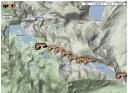
I went camping with my seven year old twins in the Desolation Wilderness near Lake Tahoe over Labor Day weekend and took my SPOT satellite tracker with me as a test. It proved pretty useful for my wife to keep an eye on our progress and I certainly felt reassured to know that we could summon help in an emergency. While it might not attract millions of users, there certainly seems to be a good niche for the product both in the outdoor market and also for keeping track of (for example) your elderly parents when they go on a long drive. I even know a colleague who uses it to keep track of where her teenage son is going in the car – I wonder how long it will take him to realize how she knows he’s not where he said he was going to be.
I wonder when we’ll see the first two way version of this device – either from Globalstar or its competitors – since it would be great to have at least an acknowledgement that your message had been delivered.

Permalink
08.25.08
Posted in LightSquared, Spectrum at 10:10 am by timfarrar
Investors in MSS-ATC spectrum are hoping to see the value of spectrum assets increase over time, as wireless operators are forced to acquire additional spectrum to serve surging data demand. Some recent benchmarks, such as the Canadian AWS spectrum auction which raised four times what was expected, are encouraging. However, Nextwave has struggled to sell its spectrum assets (including holdings at both 2.3GHz and 2.5GHz), with the exception of a modest amount of AWS spectrum. This sale took place at an average price of $0.25 per MHzPOP, which although it represents a profit on NextWave’s investment, is much lower than the prices paid for AWS spectrum in many major metro areas during the 2006 auction.
Now Clearwire has announced that its investors will receive $1.62B of stock in New Clearwire in exchange for their existing equity. Clearwire owns 15.9B MHzPOP of 2.5GHz spectrum in the US and a further 8.7B MHzPOP internationally (which it values at $0.03 per MHzPOP). Given Clearwire’s existing cash and debt, this places a value of between $0.09 and $0.13 per MHzPOP on Clearwire’s US spectrum (the higher value assumes all of Clearwire’s enterprise value is attributed to spectrum, while the lower value includes its $633M of PP&E). This is also a relatively low value, given that Clearwire paid $300M for the 1.7B MHzPOP of spectrum it purchased from BellSouth in early 2007, equating to $0.18 per MHzPOP.
Thus it seems the current credit crunch may also be putting a damper on spectrum valuations, as NextWave highlighted when explaining its failure to sell spectrum assets. The impact seems to be particularly significant in spectrum bands that have yet to be exploited, which is unsurprising since these bands tend to be the most attractive to new entrants, who are worst affected by the market downturn. As a result, MSS-ATC operators may have to wait a while for the perceived value of their spectrum to increase.
Permalink
« Previous Page — « Previous entries « Previous Page · Next Page » Next entries » — Next Page »


