06.14.11
Posted in Financials, ICO/DBSD, LightSquared, Operators, Regulatory, Spectrum, TerreStar at 3:32 pm by timfarrar
News emerged on Tuesday afternoon that TerreStar Networks (TSN) was close to agreeing a $1.2B to $1.4B stalking horse bid with DISH Networks. It appeared that DISH is likely to outbid a group of first lien debtholders and another bid from MetroPCS (possibly in conjunction with Harbinger), who jointly bid for DBSD with Solus and Harbinger back in March and were also outbid by DISH in that auction.
UPDATE: It has been confirmed to us that Harbinger was one of the parties attempting to acquire TerreStar’s spectrum assets, but its not clear whether Harbinger was aligned with MetroPCS or the other first lien holders (and it may even have been a potential customer/partner for both groups).
It seems that Harbinger had hoped to be in a position to announce a 2GHz first strategy, just as it planned back in March, in an attempt to head off the findings of tomorrow’s GPS Working Group report to the FCC which will state that testing demonstrated “widespread interference with GPS.” However, once again Harbinger may now have been thwarted by DISH.
UPDATE: Details on the agreed $1.375B stalking horse bid have now been filed with the Court. It is stated that the bid amount will exceed the secured debt (15% Notes plus PMCF plus DIP) by $90M. Thus the Exchangeable Notes (nearly $200M) and other unsecured creditors will have to make do with well under 50 cents on the dollar and no value would flow down to the equity holders in TSN (which is owned 88% by TerreStar Corporation and 12% by LightSquared). For these unsecured creditors to be paid in full and excess value to flow to the TSN equity would therefore require the winning bid in the auction to be increased to something between $1.5B and $1.6B (rather higher than I had previously estimated). Of course the disappointed equity holders (in TSN and by extension in TSC) may have some company, because at the current $1.375B bid level, Harbinger will also take a bath on its majority holdings of Exchangeable Notes, which it was buying at up to 82 cents on the dollar back in November.
Whether further bids might emerge in the subsequent auction is still unknown. The other first lien debtholders may be content to be paid in full in cash for their claim, though there were indications last night that they were still actively competing against DISH as the price rose towards $1.4B. Perhaps MetroPCS (and Harbinger?) could also try to outbid DISH in the auction itself. Unfortunately, that didn’t work in the DBSD case, and it could well be the case that no further bids emerge at the auction, given the protections that the successful stalking horse bidder will have.
If Harbinger is unsuccessful in securing rights to TerreStar’s 2GHz spectrum, its unclear where Harbinger and LightSquared go from here, unless Sprint is prepared to take LightSquared’s side in the GPS interference debate. However, if Harbinger did in fact team up once again with MetroPCS, that would make it harder to believe that a deal with Sprint is anything like as imminent as LightSquared has been hinting.
Permalink
Posted in Financials, LightSquared, Operators, Regulatory, Spectrum, TerreStar at 9:35 am by timfarrar

In a recent Vanity Fair profile, Phil Falcone was summed up by a rival fund manager as “A roll-the-dice, put-everything-on-red kind of guy”. However, with the report on GPS interference coming up tomorrow, it also appears that the GPS industry is united in putting all their efforts into pushing the emergency stop button on LightSquared. Particularly significant is the decision of the PNT Advisory Board last week to file comments with the FCC:
The formal recommendation reads: “The PNT Advisory Board recommends the PNT Executive Committee (EXCOM) should file formal comments with the Federal Communications Commission (FCC) regarding the interference issues.
“1. Based upon information and test results provided to the PNT Advisory Board at the meeting of June 8-10, 2011, the provision of GPS services cannot be assured if the LightSquared proposal for satellite and terrestrial broadband provision using the MSS L-Band receives final approval.
“2. The only reasonable and viable option to continue ubiquitous availability of GPS and the provision of a new 4G wireless broadband capability would be for the FCC to assign an alternate frequency spectrum to LightSquared that has little or no probability of affecting the delivery or utilization of GPS/GNSS services.”
The recently passed House version of the National Defense Authorization Act (NDAA) would block the FCC from authorizing LightSquared operations until GPS interference concerns have been resolved. Thus, if the GPS community continues to receive strong Congressional backing, it may become impossible for the FCC to authorize commercial operation of LightSquared’s planned terrestrial network, whatever LightSquared decides to recommend in its June 15 report (note that this report will undoubtedly not have any meaningful consensus recommendations about how to proceed). Of course it is implausible that the FCC would simply assign “alternate frequency spectrum” to LightSquared, and the other spectrum controlled by LightSquared (8MHz in the 1.4GHz band, leased from TerreStar Corporation, and 5MHz in the 1670-75MHz band) is unlikely to be usable for a large scale mobile LTE buildout.
As a result, LightSquared and the FCC both face a dilemma about how to move forward. Perhaps Harbinger could partner with the first lien debt holders (other than Echostar) (or even partner once again with MetroPCS and Solus) to make a run at TerreStar Networks, similar to its efforts in the DBSD bankruptcy auction back in March. Although providing LightSquared with a waiver of the ATC rules in the 2GHz band might be one option for the FCC, that would not solve LightSquared’s funding problem, and more likely would exacerbate it, because LightSquared would potentially then have to lease TerreStar’s 2GHz MSS spectrum from the consortium buying the assets out of bankruptcy. Granting TerreStar a waiver of the ATC gating criteria would also potentially disrupt the FCC’s current consultation process, which seeks to persuade DBSD and TerreStar to give up their spectrum for incentive auctions. Even more problematically, a decision to use TerreStar’s spectrum initially might give the Congress the excuse they are looking for to completely prohibit LightSquared from using the L-band for future terrestrial operations, as the GPS industry is requesting.
As I noted a few days ago, Harbinger therefore needs to announce something big to turn around perceptions of LightSquared. At this point, some sort of deal with Sprint (with Sprint expressing confidence that the interference issues are manageable) appears to be the best option with a chance of achieving that, with a potential partnership with MetroPCS and Solus to bid for TerreStar a rather less attractive backup choice.
Permalink
06.10.11
Posted in Financials, LightSquared, Operators, Regulatory, Spectrum at 4:37 pm by timfarrar

As data continues to emerge on the results of the GPS interference testing, it now seems that LightSquared intends to propose that it should initially use the lower part of its L-band spectrum, but that GPS users should be required to fit filters so that after a multi-year sunset period, LightSquared would be able to use the full 40MHz of MSS-ATC spectrum in its terrestrial network. Indeed LightSquared appears to be insistent that “eventually the company intends to use all the spectrum allocated to it by [the] FCC”.
On the other hand, the GPS industry is asserting that “there is no viable technical fix” and the FCC “should focus its efforts on finding [alternative] spectrum that LightSquared can operate in”. The government-chartered NPEF task force has presented a range of potential mitigation options, of which it appears the most plausible is to “limit implementation to lower end of MSS L-band” (i.e. to just 20MHz of the 40MHz of MSS-ATC spectrum that LightSquared has access to under its agreement with Inmarsat).
It therefore seems possible that caught between these conflicting demands, the FCC could choose to split the baby, permitting LightSquared to operate in the lower part of the L-band, while putting off a decision about the upper part of the L-band until considerable further study is undertaken (very likely taking a year or more). However, this would make it much harder for Harbinger to fund the LightSquared buildout, because it already has a $2B+ obligation to Inmarsat for its spectrum lease (the NPV of $115M increasing at 3% p.a.) and clearance costs, plus $1.5B in first lien debt. Unless the lower 20MHz of spectrum was valued at an implausible $1 per MHzPOP, or LightSquared could renegotiate its deal with Inmarsat (which seems unlikely given that LightSquared has just had to pay Inmarsat another $40M to eliminate Inmarsat’s permitted 9 month excusable delay in making the Phase 1 spectrum available), it would be hard to invest at anything close to the $2.5B value that Harbinger puts on LightSquared’s equity. It would also be problematic for the GPS industry, because GPS-augmentation solutions such as John Deere’s Starfire (for precision agriculture) would still be severely affected by LightSquared’s lower band operations. Thus splitting the baby might actually be far from optimal, forcing large costs on at least some parts of the GPS industry, while not enabling the buildout of LightSquared’s network to proceed.
Next week all eyes will be on the June 15 report, in which LightSquared will set out its proposed mitigation strategy. I would expect it to include a proposal for initial operation in the lower part of the L-band without any further restrictions or delay (something which will presumably be resisted by the GPS industry, who will instead likely propose further study, given that LightSquared “failed to deliver test equipment that matches its proposed operations” for the Las Vegas tests), and then propose an aggressive timetable for resolution of issues in the upper band (where the GPS industry will ask that all terrestrial operations be completely ruled out).
UPDATE: OnStar has also now requested that the FCC require additional testing before reaching a final decision to allow LightSquared to commence ATC service.
However, the big question is whether LightSquared will accompany the release of the report with an announcement of a network sharing agreement with Sprint (arguing that it could use capacity from Sprint if necessary while it waits for upper L-band spectrum). This might sound like a plausible proposition, but of course LightSquared would not be able to pay for its buildout without substantial incremental funding. Realistically the best that LightSquared could hope for is an MoU which requires it to obtain more funding and resolve its FCC issues within the next few months (before Sprint starts its Network Vision buildout in Q4).
It is unclear whether Sprint is prepared to get caught in the Congressional crossfire between the GPS industry and LightSquared, at a time when it needs all the support it can get in its attempts to block the AT&T/T-Mobile merger, and that will probably determine whether a deal comes to fruition next week or not. However, given the pressure Harbinger and LightSquared are under at the moment, it is almost certainly essential that they announce a deal with Sprint next week to have any chance of changing perceptions that Harbinger is as doomed as Captain Ahab.
Permalink
06.08.11
Posted in Financials, LightSquared, Operators, Spectrum at 7:01 pm by timfarrar
As concerns continue to swirl around Harbinger and LightSquared, one unexamined issue is whether any FCC (or Congressional) action to restrict LightSquared’s access to the upper part of its spectrum or revoke the January waiver could put LightSquared in default on its $1.5B of first lien debt.
Because this debt offering was private, it is not possible to examine the indentures which specify the events of default. However, TerreStar’s first lien debt indentures are public and probably provide some guidance as to the likely language in the LightSquared debt indentures. TerreStar’s debt indenture states that the events of default include:
(10) (a) failure by the Issuer and the Guarantors to receive the U.S. FCC Letter of Intent Authorization by July 31, 2008; or (b) a revocation, cancellation or relinquishment of (i) the U.S. FCC Letter of Intent Authorization or (ii) any FCC authorization held by the Issuer or a Restricted Subsidiary of the Issuer to operate ancillary terrestrial component facilities, unless the revocation, cancellation or relinquishment (x) remains subject to reconsideration, review, or appeal at the FCC or any court, provided that during the pendency of such reconsideration, review or appeal the Issuer is permitted to utilize the related spectrum and continues to conduct its business in the ordinary course, or (y) is accompanied by the issuance of a substitute or successor license, permit, or authorization of substantially equivalent utility;
While some features are not directly analogous (because, as a Canadian-registered satellite system, TerreStar held a Letter of Intent Authorization from the FCC rather than a License), the critical language would appear to be “a revocation, cancellation or relinquishment of … any FCC authorization held by the Issuer … to operate ancillary terrestrial component facilities, unless the revocation, cancellation or relinquishment (x) remains subject to reconsideration, review, or appeal at the FCC or any court, provided that during the pendency of such reconsideration, review or appeal the Issuer is permitted to utilize the related spectrum and continues to conduct its business in the ordinary course“. If LightSquared’s current ATC waiver was revoked or even if the waiver remained in place but LightSquared was rendered unable to use all of the “related” spectrum for its ATC operations, then (assuming similar language is in the LightSquared first lien debt indentures) an argument could plausibly be made that an event of default had occurred.
Of course, just because an event of default had occurred (and any such proposition would be vehemently resisted by Harbinger), that does not necessarily mean that the first lien debtholders would take action to enforce their rights. However, if a truly dire outcome (such as Congress forbidding the FCC from authorizing LightSquared’s terrestrial operations) did come to pass, then the debtholders might be better off trying to get hold of the cash on LightSquared’s balance sheet before it was all spent, and trying to renegotiate the spectrum lease agreement with Inmarsat before all of the Phase 1 payments had been made. Certainly I would expect all of these options to be under active consideration, as the first lien debtholders in LightSquared contemplate the various possibilities for what happens next.
Permalink
06.04.11
Posted in Financials, LightSquared, Operators, Regulatory, Spectrum at 9:49 am by timfarrar
A first, very modest concession has now emerged from the FCC Chairman over the process for authorizing LightSquared’s commercial operations, in a letter dated May 31 to Senator Chuck Grassley. This letter is a response to the demand from Grassley on April 27 for records of communications between and within the FCC related to Harbinger and LightSquared. The May 31 letter completely ignores Grassley’s specific request and also fails to addresses the concerns he expressed about the very short comment period originally set for the November proceeding, which as the CTIA pointed out, was “unlike most satellite modification filings”. Unsurprisingly, Grassley is therefore still upset about the FCC’s “lack of transparency in this case”.
However, the letter does make one modest concession, in that it promises that the Commission “will establish a public comment cycle and give all parties further opportunities to present their views”. This was one commitment that was missing from the January 2011 waiver order, and was of considerable concern to the GPS community, although it does not go as far as the Save Our GPS Coalition requested, which was for a comment period of “at least 45 days” and for “further FCC actions [to] take place with the approval of a majority of the commissioners”.
The FCC Chairman is presumably very cognizant of the language in the House version of the National Defense Authorization Act (NDAA), which would forbid the FCC from authorizing LightSquared’s commercial operations until GPS interference concerns are resolved, and wants to prevent similar language from being included in the final bill. Whether his concession on a public comment period is sufficient to achieve that remains to be seen, especially given his conclusion that “I remain focused on ensuring that the Commission takes full advantage of the incredible economic opportunities that underutilized spectrum presents. This includes the opportunity presented by LightSquared…”
However, even if the FCC is successful in forestalling Congressional intervention, a public comment period (of say 30 days or longer if it includes time for reply comments) will certainly push back the timeline on which a final ruling from the FCC can be expected to at least the end of July, and more likely sometime in August. Unless and until the GPS interference issue is resolved, it hardly seems likely that Sprint will want to finalize a network sharing deal with LightSquared, or that LightSquared will be able to raise the money to pay for that buildout. Thus it appears that a LightSquared IPO in July is certainly off the table, and the supposed network sharing deal with Sprint seems to be no more imminent than it was in mid-March (when supposedly LightSquared was about to announce a deal with Sprint at CTIA) or in mid-April when these reports last emerged.
Permalink
05.31.11
Posted in Financials, ICO/DBSD, LightSquared, Operators, Regulatory, Spectrum, TerreStar at 11:08 pm by timfarrar

Although Charlie Ergen has his Seinfeld strategy for exploiting DISH’s new assets, including DBSD and Blockbuster, Harbinger’s plans for LightSquared are becoming ever harder to discern, with news today that LightSquared is “considering a deal with AT&T to buy network capacity from the carrier”. Presumably this story comes in response to concerns that LightSquared might be forbidden from operating its L-band terrestrial network indefinitely, if new language in the National Defense Authorization Act passed by the House of Representatives last week is ultimately included in the final bill. At the very least it now appears that the FAA will insist that LightSquared’s operations be confined to only the lower half of its 40MHz of L-band spectrum, while John Deere contends that “permitting LightSquared to operate its network as proposed or any variant of its currently proposed network will create massive interference into Deere’s StarFire system and other similar systems risking serious harm to the U.S. agriculture industry”.
This news marks yet another 180 degree turn in LightSquared’s ever-changing story, which over the last year has shifted from a $7B contract (or rather MoU) with Nokia Siemens Networks (which disintegrated in January) to a joint bid with MetroPCS for DBSD to a network sharing agreement with Sprint (which at one point was supposedly even going to supplant Clearwire) to now an “initiative” with AT&T, along the way apparently including talks with Cablevision, Time Warner Cable and any number of other companies. This extraordinary saga reads like something by Hans Christian Andersen, the only question being whether the final tale will turn out to be “The Ugly Duckling” or “The Emperor’s New Clothes“.
Meanwhile, the FCC appears to be doing its best to make the TerreStar bankruptcy auction even more confusing, releasing a Public Notice on May 20 which “invites technical input on approaches to encourage the growth of terrestrial mobile broadband services in the 2 GHz spectrum range”. Unfortunately for TerreStar, the FCC once again insists that “the public interest” requires that “any grant of terrestrial rights in the 2 GHz band [should] have ‘conditions designed to ensure timely utilization of the spectrum for broadband and appropriate consideration for the step-up in the value of the affected spectrum’” in the form of “Voluntary Incentive Auctions” or “Voluntary Return of MSS Spectrum Rights”, thereby potentially reducing the perceived value of TerreStar’s MSS spectrum in the upcoming auction quite significantly.
Of course, things are not looking that great for the FCC’s other attempts to bring additional spectrum into use for terrestrial mobile broadband (i.e. LightSquared and broadcast TV incentive auctions), so perhaps the buyer of TerreStar’s spectrum will simply tell the FCC to go pound sand, and continue to pursue a (loss making) satellite-based business plan until a better offer is on the table. However, in those circumstances, whoever buys TerreStar would need to have deep pockets, and be happy to wait for several years rather than seeking a quick flip of the spectrum. Given Harbinger’s experience with LightSquared, that might well put off some of the financial players who could otherwise have been interested in TerreStar’s spectrum.
Permalink
05.26.11
Posted in Financials, LightSquared, Operators, Regulatory, Spectrum at 12:24 pm by timfarrar
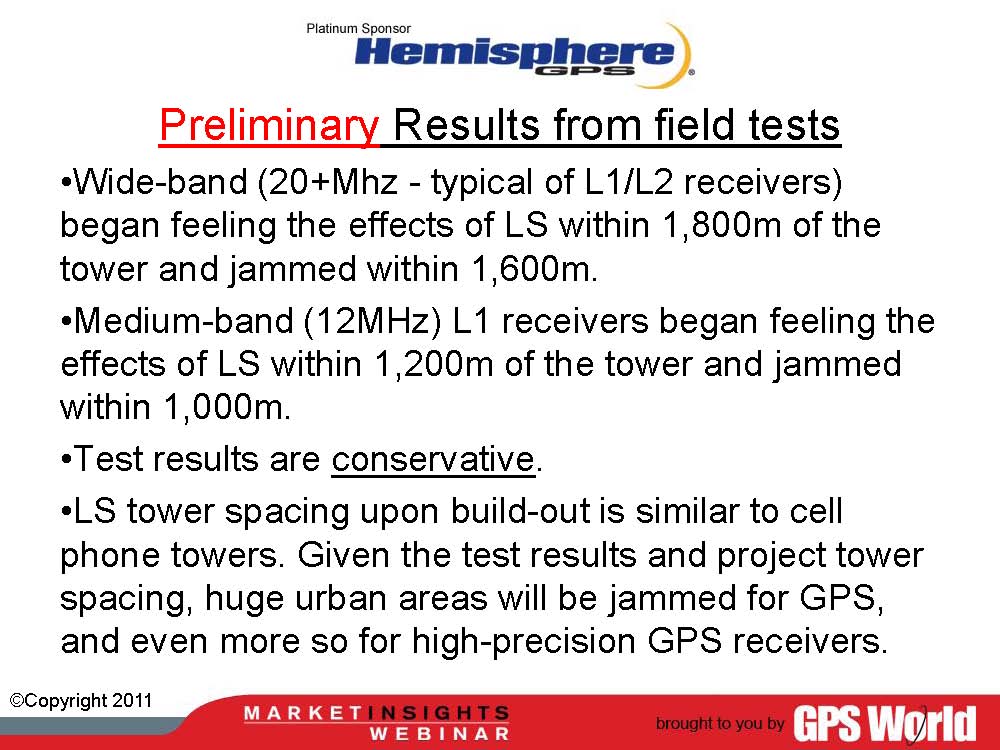
Over the last week, a clearer picture has begun to emerge of LightSquared and the GPS industry’s respective strategies, as interference tests continue in Las Vegas. Some data is now emerging from these tests, with a GPS World webinar this morning citing that in a rural test case (see presentation), high precision receivers were impacted up to 1800m from the base station (although the radius of interference would obviously be less for narrowband GPS receivers and for more urban environments with higher levels of clutter).

Given that the problem is mainly caused by transmissions in the upper channel (Phase 0 spectrum) closest to the GPS frequencies, LightSquared is already indicating that it will offer to operate only below 1545MHz, until the FCC introduces receiver standards and old GPS equipment is phased out (a process that will take many years to complete). As Jeff Carlisle of LightSquared commented in a May 23 Space News article: “If the most efficient and fair solution is not to do a receiver-side solution, we haven’t taken any of the possible transmission solutions off the table. We can look at ways of implementing our service, how we do it, when we do it, using what spectrum”. Indeed LightSquared has just paid Inmarsat another $40M to speed up the availability of the Phase 1A spectrum, and moved back its commercial deployment timeline into the first half of 2012 for precisely this reason.
However, as problems have emerged with the testing in Las Vegas, it appears that the GPS industry will demand that significant additional testing must be carried out, before LightSquared is given permission to launch commercial service even in the lower part of the band. As Alan Cameron of GPS World put it on this morning’s webinar, LightSquared does not have the full software [needed to operate its base stations in the way it plans to do commercially] so the current testing is premature. A letter sent to the FCC last week, signed by 33 senators, even asks the Commission to “rescind LightSquared’s waiver until this demonstration [of non-interference with GPS] is made”. Of course, as everyone should know, a demonstration of total “non-interference” is impossible.
Next week we should expect to see more data on the government’s testing of interference in New Mexico, based on the charter of the National Space-Based PNT Systems Engineering Forum, which was tasked to produce a final report “in a publicly releasable version” by May 31, 2011. Indications to date are that this testing certainly does not demonstrate “non-interference” with GPS (and the report itself will written by proponents of GPS not LightSquared), so this is likely to intensify the political firestorm aimed at LightSquared and the FCC.
UPDATE: The FAA report is also scheduled to be released on June 3 and, according to a report in FlightGlobal, the conclusions also appear to be problematic for LightSquared, notably a statement that “From an aviation perspective, operations at Phase 0, 1 and 2 spectral deployments, the upper channel [frequencies above 1536MHz] should not be permitted”.
FURTHER UPDATE: The FlightGlobal article has now been taken down, but is still available here and a more complete report on the study is available here. Also the House of Representatives has now passed the National Defense Authorization Act (NDAA), with strengthened language apparently requiring that the FCC should not provide “final authorization for LightSquared operations until Defense Department concerns about GPS interference have been resolved”. If that bill passes the Senate and is signed by the President, then it would seem likely to stop any prospect of near term commercial operations by LightSquared.
Of course, a requirement for more testing and a further delay to LightSquared obtaining permission to commence service (at best) or a withdrawal of the waiver (at worst) could very easily derail the LightSquared venture completely. I’m told that LightSquared had been hoping to raise money from private equity sources and then undertake an IPO in July, after signing a provisional network sharing agreement with Sprint. This new funding is a pre-requisite for Sprint to move forward with any buildout under the network sharing agreement, because of the upfront costs that it would incur, and so Sprint needs to be convinced that LightSquared will be able to reimburse these costs, either with cash or spectrum rights.
With Sprint expected to announce its plans for Network Vision this summer, LightSquared therefore needs to achieve some certainty about its spectrum position very soon, or risk missing that boat. Ominously, at a New America Foundation event in Washington DC two weeks ago featuring LightSquared’s CEO, Sprint noted that it would be able to host other spectrum on its Network Vision platform, including “possibly Clearwire, possibly public safety”, but conspicuously failed to include LightSquared on that list.
Permalink
04.29.11
Posted in Financials, LightSquared, Operators, Spectrum at 4:35 pm by timfarrar
Intriguingly, yesterday’s Reuters article about Harbinger noted that at the end of 2010 Harbinger only controlled “roughly 80 percent of the wireless telecom company’s shares”. This raises the obvious question of who controls the other 20%?
Clearly, some of these shares might have been offered to LightSquared’s new management team as an incentive, but that can’t account for the difference between the 100% of the equity that Harbinger acquired in March 2010 and the 80% reported as of the end of the year. Did Harbinger manage to offload some of its equity stake in LightSquared last year (as it was reported to be trying to do in July)? Could this account for some of the “$2 billion in equity and debt proceeds and in commitments” that LightSquared highlighted in a press release last October?
Who are the potential candidates? I’ve heard various names, but one possibility might be Soros Fund Management, which, according to a November 2010 Wall Street Journal article, “during the past year became a significant new investor” (whether this was in Harbinger or in LightSquared is not explicitly stated in the article). Of course, there may very well be other investors as well.
Even more importantly, how much did the other investor(s) pay for what is presumably a near 20% stake? It appears that not all of the $2B in commitments that LightSquared cited in October 2010 actually materialized (presumably the difference is Harbinger’s “$250 million unfunded commitment to LightSquared“), but I’ve assumed in the past that it included both the $850M October 2010 first lien debt and the $400M July 2010 UBS loan. However, rather than Harbinger converting its original (majority $430M holding of) LightSquared’s first lien debt into equity as part of the October 2010 refinancing (as it had previously indicated), it seems that Harbinger instead retained an unfunded $250M commitment at that stage, allowing it finally to take a limited amount of money off the table.
As of February 2011, LightSquared indicated that in fact it had actually raised “about $1.75B in debt and equity” (the same figure as given in late September, which refers specifically to $1.75B of debt and equity from “outside investors”), before increasing this to “over $2 billion” when the $586M first lien add-on was completed later that month. That would imply that the new equity investment might have been about $500M for a near 20% stake in LightSquared (i.e. $1.75B minus $850M and $400M) which would certainly fit fairly well with Harbinger’s internal valuation of about $3B for its own 80% LightSquared stake (“about half” of the $6 billion fund’s assets according to Reuters). However, it is slightly puzzling that Harbinger still said only that it had raised “over $2 billion” in February (rather than the $2.3B+ that would have been implied by adding $586M to $1.75B). Was some (half?) of the new outside equity either redeemed or converted to first lien debt in February, or is Harbinger just trying to avoid giving an exact figure for how much it has raised?
Of course, if LightSquared really is serious about pursuing an IPO “as early as this summer”, then all of this detail should become much clearer. However, it appears from Sprint’s results call this week that the Network Vision deployment is being delayed until the fourth quarter. That may imply that decision point on a network sharing agreement with LightSquared will also be delayed, presumably until after the results of the GPS interference testing are known in mid June. If Sprint is concerned about whether LightSquared’s spectrum provides adequate security for LightSquared’s commitments under a network sharing agreement, then that would certainly be logical, especially if Sprint views LightSquared (cynically) as an opportunity to boost its spectrum resources at low cost (after a default), rather than as a viable long term supplier of wholesale capacity. Nevertheless, if the first lien debtholders refuse to allow Sprint to pre-empt their claims, then LightSquared might have to move forward with an early (and substantial) IPO to give Sprint the security of more cash in the bank, but otherwise we might not know much more about LightSquared’s financial position for some time to come.
Permalink
04.11.11
Posted in Financials, LightSquared, Operators, Spectrum at 2:36 pm by timfarrar
Last week, I suggested that LightSquared’s most plausible path to a network sharing deal with Sprint would involve signing a multi-billion dollar take-or-pay capacity contract and using this to raise $1B+ of new equity. It appears that LightSquared is definitely exploring a possible equity raise through an IPO, although that would require it to strike a capacity deal first, and the only obvious large deal at present is via paying part of its obligations to Sprint in kind.
Of course that could leave Sprint in the uncomfortable position of being the only potential financial safety net for both LightSquared and Clearwire, precisely the issue which led me to speculate that Sprint might be better off choosing to partner with only one of the two companies. At this point in time, Sprint only gains an advantage in partnering with both LightSquared and Clearwire if it can either be sure that LightSquared will be solvent for long enough to (more than) offset the costs that Sprint would incur in a network sharing agreement, or if LightSquared can provide other adequate security for these obligations. Given LightSquared’s ongoing payments to Inmarsat, and the costs incurred by Sprint in a network sharing buildout, then (under the “deal” modeled by Credit Suisse) that might require new fundraising or guarantees (in addition to LightSquared’s existing cash) of perhaps $1B or more. If LightSquared could successfully execute an IPO then that would presumably help matters significantly, though it is far from clear whether raising anything close to $1B is feasible at this point.
Otherwise, I assume Sprint would be looking for other LightSquared or Harbinger assets to secure LightSquared’s obligations. I’m told that one possibility that has been floated is for Sprint to take a first lien position in LightSquared’s spectrum assets, and subordinate the existing $1.5B of debt. That prospect would presumably be very unpopular with existing debtholders, who already have to face a $2B+ obligation to Inmarsat, associated with the Cooperation Agreement (without which half of LightSquared’s ATC spectrum would be forfeited). Alternatively, would Harbinger offer some sort of guarantee secured against its other hedge fund assets (like the $400M UBS loan last July) or even a personal guarantee from Mr. Falcone?
Permalink
04.07.11
Posted in Financials, LightSquared, Operators, Spectrum at 10:17 am by timfarrar

After a difficult March, when Harbinger failed to buy DBSD in partnership with MetroPCS, and Sprint decided not to make the expected announcement of a network sharing agreement at CTIA, it is now becoming possible to discern how LightSquared might plan to move forward.
As I noted previously, the key challenge for LightSquared at this point in time is to persuade Sprint that it should undertake a network sharing arrangement, rather than Sprint focusing solely on its partnership with Clearwire. This will only happen if LightSquared can convince Sprint of its ability to bring substantial funding to the table, which would reduce the cost of Sprint’s Network Vision buildout, and mitigate the risk of leaving Sprint holding the bag for increased tower lease costs that would result from adding the LightSquared frequencies. However, LightSquared has already raised $1.5B of first lien debt, and so any further fundraising would have to be subordinated to that, and would therefore likely have to rely on a take-or-pay capacity commitment from a partner.
As a result, I think the four steps LightSquared will now need to execute, in order to move forward, are as follows:
1) Strike a multi-billion dollar take-or-pay contract with one or more major “anchor tenant” customers
2) Raise $1B+ of additional external equity investments based on the take-or-pay commitment (perhaps even including an IPO???)
3) Convince Sprint that the network sharing agreement is therefore a better deal than going with Clearwire alone
4) Sign a contract with Ericsson for buildout of the network (replacing NSN).
Of course all of these steps are fraught with risk and need to be executed simultaneously, since they are mutually interdependent. Some of the most obvious risks include:
a) How solid can the take-or-pay contract be when there are still interference risks to be resolved?
b) Does the LightSquared equity have any value, when there is $1.5B of first lien debt plus a $2B+ spectrum lease/rebanding commitment to Inmarsat ahead of the equity?
c) Would it be better for Sprint from a regulatory point of view if (one of) LightSquared or Clearwire folded?
However, the overarching issue is where such a huge take-or-pay contract would come from. Could it one of the “top three global consumer electronics companies” that LightSquared claimed to be in “advanced talks” with (these 3 are Samsung, HP and Sony)? However, “connections for services such as wireless photo uploads and wireless multiplayer gaming” seem unlikely to generate that much money. Similarly the deal that LightSquared “has already signed…with a maker of tablet computers and smartphones that could start using LightSquared’s network as soon as the fourth quarter” would require an enormous commitment to come close to billions of dollars in value, which is hard to envisage while the LightSquared network has limited national coverage. If neither of these is a realistic option for more than a fraction of the capacity contracts that are needed, then that brings us back to wireless operators or new entrants – MetroPCS or Leap? One of the potential partners that has been talked about in the past? Who knows? But with T-Mobile out of the picture, the list of possible anchor tenants is pretty short, and both Sprint and skeptical journalists will need to see some concrete progress on LightSquared’s part fairly soon, amounting to more than just a roaming or sales agreement with no hard volume commitments.
UPDATE: Credit Suisse is now suggesting that LightSquared would pay 50% of its network sharing costs to Sprint in capacity, which clearly represents multiple billions of dollars of capacity over time. However, in order to convince Sprint to move forward, I think LightSquared’s deals would still have to include major capacity commitments from one or more third parties, so that it can raise the money to pay for the hosting agreement with Sprint. If LightSquared paid $500M upfront in cash, plus $1200 per month per base station in cash for 45,000 base stations as Credit Suisse suggests, it would need to pay Sprint about $650M per year in cash for these hosting fees once the network was fully rolled out, and in excess of a billion dollars in cash in total over the next three years before it can generate much revenue. Given that this does not include LightSquared’s other core network development and operating costs (including the ongoing payments to Inmarsat), and as Credit Suisse admits, Sprint would spend an extra $1.2B between LightSquared and Clearwire before it started to make money from the hosting agreement (and is liable for ongoing payments to tower companies of $700 per tower per month), I think Sprint will want to see that LightSquared is able to fund at the very least the next several years of payments before committing to a deal. This clearly puts the onus back on LightSquared to secure substantial additional capacity commitments from companies other than Sprint, and raise significant equity funding ($1B+) in the very near future.
Permalink
« Previous Page — « Previous entries « Previous Page · Next Page » Next entries » — Next Page »